The Four Paths · Lesson 20 of 29
Tantra: the Worship of God as Mother
Going Deeper: Tantra and Kundalini.
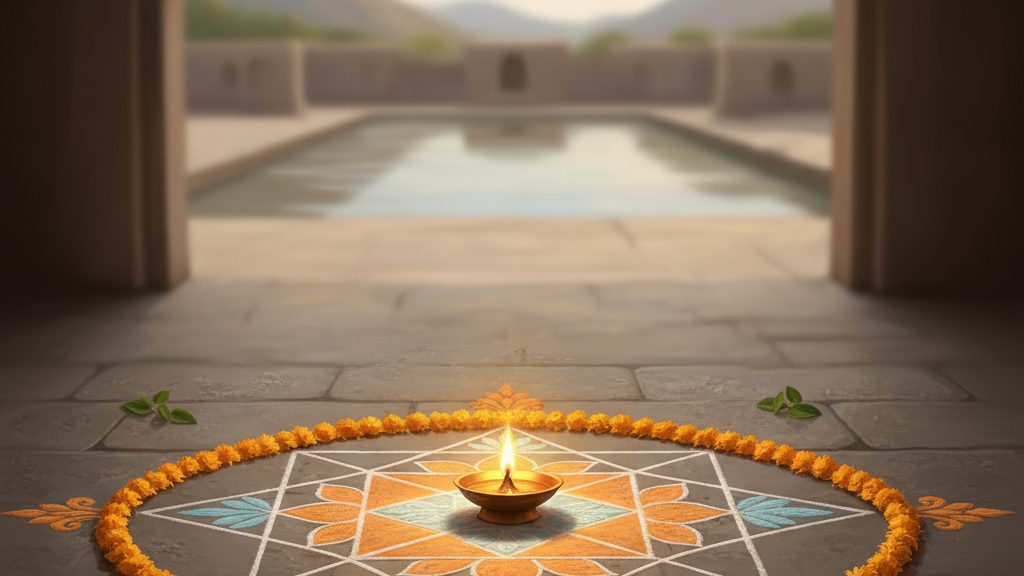
O Goddess! Having pierced (the five
elements) earth, water, fire, air and ether
at the Muladhara, Swadhisthaana,
Manipura, Ahahata, and Vishuddhi Chakras
respectively; and having crossed over
the mind in the Ajna Chakra, passing
through the mystic channel of the Kundalini,
You sport with Your divine consort Param
Shiva (God—the Supreme Self) all alone
in the secrecy of the Sahasrara—
the Thousand-petalled Lotus
(at the crown of the head).
Ananda Lahiri 9
of Sri Adi Shankaracharya
CHAPTER SEVEN
Tantra and Kundalini Yogas
The name Tantra is derived from the Sanskrit word Tanoti, meaning, “to save,” because it saves the soul from the repeated cycles of birth and death, and allows an aspirant to experience Divine Communion through Self-Realization.
Broadly speaking, Tantra Yoga includes all the major Yogas, but puts more emphasis on a blend of Jnana and Bhakti Yogas, that is, Wisdom and Devotion. In practice, it combines Mantra (mystic syllables) and Yantra (mystic diagrams), and includes Kundalini Yoga along with all its ramifications.
TANTRA YOGA
Most mystic systems require certain qualifications on the part of an aspirant before he can commence his journey towards Self-Realization. In the Tantric system, however, the aspirant can begin his spiritual movement at any stage in his life. Tantra Yoga finds its support in many of the classical Yoga scriptures and texts, including the Vedas, Upanishads and Puranas. It has a philosophy similar to the non-dualistic school of Vedanta or Advaita, which contends God or Brahman alone is.
Instead of calling Brahman the Ultimate Reality, the followers of Tantra consider either Shakti (the Divine Mother) or Shiva (the Father) to be the Ultimate Reality. Therefore, in Tantra there are two schools, which supplement and compliment each other. Those who regard Shakti or the Devi (God in the form of the Mother) as the Highest, consider all other Divine manifestations such as Vishnu, Shiva and Brahma subservient to Her. Those who hold Shiva as the Ultimate, consider the Devi and Her manifestations as subservient to Shiva. The fact is, in each case, the Devi or Shiva refers to Pure Consciousness, or the Absolute Reality—Brahman.
The Worship of God as Mother
The worship of Divinity in the form of the Divine Mother is found in every religious system. This is seen through the worship of Mother Mary in Christianity, the many woman saints of Islam, and in various other ways in the Buddhist tradition. In India, the Durga Saptashati (the basic Tantric Scripture dedicated to the Divine Mother) presents an outline of the worship of God as Mother in a highly mystical language.
The Devi in this Scripture manifests Herself in three stages. The first as Maha Kali (also known as Durga) Who destroys the gross impurities of the heart, such as anger, hatred, greed, etc. The second manifestation of the Goddess is that of Maha Lakshmi, Who destroys the subtle impurities in the form of distractions of the mind (desires), thereby enabling the aspirant to be more focused in his pursuit of God-Realization. The third manifestation, in the form of Maha Saraswati, destroys the illusion that separates us from our intrinsic Reality, the Absolute Self. She leads the aspirant through the development of intuitive intellect, to Self-Realization.
From the book Integral Yoga: The Secret to Enlightenment by Swami Jyotirmayananda, published by the Yoga Research Foundation. © Swami Jyotirmayananda. All rights reserved.
Swamiji teaches live every morning at 8:25 Eastern. Free, and nothing to sign up for. Sit in on the morning satsang
Know someone who would like this? Send them jyotirmayananda.org/start
- Previous · Lesson 19Review of the Four Paths
Next: Lesson 21, Kundalini: the Chakras of the Astral Body
It arrives by email two days after this one.
The Four Paths: the full outline