Sita Through the Fire: The Shadow Sita and the Real
In the morning satsanga of November 21, 2026, Swami Jyotirmayananda read Sita's ordeal of fire as the passage from Kumati to Sanmati, taught that the Sita who suffered was only a shadow, and closed with thanksgiving for the human embodiment.
The satsanga opened with the invocation to Lord Rama, the Lord of the Raghu dynasty, whose complexion is like a blue lotus, tender and delightful in appearance, with Sita seated at His left side. After the Hari Rama and Hare Krishna mantras, Swamiji read a poem, "Song of the Soul."
The poem is a song of thanksgiving and celebration. The entire world one has experienced, its pleasure and its pain, becomes a reason to give thanks for everything. A limpid lake of divine love surges in the heart, and the very sky enters in, with its luminous moon and stars. "The veil of ignorance is lifted." No words can describe the bliss that sweeps over the eternal Self. All names and forms have vanished. The poem closes on the soul's flight to eternity and the realization "I am that am I."
Rama on the Throne, and the City Where Battle Ends
Swamiji then took up the day's episode as an allegory. The soul is Rama, he explained, and the goal is to return to Ayodhya. This Ayodhya, he said, is no ordinary city. It is the state where life's battle vanishes, where there is no more battle.
Sita Must Enter the Fire
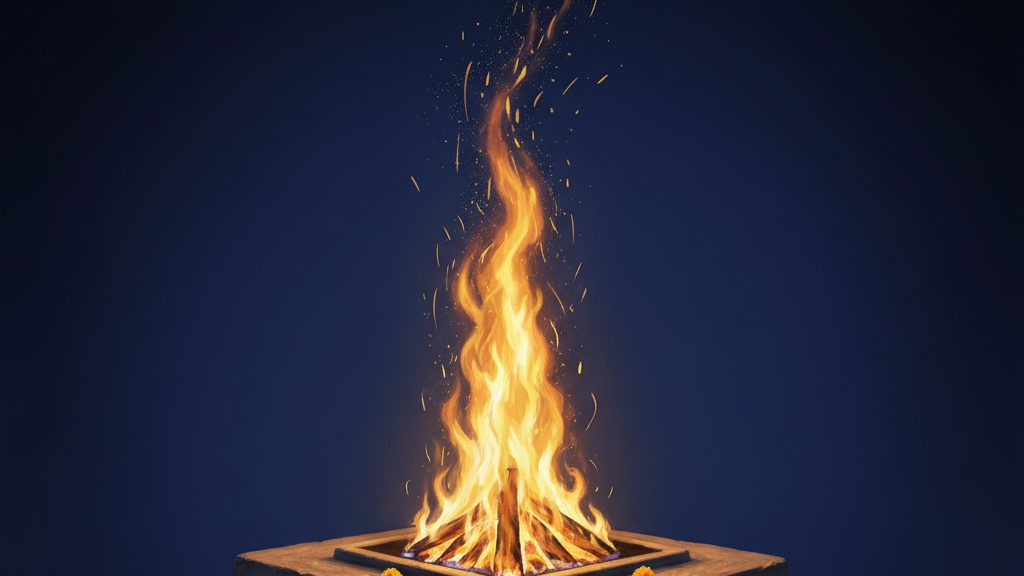
The Sita who was kidnapped, Swamiji taught, was not the real Sita. In order to recover the real Sita, Sita has to enter the fire, and that fire is enlightenment. As long as one remains under the control of ignorance, one cannot be enlightened, and one is constantly harrowed by Kumati.
To enter the fire is to come to one's real state, Sanmati: the passage from Kumati to Sanmati. Swamiji called it a very suspenseful story. While Sita is in the fire, everyone watching is held in suspense. Then the Fire God brings out Sita.
In this telling, Swamiji said, Rama plays the role of the jiva, the individual soul. Haunted by Kumati, the jiva is constantly drawn into the cycle of birth and death. When the fire has done its work, one is no longer haunted. What follows is a sudden miracle of revelation: the Sita who received all that torture was Kumati.
The Real Sita Was Never Away
When Sanmati, the real Sita, emerges, people are surprised. The real Sita "was always with Rama." It was a shadow Sita that went through all of it, and Kumati is that shadow. Therefore, Swamiji said, always pray.
When you become Sanmati, he continued, your heart showers grace, and not only on those who are near and dear. The whole world comes within its reach. He recalled the name Vishwamitra, in which mitra means friend.
Thanksgiving for the Human Embodiment
Swamiji closed on thanksgiving, the note on which the poem had begun. Even for the sufferings that have been given, thank God. Give thanks for entering the human embodiment, which makes this great achievement possible: bringing out the real Sita and coming to the end of ignorance. The human embodiment, he said, is the grace of God, and for it, thanks to God.
The satsanga ended with prayers for the welfare of all, sarve bhavantu sukhinah, and the hymn to the Divine Mother, sarva mangala mangalye.
Terms in This Satsanga
- Kumati — the shadow Sita; the state haunted by ignorance and drawn into the cycle of birth and death.
- Sanmati — the real Sita; the real state that emerges from the fire, never separated from Rama.
- jiva — the individual soul, whose role Rama plays in the allegory.
- Ayodhya — not an ordinary city, but the state where life's battle vanishes.
Follow the WhatsApp channel at jyotirmayananda.org/whatsapp.