The Flying Chariot Home: Rama and the Pushpaka
In a recorded morning satsanga of May 26, 2026, Swami Jyotirmayananda followed Rama from his meeting with the soul of Dasharatha to the flight home to Ayodhya, and read the Pushpaka chariot as the restless mind made steady and carrying every devoted soul.
From the recorded class of May 26, 2026.
After the invocation to Lord Rama and the Hare Rama mantra, Swamiji read a short poem on the palace of Self-realization. That palace has four gateways: serenity, contentment, satsanga and spiritual inquiry. Enter by any one of them, he read, and you are going into your own divine palace. Eternity is its roof and infinity its couch.
Then he turned to the day's passage, which he called an allegorical presentation: Rama's return to his palace in Ayodhya.
Only the Son of Dasharatha
The war is over, and Brahma glorifies Rama. Swamiji explained Rama's reply. During his avatara, Rama does not want to reveal himself to people as Brahman. All that he wants to reveal is that he is the son of Dasharatha. Brahma agrees and vanishes.
Now the soul of King Dasharatha appears. He realizes first that Rama is beyond heaven, an avatara of Brahman. Rama again asserts that he is simply his son, and Dasharatha says that he will always love him as his dear son.
Swamiji drew out the mutual love in this meeting. The son shows great devotion to the father, yet in that love he never views his father as an ordinary soul; he sees that his father is the same Brahman. And the son's purpose is to elevate his father and lead him to liberation.
Duty Without Desire
Rama then draws his father's attention to Kaikeyi, whom Dasharatha had renounced. Dasharatha answers that his spiritual eye has opened, and he has no negative feeling toward her.
Rama seeks one more blessing: that he may perform his duty. Swamiji explained what that means. The purpose of the avatara is to show how to do all your duties, not to secure your happiness in the perishable world, and to guide people to develop a nishkamya mind, a mind free of desire.
Everyone Is Ashtavakra
Swamiji paused on the allegorical story of Ashtavakra, and gave it a turn of his own: everyone is Ashtavakra. Whenever you approach a saintly personality, you stretch yourself on the floor with eight limbs touching it. The identification with the body is then no longer stiff. From the point of view of the body you become Ashtavakra; from the point of view of the soul, Brahman. The more expert you become in this, the more you are united with God, who, as it were, bows down and lifts you.
Why Rama Asks for the Curse to Be Withdrawn
A listener asked about the significance, for sadhana, of Rama asking Dasharatha to withdraw his curse.
This, Swamiji answered, is real reverence. A gracious heart has to develop for attaining liberation: a heart that adores people, and whose adoration encourages all its relatives to discover their essential nature. The son's prayer is that the father shower his blessings and no longer hold anything negative toward anyone.
Reverence does not mean worshipping a person no matter what he is. You worship because the person is not what he appears to be. His reality is the same as yours. Every soul, Swamiji said, is Brahman.
The Chariot That Leaves No One Behind
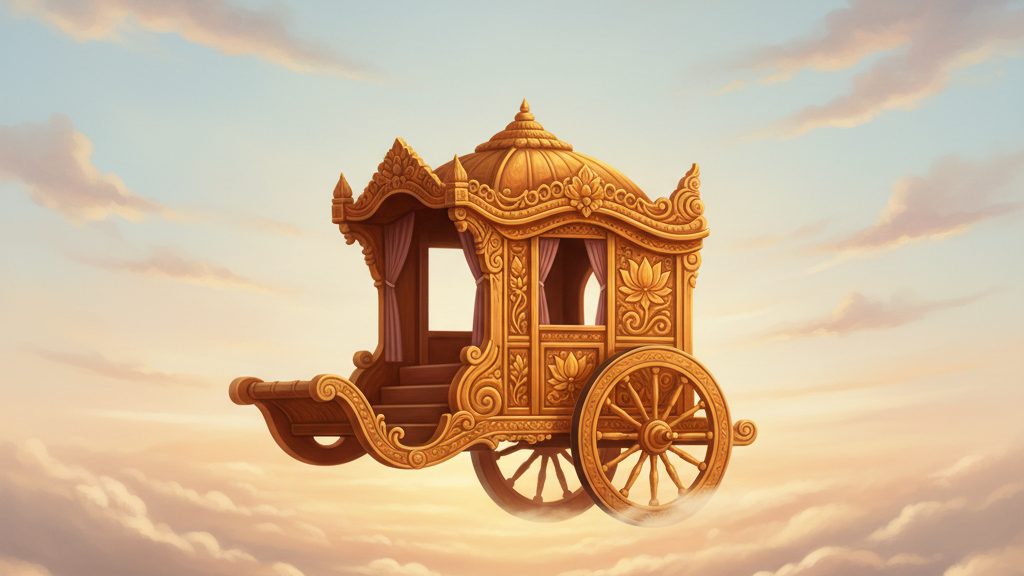
Only two days of the fourteenth year remain. Rama had promised Bharata to return the moment the exile ended, and Ayodhya is far away. Hanuman offers to carry him on his shoulders. Then comes the Pushpaka, the flying chariot that Ravana had seized from Kubera, which can become large or small as needed. The monkeys and bears will not let Rama go alone, and Rama takes them all.
Swamiji called it a very profound episode. The mind that was like a monkey, fickle and distracted, has become the vehicle of Rama. An enlightened mind is not pressed by time. You do not have to wait for Brahman, he taught, because every moment Brahman is a reality. "Brahman is here." All that one waits for is the state of mind that is no longer fickle.
The Pushpaka, he explained, is made of the flowers of divine virtue, and the wealth gained in it is no longer perishable wealth. It does not leave any devoted soul behind. The monkeys and bears of your own mind, which once went under Ravana's control, are now led by Rama. What expressed the lower self now expresses the higher. The blessing of a saintly personality, he added, is not for a few people; it is for all.
Free to Scold God
On the way, Rama stops for Sita's worship of the Ganga, and his old friend the Nishada king complains that Rama meant to pass by without meeting him.
Swamiji read this as the friendship a devotee develops with God. God is no longer some awesome personality; you are free even to scold him. In the Mahabharata, he recalled, Arjuna is the friend of Krishna and now and then scolds him, and Krishna shows his grace. The more friendly you are to God within you, the less you hide your feelings. You may complain of how long you have practiced, but while you are doing it you know that you are enjoying the grace. "So, all this is sadhana."
The Ganga in the Heart
The Ganga purifies everything. If your heart views Rama's presence, Swamiji taught, all the sacred pilgrimage centers are present within it. "They are all there in your very heart." You are no longer running from one pilgrimage center to another, and even your bath at home is enjoyed as if you had entered the Ganga.
The satsanga closed with a prayer for the grace of God to shower over all.
Terms in This Satsanga
- satsanga — the company of truth; one of the four gateways to the palace of Self-realization.
- avatara — the descent of God into human form; here, Rama living as the son of Dasharatha.
- nishkamya — free of desire; the mind that does its duty without seeking perishable gain.
- Pushpaka — the flying chariot that carries Rama home; the mind adorned with flowers of divine virtue.
Follow the WhatsApp channel at jyotirmayananda.org/whatsapp.