The Lamps of Ayodhya: Bharata's Wait and the Moment of Wisdom
In a recorded morning satsanga of May 27, 2026, Swami Jyotirmayananda took up Bharata's anguished wait for Rama and taught that one moment of the eye of wisdom is enough, that Deepavali is celebrated every moment, and that Ayodhya is a state where no battle is needed.
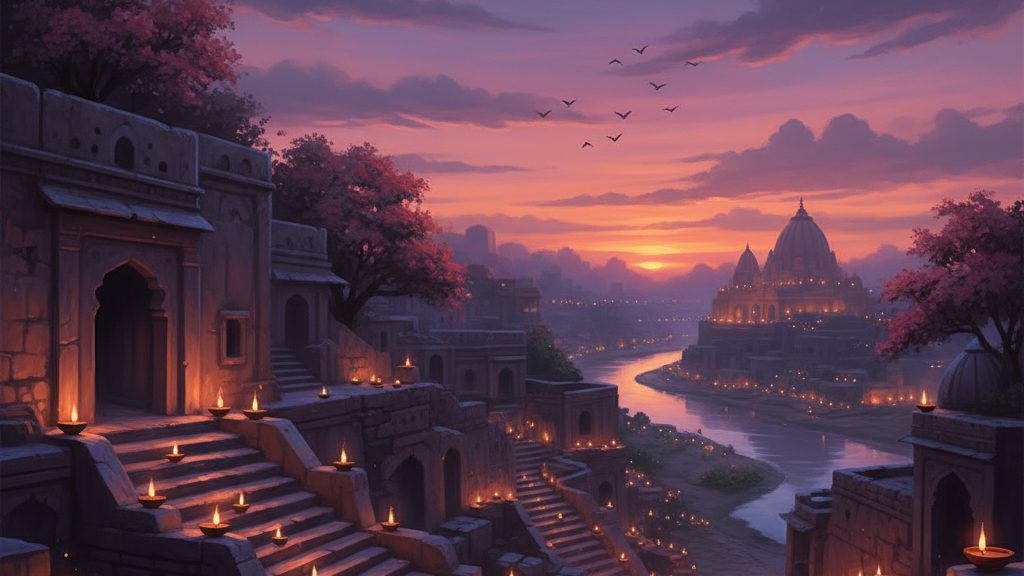
From the recorded class of May 27, 2026.
After the invocation to Lord Rama and the Hare Rama mantra, Swamiji read a poem on the realization I am Brahman. Before the effulgent glory of Brahman, millions of suns shine like tiny sparks, and countless world systems appear like dust particles in a beam of sunlight. Brahman alone is Satchidananda, absolute existence, consciousness and bliss.
One Moment Is Enough
The passage opens on Bharata's despair. Rama has not come, and Bharata asks how long he must wait. Sage Vasishtha tells him that for a spiritual hero, "even one moment is enough to attain the highest revelation."
Swamiji drew from this an insight into upasana. Practice takes time, mantra after mantra, day by day, and along the way miracles do happen: hopes are fulfilled, great miseries move away. But this is not the goal, he taught, because all happenings are in the world of mortality. Upasana must end with brahmakara vritti, the mind turned from objects toward Brahman: intuitive vision, which does not depend on the opening and closing of the eyes.
The Screen Behind the Show
He gave another way to understand the experience of the world: a cinema show. The suspense becomes so great that the heart asks when it will end. Then an insight develops: it is only a show, and the screen is ever present. This, Swamiji said, is the teaching given to Bharata. Do not wait in time; wait to open the eye of wisdom, jnana chakshu.
The ordinary eye sees as if through colored glasses. Put on a different color and the whole world appears according to your spectacles, and it is karma that hands us those spectacles. A mind pressed by sorrow looks at a world filled with misery and is never satisfied. That state changes when the window of wisdom opens.
Swamiji added a caution. Intellectual knowledge does not give security, and it does not heal an injured heart. "Intellectual knowledge cannot take away even your headache unless you go through treatment." Yet it prepares the ground.
Deepavali Every Moment
The people of ritual wait every year for Deepavali. For one moving to enlightenment, Swamiji taught, "Deepavali is celebrated every day, every moment." Look anywhere and there is light in every heart.
Life led by karma, he explained, lives under a terror of darkness: hardly has something been attained than a hurricane or an earthquake may be coming. Darkness makes people nishachara, wanderers of the night, demoniac, and every attainment made in that darkness perishes. Rama has destroyed the nishachara. "Light destroys all dark." The people of Ayodhya had been in restlessness, without peace; now, with Rama arriving, their lack of inner fulfillment and all their thirst are being removed.
The Teacher Who Waits
The spiritual teacher, too, waits to see the disciple open the eye of wisdom, as if for ages. When the disciple develops that enlightened mind, all the waiting turns into a miracle.
The Earth as Mother
Worship your mother and the land where you were born, Swamiji said; yet the entire earth is your mother, Prakriti, and so you learn to see the mother in everyone. Heaven does not give moksha. "Celestial enjoyment doesn't give you liberation." Apavarga, going beyond, comes by the grace of the Divine Mother.
Rama Meets the Three Mothers
Every soul, Swamiji taught, moves through many embodiments, and what is enriched today has come from previous births. You learn music and it takes time, yet a five-year-old may surprise his parents by playing the harmonium or the flute.
So Rama meets all three mothers, and each becomes highly fulfilled. Kaikeyi is no longer the creator of terror; all are united with Rama's heart. Each one feels as though Rama had chosen her as his only mother. This, Swamiji said, is an allegorical description of fulfillment: each devotee realizes God as if God had blessed him alone.
Childlike, Not Childish
Shiva is called Bhola, simple as a child. Swamiji recalled the old song sung to the baby: you are not just a baby, you are pure, enlightened and free. All people are like children, he said, but do not be a child; be childlike. The child's movement trembles and its speech is scattered, while the one who is childlike inspires everyone. Love God as a mother loves her baby, expecting nothing. "It's pure, selfless love."
Ayodhya Without Battle
A listener asked whether fulfillment in liberation is the conflict-free state of Ayodhya. These are allegorical presentations, Swamiji answered. Ayodhya means where battle is not needed. It is not a physical location: the entire world becomes Ayodhya, and all people its inhabitants, enjoying Rama's victory and celebrating his coronation.
That spirit has to develop in prayer. Each time you say sarve bhavantu sukhinah, you direct your love to all. The greater the inner enlightenment, the greater the radiation of grace, and then you do not have to say anything. "A blossoming flower doesn't have to say anything." Any goodness that comes in you, he said, is never selfish; it is a blessing to all around.
The satsanga closed with a prayer for a shower of grace and threefold blessings, the shakti of Hanuman and the bhakti of Bharata among them, and the Mahamrityunjaya mantra.
Terms in This Satsanga
- upasana — devoted spiritual practice, which Swamiji taught must end in brahmakara vritti.
- brahmakara vritti — the mind's movement turned toward Brahman; intuitive vision beyond the physical eyes.
- jnana chakshu — the eye of wisdom, which Bharata is taught to open rather than wait in time.
- nishachara — a wanderer of the night; the demoniac state that darkness creates.
- apavarga — going beyond; the liberation that celestial enjoyment cannot give.
Follow the WhatsApp channel at jyotirmayananda.org/whatsapp.