
Nine Places the Divine Is Already Showing — Srimad Bhagavad Gita, Lecture 79
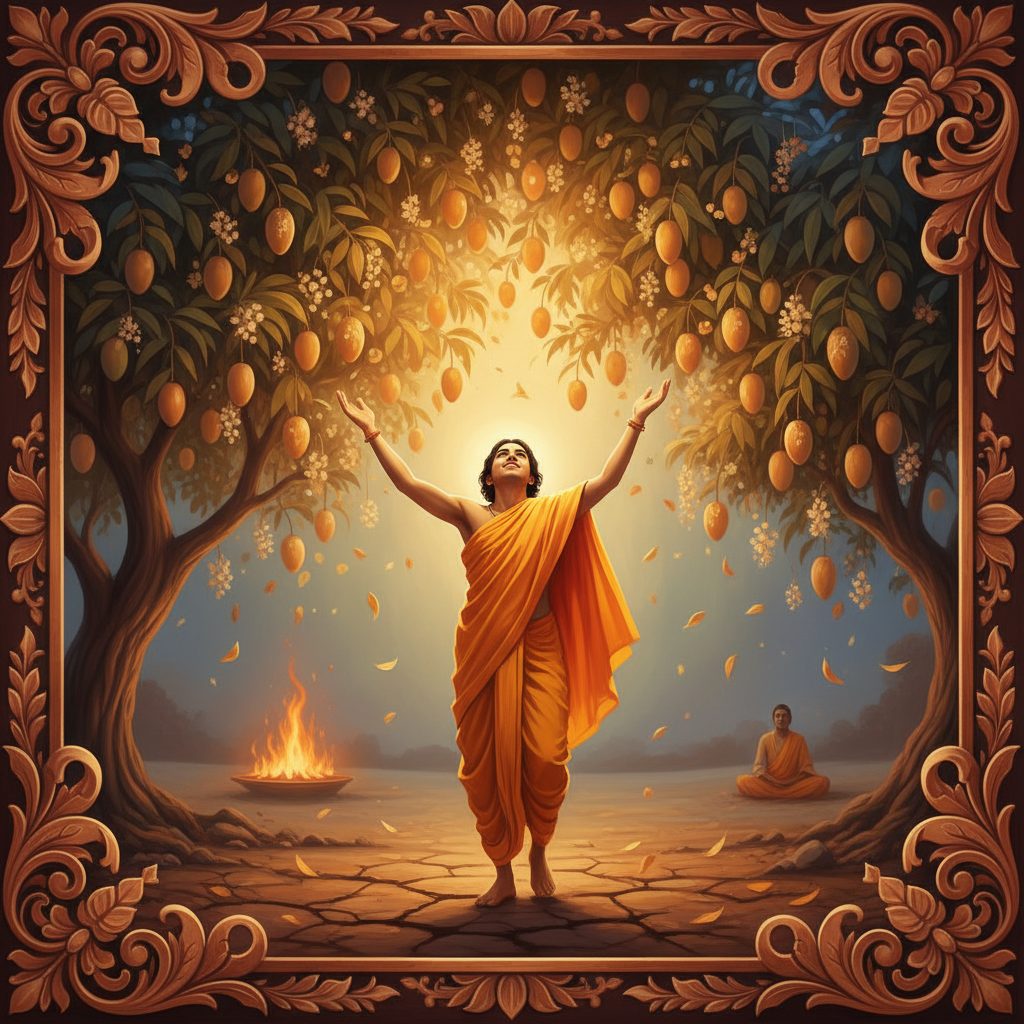
Chapter 7 of the Bhagavad Gita has just finished making its largest claim. In the verse before this lecture opens, Krishna says that all this is strung upon Me like clusters of gems on a single thread. Lecture 79 is Swami Jyotirmayananda taking that image apart to find out what it obliges a person to do. He begins by refusing the easy reading. When the verse says all things, the mind reaches for objects — mountains, trees, big things and small rubbish, laid out in a row and threaded like beads. Swamiji says that is not the meaning at all. What is strung together is not the furniture of the world but the whole of your experience, and experience arrives on three levels. There is the world the senses report. There is the world of feeling, where a piece of profound music blows the mind open. And there is the world of intellect and ego, where every thought — from the highest realization down to the most stupid idea a person ever entertained — is backed by a consciousness that remains once the thought has moved on. Having established that, the lecture turns to the two verses that give it its substance. Krishna names nine specific things and says: that is Me. The sap in water. The light in sun and moon. Om in the Vedas. Sound in space. The capacity for self-effort in a person. Then, in the second verse, the pure fragrance in the earth, the brightness in fire, the life in every living being, and the austerity of those who practice it. These are not poetic flourishes. Each one is a place to look, and Swamiji works through them the way he works through everything: the plain physical meaning first, then the psychological meaning, then the meaning that costs something. The word for taste opens into a whole ladder of enrichment. The word for fragrance turns out to describe qualities in a person that the person cannot detect in themselves. The word for austerity produces the story the lecture ends on, and that story quietly reverses what most people assume spiritual effort is supposed to feel like. The lecture closes not with a definition but with a man dancing under a tree, having just been told his wait would be measured in the number of leaves above his head.
Where to find each passage
- 00:00 — The bond between sun and earth
- 01:53 — Para and apara: the magician and his magic
- 04:46 — One thread through the mala
- 06:07 — Three planes: senses, feeling, intellect
- 12:01 — The five glories, and rasa as the taste that keeps deepening
- 14:47 — Fragrance and ripening in sadhana
- 18:03 — The light in the sun and the moon
- 22:10 — Pranava: the four aspects of Om
- 30:10 — Sound in space: three kinds of akasa
- 34:51 — Purusha and the four purposes of life
- 40:27 — Fragrance, fire, life, austerity
- 45:40 — Two austerities: the fire and the tree
The magician and the magic were never two
Before reaching the verses, Swamiji restates where chapter 7 has brought us. Creation is described as two aspects of nature: para, the transcendental aspect, pure consciousness; and apara, the mixed world where conscious beings and inert things sit side by side. Souls are conscious. Stones and bricks are not. The world divides broadly along that line. But the word for nature, he insists, names the power of illusion belonging to Brahman — not a second thing standing next to God. His image is a magician. The magician produces many things by his art, and while you are deluded by the performance you experience genuine duality: there is God, and there are all these other items. Step out of the delusion and the magician is simply a person, with no separate entity called magic standing beside him. The power and its possessor were always one. That matters for what follows, because it sets the task. Realization is not the acquisition of something absent. It is getting out of the enchantment. The illusion has to break.
What is actually strung on the thread
The thread image is the hinge of the whole lecture, and Swamiji spends real time keeping the reader from cheapening it. Your mala has one thread running through every bead. In the same way the Divine interpenetrates all things. But he stops the mind before it starts counting objects. Take the first level, the physical world reported by mind and senses. Everything there is held together by the Divine presence, and he notes that this is also a plain scientific fact — the sun and the earth are bound to each other by something no human being can picture, and the countless other bodies of the universe are bound the same way. On the second level, feeling, your experiences are enormous. Music, art, dance. Feelings can be magnanimous or petty or diluted, and all of them are strung together by the Divine Self. His analogy is a lake: every reflection on the surface is bonded to every other by the water itself. On the third level, intellect and ego, you reach the climax of what relation to the world can offer — knowledge of every kind, rising to spiritual knowledge. The whole of that is woven together by God. And then the line that makes the claim total: even when you are thinking the most stupid things in the world, that thought is backed by consciousness, and when the thought moves away the consciousness remains. He is candid that this cannot be absorbed by hearing it once. It requires constant listening and reflection, the practice of inquiry.
The taste that keeps deepening
The first of the nine glories is rasa in the waters, ordinarily translated as sapidity — the sap, the liquidity that quenches thirst. Swamiji says the word carries far more, and then does something characteristic: he makes the depth of the word depend on the depth of the person using it. Say taste to a crowd and the mind goes straight to ice cream. But someone returning from a good kirtana uses the same word for something else entirely. Someone leaving an enlightening satsanga uses it again, differently again. And then devotion rises out of the heart — not intellectual devotion, but something he compares to the feeling of coming close to a mother. So the word describes a sap running through the physical world, the world of sentiment, and the world of intellect alike. The spiritual instruction is not to acquire a new taste but to let the existing one become progressively pure. And when it does, two specific things develop: fragrance, and ripening.
Qualities you cannot see in yourself
Look at a mango tree, he says. The blossoms come first, and they are fragrant. Fragrance on a tree means the tree has been nourished well. The same holds in practice. When you are nourished well in sadhana, good qualities begin to develop — and “Qualities that you don’t even know yourself.” This is the passage that gives the lecture its most disarming image. “A flower wafts fragrance. It doesn’t know about it; it has not studied books and its implications.” The fragrance touches many people regardless. Good qualities in a personality work the same way: whether we know it or not, something sublime is present, good for the person and good for everyone nearby. Swamiji calls this the pointer to real success — not a feeling of progress, not a measurable attainment, but an effect on the room that the practitioner is the last to notice. Then the fragrance ripens, as the tree ripens a mango, into understanding. Understanding that I am not the body and not the mind. Understanding that the world does not hold me down. Understanding that you are like the sun, which is never lost though countless reflections come and go. When that ripens fully it becomes the supreme sweetness the Upanishads describe as existence, knowledge and bliss absolute.
The light that is not the sun
The second glory is the light in the sun and the moon. Physically the case makes itself: no life exists without the sun, and every small plant on the earth owes its existence to a body impossibly far away. The moon has no light of its own — it shines by reflection, and its rays are described as nourishing plants and creatures, with living things influenced by its waxing and waning. Human psychology has studied the connection, which is why some languages derive a word for madness from the word for moon. But the scriptures also call the sun and moon the presiding deities of the eyes and the mind, and here Swamiji widens the term. Vision does not mean only what the eyes take in. It means how you feel and how you understand. Vision is all your experience. And “There will be no vision without the sun.” — not the physical sun, but the Divine Self shining as the sun. He pauses on the atheist here, and is generous about it. Atheists have plenty of explanations and are perfectly satisfied with them. His only objection is the cost: to stay satisfied you have to ignore blazing realities.
Om, in four aspects
Pranava is the Sanskrit word for Om, and it means that which is ever new. It also names a mystic roar — the sound of calmness and stillness roaring, which he admits will take some imagination. Om has four aspects: the sound A, the sound U, the sound M, and the transcendental. A belongs to the physical plane, U to the subtle or mental plane, M to the causal. Every person experiences all three. What the practice does is refuse to let any of them stay private. On the physical plane you say: I am the body. Swamiji points out that a rational person cannot stop there. If the body is you, and body is matter, then the entire universe of matter is you as well, including matter spread millions of light years away. To say I am the body and separate from the universe is the dull-witted version of the statement. On the mental plane the same expansion happens. Thoughts entering your mind have a cosmic source; minds are not sealed objects like pieces of diamond. If they were, enlightenment could not happen and neither could communication — nothing you understood could be conveyed to anyone. A purified mind channels the thoughts of highly advanced beings; a coarsened one channels ugly thoughts and barbaric philosophy. Hence: “Your mind is not altogether yours.” If I am a wave, why should I not be the ocean? The causal aspect goes deeper still, into what feels like your own unconscious and is not. Entered properly, it is the unconscious behind the entire universe — the cosmic illusion that produced the world, studied at length in the Mandukya Upanishad. Saying Om negates the physical, the subtle and the causal, and asserts what lies beyond all three, beyond waking, dream and deep sleep. Om, he notes, is the simplest mantra adopted by every religion whether it knows this or not: amen and amin are its modifications, alpha and omega are its two letters, and between the opening of the throat and the closing of the lips lies everything that can be said. “When Oṃ is said, all is said.”
Three kinds of space, three kinds of sound
Sound is impossible without space, and their conjunction is itself a glory of God. But the deeper reading is that sound is how inner enrichment gets out — how what you have attained reaches the ears of others, carrying the fragrance with it. Space comes in three kinds. There is physical space, which cannot solve an internal trouble. There is the space of mind, where thoughts actually move — which is why a sage can live in a small cave and produce revelation, the body located in a tiny area while the mind is beyond limits. And there is the space of pure consciousness, the space of all space. Until that is attained, Swamiji says plainly, you are in bondage. Each space has its own sound. In physical space, ordinary sound. In mental space, the sound of prayers and mantras and the power generated by mystical root letters. And then the sound of all sounds: “But the sound of all sounds that crashes over your ego like a lightning crash.” He is careful to say he means the ego as illusion — the idea I am the doer, I am the enjoyer, this is me, this is mine. That is the illusion the sound breaks. It is the sound that enlightens.
Self-effort and the four purposes
The last glory of the first verse is manliness in men, and Swamiji immediately interrupts himself to say the scriptures made no such division — all souls are called purusha, and everything material falls on the other side of the line. Purusha means one who dwells in a city. Your subtle personality is that city, built of eight components: ignorance, subtle desires, past actions, subtle elements, the mind and its faculties, the vital forces, the senses of perception and the organs of action. “One who lives in this city and rules over it is Puruṣa.” That ruler is your soul, and its potential is to realize its identity with the Absolute. To realize it, the soul must exercise self-effort, and that capacity is what the verse is calling manliness. It is spent on four purposes. Ethical value is the foundation. Material value rests on that foundation — and he is not squeamish about it, since everyone is bound to be involved with material things and there is no limit to how much, provided the foundation holds. Attain things by contradicting the ethical basis and you are erecting a large building after telling the architect to skip the foundation. Third is desire, which he treats with real generosity: “And desires well handled become aspiration for God-realization.” Desire also drives contact and relationship, so it carries the social value of life. Fourth is liberation, the infinite value. Fail to pursue these four and, in the verse’s own terms, you have not yet exercised what makes a person a person.
Earth, fire, life, and the austerity that works
The second verse adds four more glories. Pure fragrance in the earth is the smell that fills the nose after the first rain falls on dry ground — the sign that spring has come, and a reminder that all nourishment reaches every tree from the earth. Its inner meaning is support. Where a person has real inner strength, “fragrance will come out of you in the form of good feelings, joyousness.” Imagine a group of people, he says: someone walks in and the whole room becomes happy. Someone else walks in and the room shivers. Dogs and cats work with their noses; the soul has a mystical nose of its own, and good-heartedness produces an aroma it can detect. Fire is latent in every object, invisible until two objects rub against each other. On the plane of feeling it becomes the fire of separation from God, which is what draws a person closer. On the highest plane it becomes the spiritual effulgence around those who are enlightened — not a physical sight, he specifies, but a mystic fire. Then austerity, and here the lecture makes its final and most practical turn. Austerity does not mean forcing yourself to do what you dislike. “Austerity simply means you like something and you want to plan to get it.” You discipline yourself in order to reach and enjoy higher levels of consciousness. How enriched you become depends on how much of it you are willing to do. But there is a dull-witted version, calculated by the human intellect on the formula that there is no gain without pain. A person designs a suffering: I will fast for so many days, I will give up this for so many days. Some have surrounded themselves with fire to intensify the effect. Which produces the story. Narada, on his way to Vishnu, passes a man seated inside a ring of fire, who asks him to find out how long he must continue before he receives a vision. Further on, a second man sits under a tree, entirely relaxed, singing and dancing, finding the divine presence in every leaf. He asks the same question. Narada returns and tells the first man that Vishnu is very pleased and will come in five years — and the man leaps up in outrage at how long he has been tortured. To the second man Narada tells a deliberate joke: count the leaves of the tree, and after that many years, when all those leaves have fallen, the Lord will come. The man starts dancing. “Because each day of my austerity makes me better and better.” That is the ideal, and Swamiji states it directly. The mind should not be constantly calculating when liberation will arrive or how long it will take. The question is a different one: “How relaxed I have become. How much am I enjoying day by day.” Is life becoming a source of joy, relaxation and enrichment? If it is, the timetable stops mattering — “Today tomorrow will be better than today and day after tomorrow will be better than today.”
Terms
- para prakriti — the higher, transcendental aspect of nature; pure consciousness, the soul
- apara prakriti — the lower nature; the mixed world in which conscious beings and inert matter appear together
- rasa — sap, taste, sweetness; the nourishing essence running through physical, emotional and intellectual experience
- sattvika — pure, luminous, harmonious; the quality the sap is meant to acquire
- sadhana — sustained spiritual practice
- pranava — Om; literally that which is ever new
- akasa — space or ether, in three grades: physical, mental, and the space of pure consciousness
- purusha — the soul, understood as the one who dwells in and rules the city of the subtle personality
- puryashtaka — the eightfold subtle personality that constitutes that city
- purushartha — self-effort, and the four purposes it is spent on: ethical, material, social and infinite value
- virahagni — the fire of separation; longing for God experienced as heat
- tapas — austerity; disciplined effort undertaken for something wanted, not suffering designed for its own sake
For reflection
- When the taste in something ordinary deepens without the thing itself changing, what has changed?
- What good qualities do the people around you seem to detect in you that you would not have named yourself?
- Is your practice measured by how far it has left to go, or by how the day it belongs to is going?
About this lecture
Lecture 79 in the Srimad Bhagavad Gita series, on chapter 7, Jnana-Vijnana-Yoga. Given by Swami Jyotirmayananda, founder of the Yoga Research Foundation, Miami. The complete archive of Swamiji’s lectures is free to all.
This study guide is drawn from the archived teachings of Sri Swami Jyotirmayananda.