
The Eternal Seed, and the Joy That Was Never in the Object
Before You Begin
Chapter seven of the Bhagavad Gita carries a compound title, and Swami Jyotirmayananda opens this lecture by pulling it in half. Jnana is intellectual grasp. Vijnana is intuitional realization. Both are knowledge. Only one of them is the goal, and the illustration he uses is a mountain: a great many people can tell you exactly where Mount Kailasa stands. Standing on top of it is a different matter entirely. He is careful not to let that become an argument against study. The intellect goes first, always. Every path hands you a plan before it hands you the destination — devotion has its graded steps, jnana yoga has its own, kundalini yoga maps a movement from center to center. Grasping the plan is itself a real attainment. What the plan cannot do is arrive for you. From there the lecture takes up three verses in sequence. Verse ten names God as the eternal seed of all beings, the intellect in the wise, and the radiance in the effulgent. Verse eleven claims the strength of the strong — specifically, strength that has been emptied of craving and color. Verse twelve gathers up the three modes of nature and says all of them proceed from Him, while He depends on none of them. Between the verses Swamiji does the work the verses assume. He separates kama from raga, two words that most translations fold together and that turn out to describe different movements. He explains why a cause that is genuinely first cannot itself be caused, using the rope mistaken for a snake and then the sun with its countless reflections. And he tells the Upanishadic story of the banyan seed, which is the image the whole lecture rests on: a disciple splits a seed, is asked what he sees inside, and answers that he sees nothing. The turn, when it comes, is practical rather than metaphysical. Objects do not contain happiness. Desire works on an object the way polish works on metal, and what the polished object gives back is your own light. That is not a consolation. It is a relocation of where the search should be conducted.
Passage Index
- 00:00 The Seed That Held Nothing
- 01:31 Jnana and Vijnana: Knowing a Mountain, Standing on It
- 04:14 Three Lokas: Senses, Feeling, Intellect
- 05:55 Verse 10: The Eternal Seed of All Beings
- 06:22 Tejas, and When Magnetism Turns Demoniac
- 10:53 Rope and Snake: The Theory of Illusory Modification
- 11:53 The Sun and Its Countless Reflections
- 17:25 The Banyan Seed and the Irritated Disciple
- 21:50 Buddhi’s Two Powers: Grahana and Viveka
- 27:03 Verse 11: Might Free of Kama and Raga
- 32:34 Desire Polishes the Object, But the Shine Is Yours
- 39:13 Verse 12: The Three Gunas and the Three Creations
Two Words in the Chapter’s Title
The distinction between jnana and vijnana is not a ranking of subjects but a description of two distances from the same fact. One can be held in the mind. The other has to be occupied. Swamiji’s mountain is the cleanest version of it. A geographer knows where Kailasa is, and that knowledge is genuine — it is not error, it is not superstition, it can be checked. But it is knowledge held at arm’s length from the thing known. The climber’s knowledge is the same fact with the distance removed. He is quick to add that this is no reason to skip the intellectual work, because spiritual movement offers no choice about the order. First the intellect grasps the plan. The plan comes from different sources and each source describes the same country in its own vocabulary. Only after the plan is held can there be any question of walking it.
The Three Worlds You Are Already Living In
Before he reaches the verse, Swamiji lays out the three planes of experience, and it is worth pausing over because the rest of the lecture keeps returning to them. The first is the physical plane, where the senses predominate. He characterizes its whole philosophy with a single old phrase: eat, drink, be merry. It is not dismissed, but it is bounded. The second is the plane of sentiment, and his description of it is generous. Feeling puts you in a different dimension altogether. It is the source of every fascinating story, every drama, every artistic talent, dance and music. A person living there lives in a genuinely different world than someone confined to the senses. The third is the realm of understanding — what you actually comprehend about yourself and about the world. This one, he says, is the plane that impacts you most, and it is the plane that opens the door to the highest attainment. Which is why the lecture that follows spends so much of its time on the intellect.
The Eternal Seed, and Why a First Cause Cannot Be Caused
Verse ten’s first claim is that God is the eternal seed of all beings. Swamiji reads it as a statement about causation, and then immediately complicates what causation means. If God is the supreme cause, why is He supreme? Because He is beyond causation entirely. To make that workable he brings in the rope and the snake. In poor light a rope is taken for a snake, and the snake hisses, and the fear is real while it lasts. Then you are told the source of all that trouble was a rope. The snake was never produced by the rope in the way a potter produces a pot. Sanskrit has a word for this relation: vivartavada, the theory of illusory modification. The world is an illusory modification of Brahman, and so are all three of the planes just described. The sun makes the same point more gently. One sun is behind the illumination in the sky, the dazzling clouds, the rainbow, and the countless reflected suns scattered over the earth. All of these have been caused by the sun. And yet, Swamiji says, causation has question marks about it — the sun did not cause them. The sun alone is the reality. Meanwhile the human mind announces that it does not much care to look at the sun, and would rather look at the rainbow, which is more relaxing and more desirable. He draws one further consequence out of this, and it is the most human moment in the lecture. In deep sleep you are stripped of body, mind, senses, intellect and ego — and it is the most restful hour of your day. Day by day, he says, you are being reminded of your goal. It is whispered in your ear every night.
Tejas: Radiance Is Not the Same as Holiness
The verse’s third claim is that God is the tejas in the effulgent. Tejas literally means light, and Swamiji lets it travel into ordinary speech: it is what people are describing when they call someone magnetic, or speak of a person’s aura. His account of how it is produced is concrete. Someone of great sincerity, whose words are truthful, radiates a special power from the face and from the words. That is real, and it is earned. The scale runs on control — of action first, then of speech, then of thought. Control your actions and you rise a level. Control your words and your capacity to reach people widens. Conquer your thoughts and the influence travels further than you can follow, the way a flower’s fragrance moves through a whole forest without the flower doing anything about it. Then comes the warning that gives the section its weight. If that magnetic power is turned toward ordinary craving, it is worldly, and it can become demoniac. He names examples without softening them: Hitler had that power, and drew thousands under his control. Napoleon had it. Ravana had it in the Ramayana and Duryodhana in the Mahabharata. That type of power, he says plainly, is not spiritual. What Krishna claims is the radiation of the soul that becomes pronounced through the control of thought, word and action — not charisma as such.
The Banyan Seed
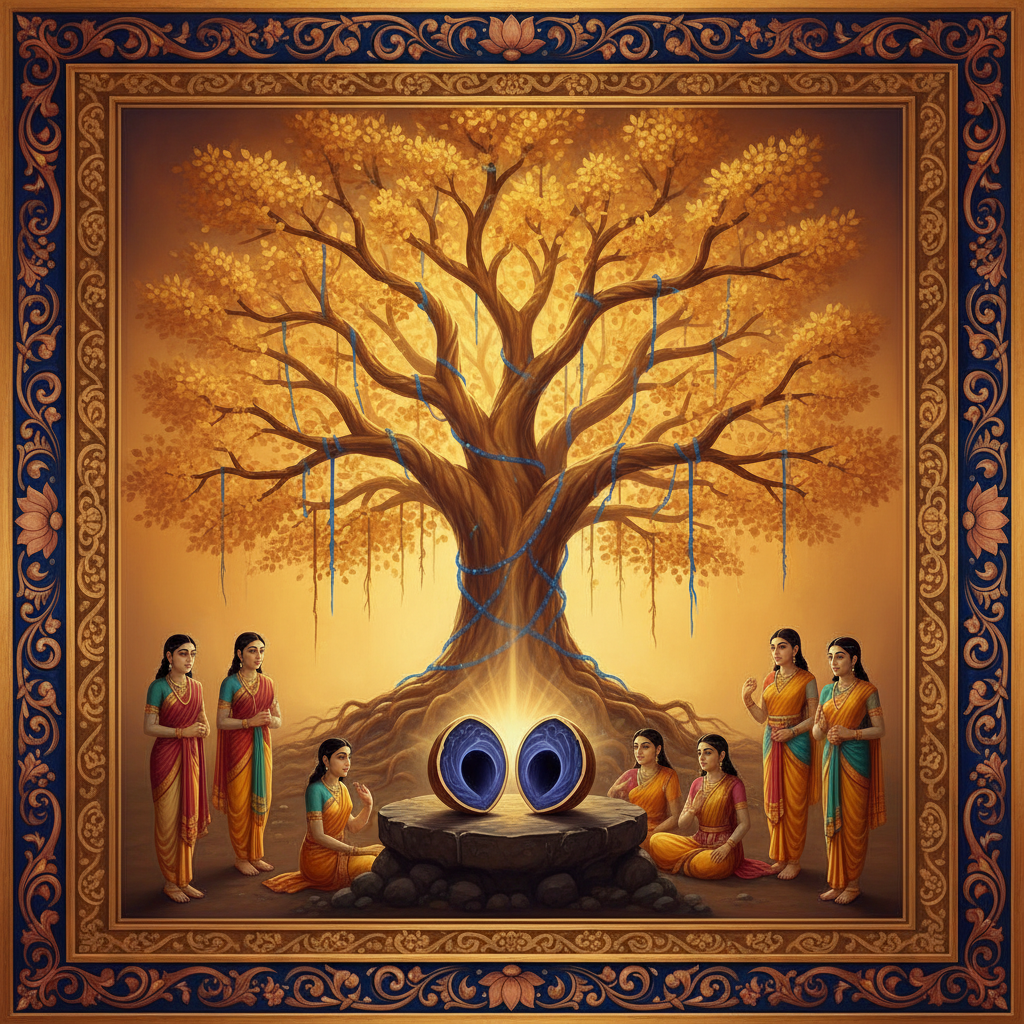
The story from the Upanishads is short and Swamiji tells it twice, once at the very top of the lecture as a cold opening and once in full when the verse brings him back to it. A teacher asks a disciple to fetch a seed of the banyan tree. He does. Break it, the teacher says — and it takes some time, because the seed is so small that a very sharp blade is needed. Look into it, and tell me what you see. The disciple looks and reports that he sees nothing. Swamiji adds, with evident enjoyment, that by now the disciple is thoroughly irritated, and then admits he has been spicing up the story and that anyone going to the Upanishads for those particular words should not be upset when they are not there. The teacher’s answer is the lecture’s center. That nothing has created this enormous banyan tree. Likewise Brahman, which seems like nothing, has produced the entire universe of past, present and future. Go after that nothing. He turns the image toward practice rather than leaving it as metaphysics. Consider what a seed actually does. It has attended no university, been handed no data, never been introduced to photosynthesis, and it sends out fibrous roots of such fineness and such persistence that they find every vulnerable point, enter, swell, and break what they entered. The miracle each seed performs is beyond imagining. And it is that God who is the seed of your personality and of the whole world you experience — which means, he says, the resources are already with you. What remains is to become aware of it, and to let your life flow from that awe.
What the Intellect Actually Does
Krishna’s second claim in verse ten is to be the intellect in the wise, and Swamiji uses it to give buddhi a working anatomy. The intellect performs two functions. The first is grahana shakti, the power of gathering knowledge, drawing it in and handling it — the faculty on which understanding is built. It comes in grades: keen, moderate, and dull. His counsel here is unusually direct. Whatever grade you start from, do not be upset by it. Repeated effort enlarges the capacity. You read the same scripture again and again, you listen to its meaning, and the grasping power develops. The second is viveka shakti, the power of discrimination — taking the conclusion the intellect has reached and actually living by it. The intellect has evaluated something; the question is how to take advantage of that evaluation. Live your life led by viveka, he says, and calls it the normal instruction. Purified intellect is what eventually enables the recognition that one is not the body and not the mind, and that the world, being transient, is not the goal. The prayer that belongs here is sanmati — good understanding. Sabko sanmati de Bhagavan: God, give good understanding to every individual. Swamiji calls it one of the best prayers there is, precisely because every human being already holds the resources for the highest attainment and what is missing is only awareness of them. The Gayatri is the mantra that asks for exactly this: may that light which illumines the three planes shine upon our intellect, and let understanding blossom.
Kama and Raga, Finally Told Apart
Verse eleven claims the might of the mighty, free of kama and raga. Most renderings treat those as a pair of near-synonyms for desire. Swamiji separates them with real care, and the distinction is the most technically interesting passage in the lecture. Kama is intense desire for an object that is still at a distance. The whole of its life is measured in distance closing. As the object comes nearer it earns names: priya, dear; then moda, sweeter; and when it arrives in your grasp, pramoda, excessive delight. Most objects, he notes, stay distant and cannot be held, which is why the impressions accumulate rather than resolve. Raga is what the closing distance does to the one desiring. The word comes from ranjana, the anointing of the eye. The object approaches and your eyes begin to shine — a little at first, as though lightly anointed. If it came all the way, he jokes, your eyes would explode. He pauses to say he is not speaking literally. So kama is the movement of desire toward the object, and raga is the coloring of your vision by it. One is out there; the other is in the eye.
The Polish on the Object
Then the correction, and it is the line the lecture is built to deliver. Objects do not have happiness in them. Situations and circumstances do not give you happiness. Happiness emerges out of your own heart, and the mind attributes it to the object for lack of understanding. The mechanism he offers is domestic and exact. When you desire an object, the desire acts as a polish. The more polished the object, the greater its ability to reflect you — and you are the embodiment of bliss, pure consciousness. So having polished the thing thoroughly, you look into it and it seems wondrous. What you do not realize is that the wonder coming from the object is coming from you. This is vishaya sukha, the pleasure of sense objects that dominates the human mind, and Swamiji asks what it costs: how much work, how much worry, how much anxiety, all of it handled by the mind, and for what — ninety years, a hundred if we are being generous, after which every one of those objects moves away from you.
The World as Family
What follows the removal of kama and raga is not withdrawal. Remove them, Swamiji says, and you look at the world as an expression of immense joy. At that stage you can speak of vishvabandhutva: the whole world as your family, the entire world friendly. The world is then neither the giver of pleasure nor of pain, because the world being maya, both were coming from your own inner Self through a crooked mind. He anticipates the obvious objection and answers it directly. This does not mean the scripture asks you to stop loving your child. Everything outside you is technically an object, children and friends and relatives included, and the scripture does not say to get out of that love. It says to recognize that you are seeing your own face in your child, and to put on a jnana spectacle — to see that what you love there is not only the child but the source of the child, the Spirit.
The Three Gunas and the Three Creations
Verse twelve closes the lecture. The sattvika, rajasika and tamasika states all proceed from Him; He is not dependent on them, though they are dependent on Him. Swamiji applies the three in two passes, like a spiral turning once and then turning again. Looking at creation as a whole: rocks and mountains, with neither senses nor mind, are tamasika. Animals, birds and the other creatures, which have senses but no developed intellect, are rajasika. Human beings, endowed with buddhi shakti, stand in the third. Then the same three applied to people. Those wholly committed to a perverted way of seeing the world — he declines to name them — are tamasika. Those interested only in externals, for whom money is the solution to everything, are rajasika, and here he allows himself a joke that lands harder than it first sounds. The mantra of that stage is: get on. Then, once a position has been secured, get honor. And when old age arrives, get honest. The sattvika are the deeply spiritual — the great sages, and in recent times Mahatma Gandhi, and Buddha, and Christ, and every aspirant genuinely working toward that attainment.
Terms
- jnana — intellectual grasp; knowledge held in the mind, true but at a distance from what it knows
- vijnana — intuitional realization; the same knowledge with the distance removed
- tejas — light, effulgence; the radiance of a personality, which control of thought, word and action makes spiritual and craving makes worldly
- vivartavada — the theory of illusory modification; the relation between rope and snake, not between potter and pot
- buddhi — the intellect, the faculty of the third plane
- grahana shakti — the intellect’s power of gathering and comprehending knowledge, enlarged by repetition whatever grade one begins from
- viveka shakti — the intellect’s power of discrimination; living by the conclusion it has reached
- kama — intense desire for an object still at a distance
- raga — from ranjana, anointing; the coloring of one’s vision by the object desired
- vishaya sukha — the pleasure of sense objects
- sanmati — good understanding, the thing the Gayatri asks for
- vishvabandhutva — the whole world as one’s family
- loka — plane or world; here the physical, the sentimental and the intellectual
Questions for Reflection
- Where in your own study are you mistaking a clear map for having made the journey?
- Which object, relationship or outcome have you been polishing hardest, and what would change if the shine in it turned out to be yours?
- Your grasping power is whatever grade it is today; what would repeated effort on one text, rather than first acquaintance with many, actually look like this month?
Srimad Bhagavad Gita, Chapter 7 — Jnana-Vijnana-Yoga, verses 10, 11 and 12. Lecture 80 by Swami Jyotirmayananda, Yoga Research Foundation. The complete archive of Swamiji’s lectures is free to all.
This study guide is drawn from the archived teachings of Sri Swami Jyotirmayananda.