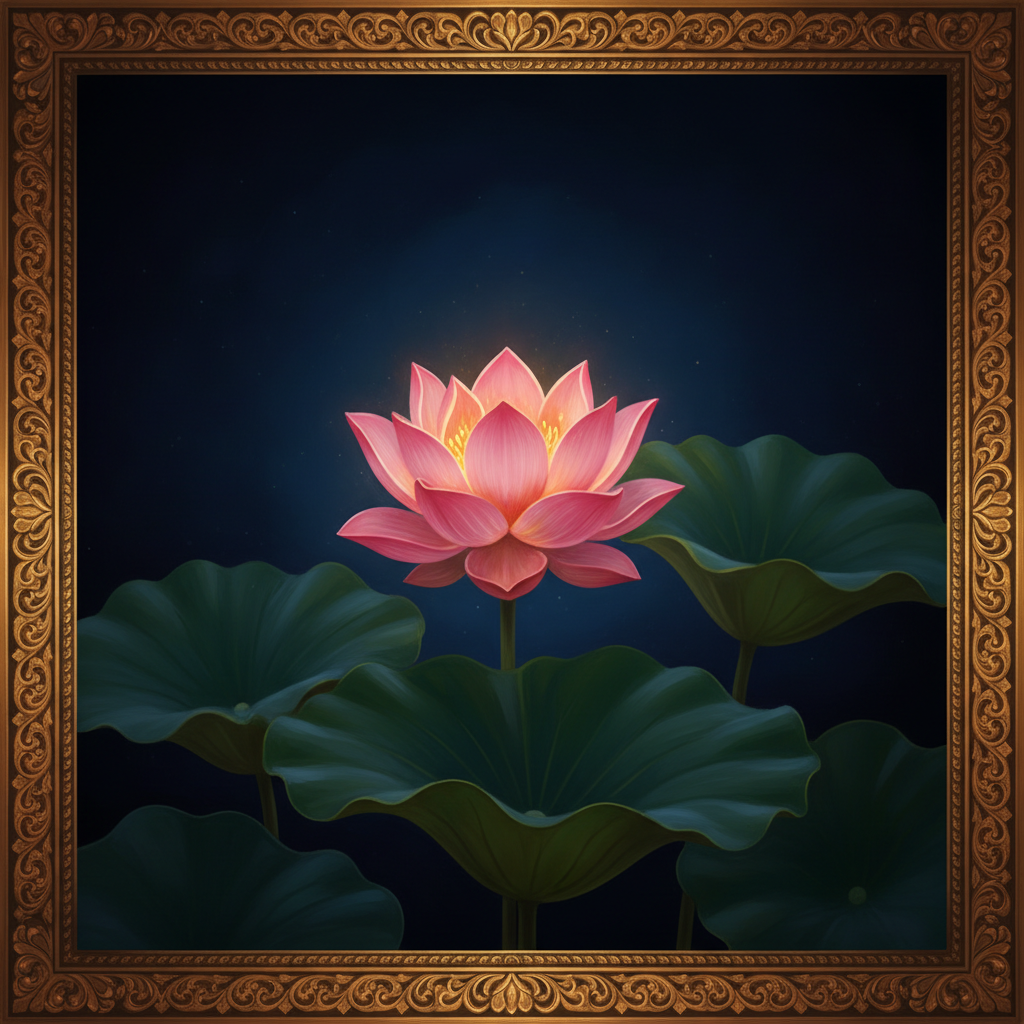
This lesson continues the eighth chapter of the Bhagavad Gita, Akshara-Brahma Yoga, with verses 12 and 13. Swami Jyotirmayananda first gathers the chapter’s seven questions into two triangles. One describes Brahman coming down into the world as God the creator and His creative power. The other describes the soul moving up, from identity with the body to the realization that it is one with God. Verse 12 then gives the method. The senses are restrained the way a charioteer holds the horses with the reins. The mind is drawn into the heart, and Swamiji makes clear that this means purity of heart, compassion and inner expansion far more than a technique of visualization. The pranas are held between the eyebrows, which he explains through the rise of kundalini and the loosening of three knots: the knot of karma, the knot of desire and the knot of ignorance. Verse 13 describes the yogi who departs uttering Om. Swamiji explains pranava, the sound that is ever new, the place of the divine name in daily life, and why death is a change of clothes rather than a cause for sorrow. He closes with King Parikshit, who was given seven days to live. If you read for one thread, follow the heart. Each step of verse 12, restraining the senses, holding the pranas, concentrating the mind, turns out to depend on how far the heart has opened.
Where each passage begins
- 00:00 Parikshit’s Seven Days
- 01:54 Chapter Eight and the Two Triangles
- 04:40 Saguna Brahman: God with Name and Form
- 07:51 The Soul’s Three Steps Upward
- 10:45 Verse Twelve: Restraining the Senses
- 14:05 Drawing the Mind Into the Heart
- 18:24 Compassion as a Touch of God
- 21:14 Prana Between the Eyebrows
- 23:59 Three Knots: Karma, Desire, Ignorance
- 29:51 Concentration, Meditation, Samadhi
- 32:04 Verse Thirteen: Uttering Om
- 38:25 Death as a Change of Clothes
Two triangles
Swamiji recalls the seven questions Krishna answered earlier in the chapter. “Out of these seven, six of them. are presented in ancient yantra where two triangles intersect.” That yantra, he notes, became popular as David’s star, and later as the cross. “One triangle implies from the Brahman to the world is like a coming down movement. Another triangle implies the soul moving up to God.” The first triangle begins with Brahman, the Absolute. “The first term is used, what is Akṣara? The imperishable. Answer is Parabrahman, the Supreme Self.” Then Brahman becomes involved with creation, “qualified by Māyā, cosmic illusion.” Third is the creative power of God, “Kriyā Śakti of God.”
God with name and form
“Brahman qualified by cosmic illusion is called Saguṇa Brahman.” “That Brahman is the one that’s worshiped as Brahmā, creator, Viṣṇu, sustainer, Śiva, destroyer.” “It is that Brahman that is worshiped in all religions because you have no choice but to have some name and form.” Swamiji answers the person who says they believe in God without any name or form. “But must realize that your belief itself is a name and form in your mind.” Even the concept of abstraction is a concept. “That abstraction that your mind conceives of is not the real. That has to be understood.” He names the cost of forgetting this. “But unfortunately, people fight over these things to such an extent that millions and millions have been killed.”
The soul’s three steps upward
The second triangle relates to the jiva, the individual soul. Swamiji names its three stages. Adhibhuta is the “Jīva identified with the body.” Adhidaiva is the “Jīva that is evolving, growing in the image of God.” Adhiyajna is the “Jīva that has become absolutely purified.” “So three steps coming down from the cosmic self, three steps coming down from the coming up through the individual soul.” “If these three by three is well understood, Then you are saturated with true religion.” “You have accepted the David’s star. You have taken up your cross.” Then the mind at the end of life will seek nothing else. “And so even at the time of death, your mind will not aspire for anything other than being united with God. Because God has become the only reality.”
Verse 12: the chariot of the senses
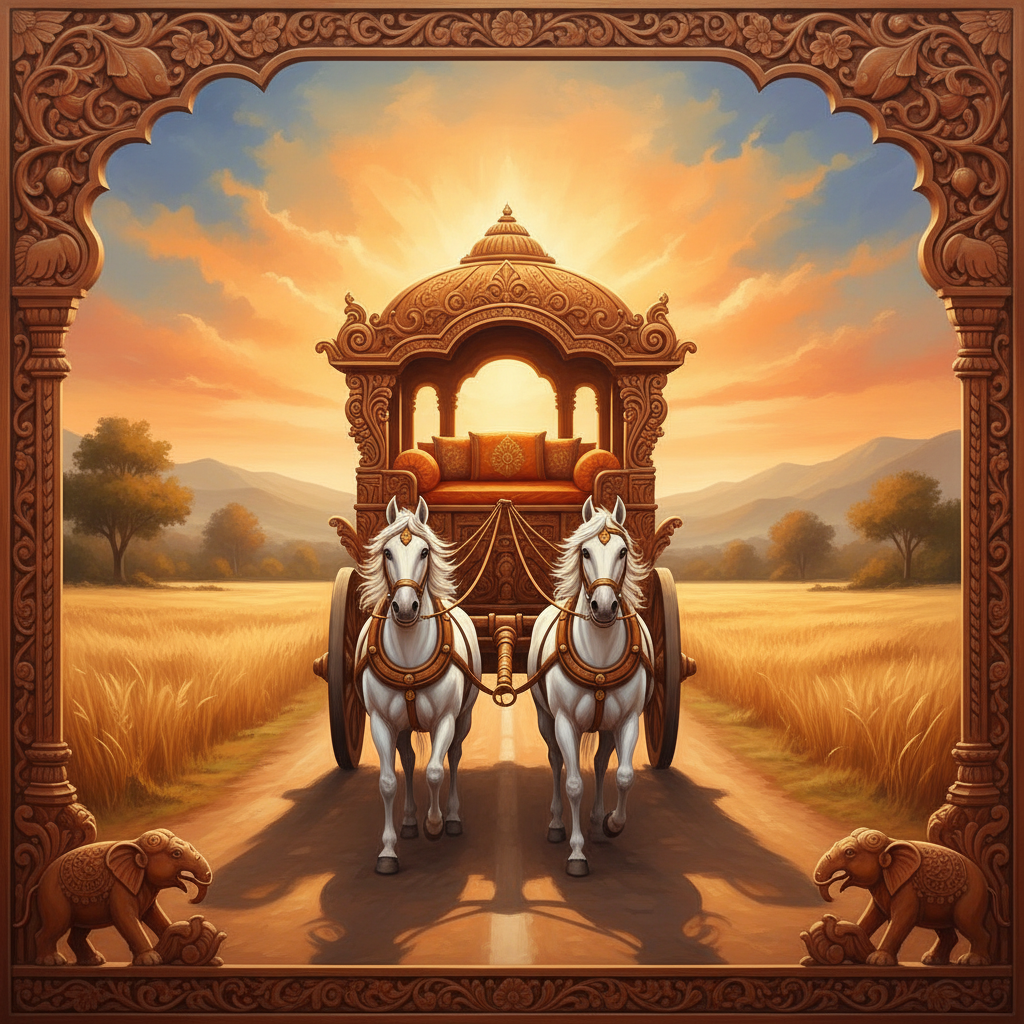
Verse 12 gives instructions for how to live the insight in that star. “The answer, simple answer is practice integral yoga day by day.” Swamiji then follows the words of Krishna point by point. The first point: “Having restrained all the senses”. “Life is not meant just to fulfill your senses.” Swamiji quotes the Katha Upanishad, “parāñci khāni vyatṛṇat svayambhūḥ.” “The senses are always outgoing.” They keep you “in a world of distraction.” So he gives the image of the chariot. “Just like in a chariot, horses are to be controlled by Reins. Reins have to be controlled by a chariot driver.” “In the same way, your personality is like a chariot. Your senses must come under mind’s control. Mind must come under the control of intellect. Intellect must come under the control of inspired understanding.” “If you are straightening your chariot day by day. You are on the right course.” Without that, the chariot swings “Sometimes right on the path, but sometimes at tangents, and sometimes completely backward, and sometimes dropping into a ditch.” And he adds a gentle note: “Some errors are easily corrected and move on. Some errors require healing.”
Drawing the mind into the heart
The second point: “drawing the mind into the heart”. In Raja Yoga, Swamiji explains, the first point is dama, control of the senses, and the second is “the practice of pratyāhāra and dhāraṇā.” For a beginner, he says, a visualization helps. “Imagine in your heart there is a beautiful lotus. In that lotus there is a divine presence. All that is helpful.” But the reality is something that must develop: “a sense of Divine Love. a sense of inner expansion. A touch of God within your heart.” “If you have developed that, Your mind becomes calm.” “Purity of heart should become your constant attention day by day.” Impurity, he says, is a broad term. It is “not just thinking of pleasures, but even entertaining the idea of anything negative.” He names “the feeling of being ignored by God Himself.” and the habit of “developing a mathematical evaluation of yourself, how many karmas have you done. Even God doesn’t know.” “If you have these ideas in your mind, you are not drawing the mind into the heart.” Nature gives a glimpse every night. “Nature allows you to draw the mind into the heart each time when you go to sleep.” “But it’s not a complete resolution. There is always a little separation. That’s called veil of ignorance.” As you advance, that veil breaks. “And if you are in your heart, then you are with God.”
Compassion as a touch of God
Swamiji gives an example everyone knows. “When you find defects in others, And your mind becomes agitated. It’s because mind is not, mind has gone away from your own heart.” If the mind were in the heart, “then you would have compassion towards those in whom you find a lot of fault.” For they are family: “the whole world is your family.” The disciplines serve this. “For that purpose, people practice mauna, silence. You practice fasting.” “Satsaṅga is always of immense help.” “So control of mind has its secret, allowing your heart to be happy, magnanimous.” “Therefore in sādhanā Serve, love. These terms become important.” And this, Swamiji says, is a kind of darshan. “as good qualities develop and your heart begins to expand, every degree of expansion leads you to touch of God. And that’s kind of a darśana of God.”
Prana between the eyebrows
The third point: “keeping the prāṇas centered at the space between the eyebrows.” Here Krishna points to the role of the pranas, which includes Hatha Yoga, breathing exercises and kundalini. As the practice deepens, “You develop a sense of buoyancy. And you begin to understand the body is your vehicle, you are not the body.” Swamiji gives a homely test of health. “Real health is if you are really healthy, you don’t know where your body is.” “If you have no headache, you don’t know where your head is. Your hand has to find it.” So two angles meet. You reflect that you are not the body, and you also make the body healthy through yoga, pranayama and meditation, until “the body becomes just a tool. Automatically you are getting rid of the body idea.”
The three knots
Swamiji describes the movement of kundalini “like a mercury in a barometer.” At the navel center, the manipura chakra, is “The knot of karma. You are karmically fettered to your body.” When that knot is released, he says with a smile, “You are not naughty anymore.” Next is “Kāma-granthi, the knot of desire. Subtle desires of the unconscious, subconscious.” “Those desires you don’t know yourself, but they are there, a load of it.” As the kundalini rises to the heart, “You develop a glimpse of attainment that awaits you.” Then the hidden desires look small, like loads of copper coins “Until you come to realize there are diamonds and pearls.” He gives a second picture. “Just like you are carrying a big load in a train and you come to realize train will carry you as well as your load. So therefore you unload your head. Put the load on the train. and go to sleep. Enjoy rest” When that knot is loosened, you still handle “all your duties and challenges and problems, but you are handling with a with a mind that is energized with a special energy.” When it is not, “even when there are no challenges, your mind is creating.” “Third granthi is avidyā-granthi. Avidyā is ignorance. And that center is between the eyebrows.” When it opens, “Now your mind begins comes in touch with intuitive knowledge.” “God alone is Truth. All else is appearance.” Swamiji warns against reading the verse as a plan for the last day alone. “Even that point, come down to that level, requires your daily practice.”
Concentration, meditation, samadhi
The fourth point: “steady in the practice of yogic concentration.” “The mind should not constantly enjoy being in a distracted state.” “Concentration, meditation, and samadhi, they go together.” Choose an object; “choose a mantra and focus on the deity, Rāma, Kṛṣṇa, Buddha, Jesus, or a divine quality.” “When focus stays continuous in an effortless way, then it’s called Dhyāna, meditation.” And meditation opens into samadhi, the way sleep arrives: first the pillow, then the blankets, “And then suddenly you slip into deep sleep.” Even a brief experience changes everything. “You will not be the same person. Even though you will look the same. Your inner understanding of yourself will be different.”
Verse 13: uttering Om
Verse 13 reads, in Swamiji’s rendering: “uttering the one syllable Om that denotes Brahman thinking of me”, “The Yogi who departs from the body attains the supreme goal.” Om is called pranava, and “It has two types of meaning. Praṇava means the best sound ever.” “Also it means that which is ever new” “If your mind begins to taste Divine Name You will not be seeing the world as a repetitive experience”. “Every step brings a new vision no matter how little.” In Hindu culture the simplest instruction is “repeat divine name.” “Ram naam japna aur sab sapna”. “Om and Ram, they are all, they are just the same. When we say Om, it has more emphasis on wisdom. When you say Ram, it has more emphasis on devotion.” Devotion keeps wisdom from going dry. “And if heart is not purified, wisdom becomes dry.” “But when you have love of God, You have a better vision Love is like light. Impurities are like darkness, both can’t sit together.” The choice of name is free: Om, Ram, Krishna, Govinda or Jesus. The letters of Om follow the chakras already described. “A opens your Maṇipūra Cakra.” “U opens your heart center M opens your Ājñā Chakra”, and the transcendental “allows your Sahasrāra thousand-petaled lotus to blossom.”
Death as a change of clothes
“Time of death, death itself is not to be viewed as something miserable.” “Children become very upset when their clothes are changed. But when they are changing, they are very happy. Death is a change of your clothes.” “So the word death should not ring a negative bell in the mind.” Swamiji quotes a mystic song, “Ghūṅghaṭa ke paṭa khola re, tohe piyā mileṅge.” A bride waits to lift her veil and meet her beloved. “The soul is the bride. The veil is the kośas, the body-mind complex that has become the veil.” “When will I be free of this veil? and stand in the glory of the beloved Self. That’s death.”
Seven days
And when? “Don’t count the calendar to understand Death.” The Purana tells of King Parikshit, who “was cursed to die in seven days And within seven days he attains enlightenment through satsaṅga.” “That curse applies to everyone. shouldn’t become sad. Everyone dies in seven days from Sunday to Saturday. Within these seven days, You should attain enlightenment.” “Simple teaching. Don’t think of death at every moment. Body is transient. Moving towards God is your highlight of life. And death is only a gentle process.”
Terms in this lecture
- Akshara — the imperishable; Parabrahman, the Supreme Self
- Saguna Brahman — Brahman qualified by maya, worshiped with name and form
- kriya shakti — the creative power of God; also the energy at the navel center
- jiva — the individual soul
- adhibhuta, adhidaiva, adhiyajna — the soul identified with the body, growing in the image of God, and fully purified
- dama — control of the senses
- pratyahara — withdrawal of the senses
- dharana — concentration
- chitta shuddhi — purity of heart
- mauna — silence
- darshana — a vision or touch of God
- kundalini — the mystic energy that rises through the spine
- karma granthi — the knot of karma at the navel center
- kama granthi — the knot of desire at the heart center
- avidya granthi — the knot of ignorance between the eyebrows, the ajna chakra
- dhyana — meditation
- samadhi — superconsciousness
- pranava — Om; the best sound, and that which is ever new
- koshas — the sheaths of the body-mind complex, the veil over the Self
Questions for reflection
- Which of your senses pulls the chariot hardest, and what would it mean to hold the reins today?
- When you find fault in someone, can you notice the mind leaving the heart, and turn toward compassion instead?
- What load are you still carrying on your head that the train could carry for you?
Srimad Bhagavad Gita, Chapter 8, Akshara-Brahma Yoga, verses 12 and 13. Lecture 89 by Sri Swami Jyotirmayananda. The complete archive of Swamiji’s lectures is free to all.
This study guide is drawn from the archived teachings of Sri Swami Jyotirmayananda.