
Ahamkara: Why the Ego Blocks Every Purpose of Life
Yoga Vasistha, Vairagya Prakarana, Section 15
Section 15 of the Vairagya Prakarana carries a title that sounds almost comic until you sit with it: Ahamkara-jugupsa, finding fault with one’s own ego. Jugupsa is the word for gossiping against something, speaking ill of it behind its back. The section is Rama gossiping against his own egoism, at length and without mercy. Swami Jyotirmayananda opens by noting why the text is built this way. Ego has arranged things so that the moment anyone speaks against it, you become exceedingly upset. So the scripture does not lecture you about your ego. It hands you a highly poetic description, image after image, and lets Rama be the one under indictment. You learn the weaknesses of your own egoism without being offended by it, because officially the subject is somebody else. What follows is a chain, and the chain is the substance of the section. Ignorance gives rise to egoism. Egoism gives rise to attachment and aversion. Those two generate karma. Karma carries the soul into a body. And with a body comes a low, constant, instinctive alertness that never entirely switches off, which the text names as the fear of death. Swamiji is careful about how ordinary this is: it runs so far beneath thought that most people never notice it, and it shows itself in small ways, in the flinch when something brushes your face. From there the lecture turns from cause to cost. What does egoism actually take from a person? Swamiji answers in four movements: it undermines the purposes of a human life, it distorts all three faces of consciousness at once, it passes through three stages of which the last is the most dangerous, and it destroys the one capacity that would have let you see God everywhere. Then it closes on the turn the entire section has been building toward, which is not renunciation of the world but a change in what the craving is pointed at. If you have never read the Yoga Vasistha, this is not a bad place to begin. Rama has returned from his pilgrimage disenchanted with everything, and these early sections are his long account of why. The philosophy arrives later. This part is diagnosis.
Passage index
- Invocation and opening verses — 00:00
- L-I-F-E: the previous section in four letters — 02:47
- The sun, the screen, and the fake “I am” — 04:51
- Rama’s indictment: ignorance, attachment, karma, fear of death — 08:06
- The four purposes of life and the termite in each — 11:24
- Ahamkara as shatru, the enemy of seer, seen and sight — 18:42
- Three stages of ego: tamasic, rajasic, sattvic — 25:19
- When good deeds inflate the ego — 30:28
- Ahamkara is my disease: viveka and dispassion — 33:07
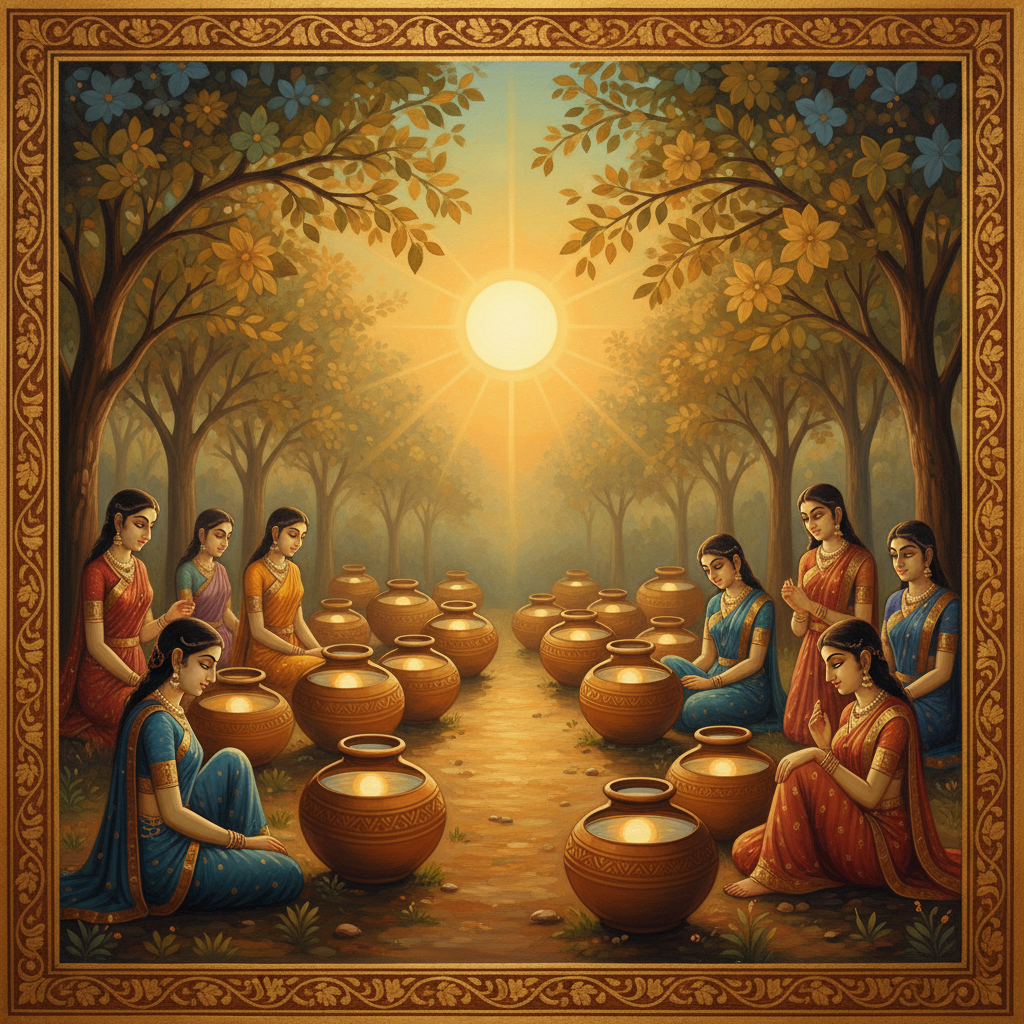
- Samadrishti: the same sun in every jar — 41:25
- The measure of attainment is self-effacement — 46:43
- Trishna becomes Krishna — 49:45
What the ego is, and what it is not
Swamiji spends the first stretch of the lecture on an analogy he returns to often. All the light on the earth comes from the sun and is nothing but the sun; take the light away and the sun remains. In a cinema, everything on screen arises out of the screen and is nothing but the screen; take the show away and the screen remains. Pure awareness plays every role in your life and remains untouched by all of it. That is what you are. Then something happens. A fake concept of “I am” develops over that awareness. That is ahamkara. And for most people, until a certain purity of heart is developed, it is not a passenger but the driver. The image Swamiji uses is the one that gives this lecture its character. “Ego sits on your neck with two legs on your neck” — and the two legs are raga and dvesha, attachment and aversion. Go along with what the ego wants and the legs rest there lovingly. Go against it and the grip tightens. A warning worth taking early, because it arrives late in the lecture and is easy to miss: none of this is an attack on the word “I.” Swamiji is blunt about the seeker who has read a few scriptures and stops saying “I” because he believes he has advanced past it. “Without ego you can’t live.” A mother saying “I did it, look” to her children is not displaying egoism; she is stating a fact and holding joy in her heart while she does. The distinction is awareness, not vocabulary. “sages exercise their ego in fun.”
The chain: ignorance, attachment, karma, fear
Rama’s opening charge is that the ego arose for no good reason at all. “In vain, ego has arisen out of ignorance.” Avidya is the root; asmita, egoism, is what grows from it. From egoism comes the split into what is liked and what is disliked — and Swamiji sharpens this considerably. It is not what you like. It is what the ego likes in you. You become attached to the first set and hostile to the second, and at that point you are no longer choosing; you are being dictated to. That movement of attraction and repulsion is what generates karma. Karma carries the soul into embodiment. And once embodied, you are not only harassed by the ego, you inherit its deepest expression, which is the fear of death. Swamiji treats this fear as physiological rather than philosophical. The body is rigged to remove death from every action. It is so natural that you never examine it, and it surfaces as ordinary irritability far more often than as dread. For someone who has attained spiritual insight, he says, death is simply a change of clothes: one body did not yield the fulfillment, it is taken away, another is given. For someone who has not, it is a background hum that never stops.
The four purposes of life, each with a termite in it
The purusharthas are the four aims of a human life, and Swamiji walks them in order. Dharma, ethical value: pursue success, but on the basis of dignity, not by hook or by crook. Artha, material value: God has already given you your best resources in body, mind and intellect, and the world will meet a genuine effort. Wealth earned on the basis of dharma leaves the heart magnanimous and gets spent on your own evolution; wealth earned otherwise leaves you watching it, multiplying it, anxious about it. Kama, vital and social value: how you relate to people, and what you leave behind you. Moksha, liberation, which the other three are supposed to culminate in. Followed honestly, the four produce a life of dignity, security and peace. Swamiji’s phrase for what egoism does to that sequence is the best line in this part of the lecture: ahamkara puts a termite into each step. Nothing collapses visibly. Each stage is quietly hollowed while it still looks intact. At dharma the termite says: who knows whether there is a God, science has found nothing. At artha it says: get ahead however you can. At kama it says: be seen doing it. Swamiji names three specific hungers here, the desire for progeny, the desire for wealth, and the desire for fame and reach — and observes drily that the modern form of the third is wanting whatever you do to go viral.
Shatru: the enemy of all three faces of consciousness
Rama calls ahamkara a great shatru, an enemy, and Swamiji takes the word apart. Sha points to everything auspicious, everything good arriving in a life. Tru is what opposes it. And what it opposes is not one thing but three: seer, seen, and sight — the way you regard yourself, the way you regard the world, and the way you meet pleasure and pain. Each gets its own distortion. Toward yourself, anger, including the peculiar anger that turns on the self for a slight suffered years ago. Toward the world, a lens: you do not see what is there, you see through the color of your own subtle desires. Swamiji says the sky alone is enough to blow your head away, and that a mind full of vasanas simply cannot have that experience. Toward experience, a permanent ledger of what should be pursued and what avoided, kept by someone other than you. Two images from this stretch are worth carrying. The first is that the pressure lifts every night: in deep sleep the ego’s whole apparatus is set down, everything that mattered so much moves away, you do not miss any of it, and you wake refreshed — which tells you something about how much of it was ever yours. The second is what happens if you go looking for the thing itself. “You cannot catch a reflected moon in water.”
Three stages, and why the third is the trap
Egoism is not one condition but three, corresponding to the three gunas, and Swamiji says the work is to lift it from the lowest and then keep going. Tamasic ego is passivity that can be mistaken for attainment. Someone sitting in inert stillness can look enlightened. “It’s a fake enlightenment.” At its lower end it goes further: boredom so complete that only something terrible produces a sensation. Swamiji traces cruelty and terrorism to this state, and notes that scriptures everywhere call it demonic — adding that people speak of being haunted by demons without realizing the demon is themselves. Rajasic ego is the respectable one. These are the people everybody calls good and civilized, and their lives are filled with constant planning for the next stimulation — a trip this way, a trip that way, and one day perhaps a trip to Mars. Then sattvic ego, and this is where Swamiji slows down. You do good, you hear yourself praised, it relaxes you, and you become genuinely virtuous. “But, it’s a big but. All that virtue does not make you humble.” It inflates you instead. He names the examples the scriptures give: Ravana, Kamsa, and from the Ramayana, Pratapabhanu — a righteous king who met a disguised enemy in a forest and asked to be made immortal and absolutely powerful. Swamiji’s comment is the whole point of the stage: if the virtuous deeds and the acts of charity had been real, that is not what you would have asked for. He puts the same observation in a domestic frame elsewhere in the lecture, which lands harder. Years of good deeds in a family, and then one day, at just the wrong moment, the tea was not brought. All of it blown away by an inflated ego.
The disease, and the medicine
Rama’s own word for it is stark. “Ahaṃkāra is my roga,” my disease, and Swamiji pauses to note that the English word “rogue” is closely related. Physically it disturbs the harmony of the humors; mentally it produces klishta vrittis, the thought waves that feed egoism, attachment, aversion and fear, and out of those come the worries — some imaginary, some not. The medicine is viveka, discrimination, and Swamiji is careful about how it feels from the inside, because it can be mistaken for depression. When discrimination develops, the shine comes off things. Sarvam duhkham vivekinah: to one who discriminates, all of it is sorrow. But this is not a psychological case of seeing everything as negative. It is health. The analogy he gives is a doctor walking a ward full of patients lying comfortably in their beds. He sees the comfort clearly. He does not therefore want to lie down. For what the ego produces, the section supplies three pictures in a row. A hunter sets a snare for deer, and the ego has set exactly such a trap. A mountain covered in thorn trees rather than fruit trees, so that even the flowers that grow on it prick your fingers when you pick them. And Rahu, the demon who is only a head, swallowing up the moon of serenity — a moment of real peace arrives, and the ego takes it.
Equal vision, and what it is not
The capacity ahamkara destroys most completely is samadrishti, equal vision. Swamiji describes it at its most practical: looking at the world without the color of an egoistic attitude, so that inspiration is available everywhere — in flowers, in trees, in the sky, in the breeze. There are so many ways to find that God is everywhere, he says, and egoism closes all of them. Then he guards the idea against the misreading it usually gets, with the cleanest sentence in the lecture. The sun reflects in many jars, and a grown person recognizes that it is the same sun in every one. “He sees the same sun in every jar, but he will not drink from every jar.” Equal vision is the recognition that the essence in every individual is God. It is not an instruction to treat every situation and every person identically. Swamiji calls samadrishti no simple virtue, and it is the first thing to go when egoism is running the household. Ahamkara, he says, works like winter weather clearing the sky — except that here the clouds being cleared are the good ones: shama, serenity, daya, compassion, generosity, the divine qualities.
The measure, and the turn
Rama’s conclusion is a refusal. “I cannot live with this ego.” If ahamkara goes, a whole family of evils goes with it: dehabhimana, the identification with the body, and mamata, the sense that these things are mine. And then the line that makes people stop the video: “I am not Rāmacandra.” Taken literally it is confusing — Rama himself saying he is not Rama. Taken correctly, it is the point. He has no desire for objects, nothing to do with the mind, and wants only to abide in the Self, free of bitterness and animosity. Everything enjoyed, every ritual performed under the ego’s direction, every karma generated: tuccha, Swamiji translates, trifling, ending in a big zero. Which sets up the question the whole lecture has been walking toward, and the answer that reverses it. If you are asking yourself how much you have attained, “the answer is how much you have effaced yourself.” Not what has been added. What has stopped insisting on itself. And then the close, which is not renunciation. Swamiji describes the ego as a demonic spirit that has strung a garland on the thread of trishna, craving, running through birth after birth, with every attainment you have ever had threaded onto it like a bead — and that necklace is your life so far. The thread must go. But the instruction is not to stop wanting. It is to change what the wanting is aimed at. The subject, who am I, is divine. The object, the world, is God’s expression. The experiences are like a cool, gentle, fragrant breeze over trees, and they are divine too. “Tṛṣṇā becomes Kṛṣṇa.”
Terms
- ahamkara — egoism; literally the “I-maker,” the fabricated sense of a separate doer laid over pure awareness
- jugupsa — finding fault with, speaking against; the section’s title is literally gossiping against one’s own ego
- avidya — primal ignorance, named here as the root from which egoism grows
- asmita — egoism as the sense of “I am,” the first product of avidya
- raga dvesha — attachment and aversion, the pair that generate karma
- purushartha — the four aims of a human life: dharma, artha, kama, moksha
- shatru — enemy; Rama’s word for ahamkara, and the term Swamiji breaks into sha and tru
- vasana — subtle latent desire; the colored glass through which the world is seen
- klishta vritti — an afflicted thought wave, one that feeds egoism, attachment, aversion and fear
- viveka — discrimination between the real and the unreal; the medicine for egoism
- samadrishti — equal vision; seeing the same divine essence everywhere without collapsing distinctions
- dehabhimana — identification with the body, the “I am the body” conviction
- mamata — the sense of “mine,” possessiveness as a state of mind
- trishna — craving; the thread on which every attainment is strung
Three questions to sit with
- Which of the three stages of ego is most active in you right now, and how would you know if you were wrong about the answer?
- Where in your life are you helping yourself, and where are you helping your ego, in a situation where the two look identical from the outside?
- What would change today if the measure of your progress were not what you have gained but how much has stopped insisting on itself?
Yoga Vasistha, Vairagya Prakarana, Section 15. Lecture 8 by Swami Jyotirmayananda, Yoga Research Foundation. The complete archive of Swamiji’s classes is free to watch on the Yoga Research Foundation channel.
This study guide is drawn from the archived teachings of Sri Swami Jyotirmayananda.