This class continues the Balakanda of the Ramcharitmanas, covering dohas 236 to 241. Rama and Lakshmana are in Janakpur with the sage Vishvamitra, where King Janaka has announced that Sita will marry whoever breaks Shiva’s bow. Swami Jyotirmayananda reads the setting as allegory: Sita is viveka buddhi, the discriminating intellect, and the bow is the pull of the world, a mind forever asking where, why and when, and never asking who am I. In its place he offers another WWW: wait, watch and wonder. At the temple of Gauri Devi the garland has just fallen on Sita’s neck, and the Devi blesses her with a blessing of truth. Swamiji explains why a saint’s blessing never weighs merit, how every desire either falls away or bows to the aspiration for liberation, why the prophecy of Narada is satsanga itself, and why God, being all knowing, does not give what would not help. Leaving the temple, Sita feels her left side throb. That evening Rama sees the full moon, thinks of Sita’s face, and then decides the moon cannot compare. Swamiji reads the moon as every worldly attainment: it waxes and wanes, it shines with borrowed light, it pales by day, and its brother, born from the same ocean, is poison. At dawn Lakshmana sees the stars fade before the sun, as the vain kings will fade before Rama at the bow. Janaka’s priest Shatananda summons them to the arena, the rangabhumi, and the whole city leaves its work to watch. There every person sees Rama according to their own nature.
Where each passage begins
- 00:00 Where, Why, When
- 01:58 Balakanda: The Contest of Shiva’s Bow
- 05:42 Shutting Down the Mind’s WWW
- 08:02 The Garland of Goddess Gauri
- 10:52 A Blessing That Cannot Be Shaken
- 14:10 Satsanga Is the Word of Narada
- 18:19 When the Left Side Throbs
- 26:48 Rama Looks at the Full Moon
- 31:23 The Moon’s Brother Is Poison
- 37:57 Dawn, and the Stars Fade
- 47:18 The Arena of Colors
- 53:46 Everyone Saw Rama Differently
Shiva’s bow and Sita as viveka buddhi
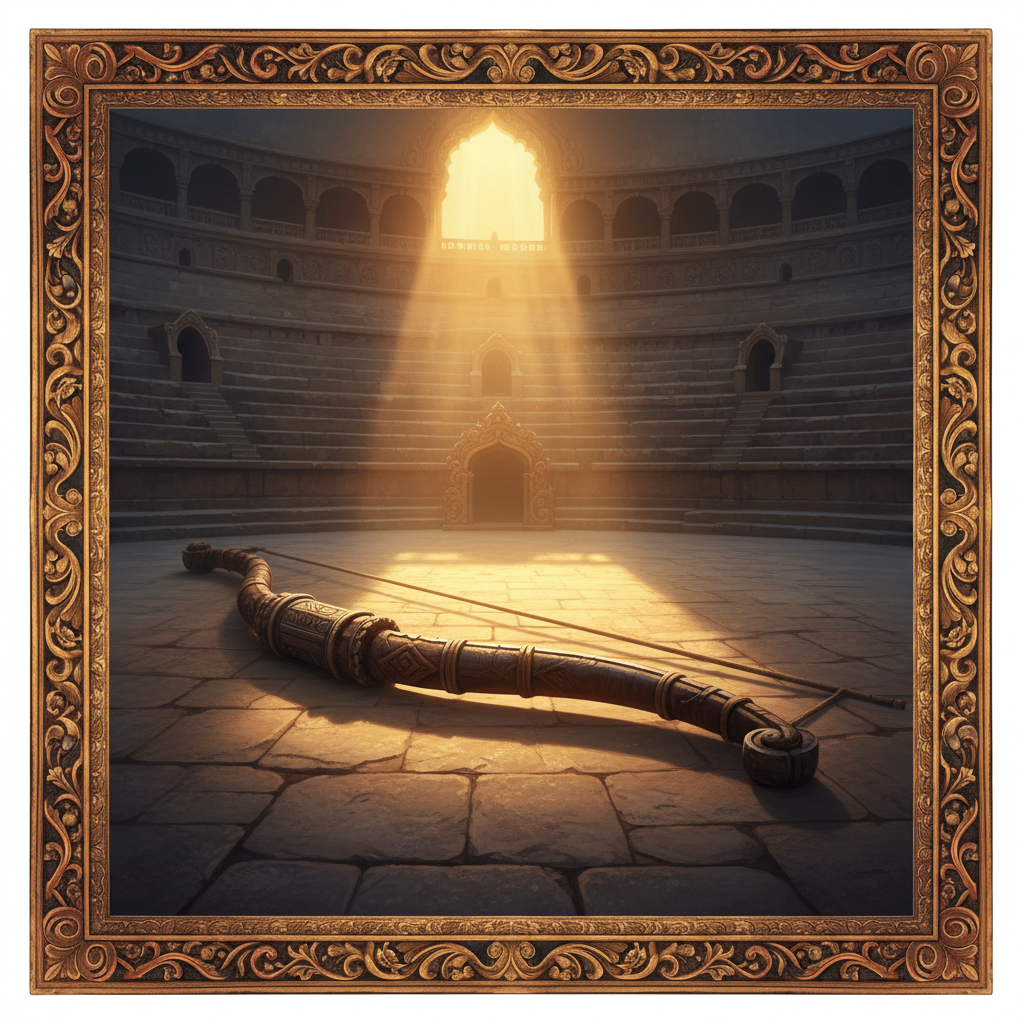
King Janaka has commenced the ceremony of the bow, the dhanusha yajna. His daughter Sita is to be married to anyone who breaks Shiva’s bow, and great souls and powerful personalities of the time have gathered in the hope of doing it. “Even demons assuming the form of human beings.” “It’s a highly allegorical setting.” People take it as history and do not go into the deeper meaning. “Sītā is viveka-buddhi”, the discriminating intellect. “Soul in you is Rāma”, “Rāma with the potentiality of destroying ignorance, Rāvaṇa.” At this stage the soul is not yet playing its full role. It must become fascinated with viveka buddhi and develop a keen love, a keen aspiration, for intuitive intellect. “Once that has happened, the soul moves on to the highest goal.” Until then, wedded to impure intellect or an inflated ego, the soul remains wretched and makes others wretched as well. To marry Sita, to have that glimpse of viveka buddhi within, the personality must be integrated to such an extent that “You don’t find your goal anywhere in the world that is transient.”
The mind’s WWW and another WWW: wait, watch, wonder
The mind, no matter how advanced, keeps looking at some corner of the world, living in time, space and desire. “Mind is constantly involved with where, why, when.” That is the bhava chapa, the pull of the world. “And you are fooled by this pull. Because you miss the point, who am I?” “Your attention does not go towards who am I.” “But attention goes to where, when, why.” This WWW becomes a terrible force, pulling the soul into a world filled with misery and into the cycle of birth and death. “Come to that stage where you can shut down this WWW.” Then highlight who am I. “Come to another WW. Wait. Watch and wonder.” “Practice Sadhana. Allow the negative to move away, wait.” Watch how much potential you have that you did not know, and wonder, until you come to the grip of realizing the Self.
Gauri’s garland: prarthana, darshan, pratiti
As was the custom, Sita went before her marriage to the temple of Gauri Devi, the embodiment of auspiciousness. There the statue smiled. “Statue came to a divine transformation.” It bent its head toward Sita. “Thereby her mala, rosary, her garland fell upon Sita’s neck.” Swamiji returns to the three stages he has explained before: prarthana, darshan and pratiti. You pray, and if your feeling, your bhavana, is very advanced, you have a touch of something mystical about whatever you are worshipping. That touch is darshan. “A profound change occurs.” It is not vivid. “When your big headache moves away, you hardly know it.” “But pratiti is a feeling of inner expansion, inner fulfillment.” The garland coming down on Sita’s neck means that the divine virtues begin to embellish and adorn the devotee. “You are growing in the image of God.”
Sunu siya satya asisa: a blessing of truth
Gauri Devi then gives Sita her blessing, sunu siya satya asisa hamari, pujihi mana kamana tumhari. “Oh Sita, listen to my blessing.” It is sachi asis, an infallible blessing. “Truth cannot be shaken, it is a blessing of truth.” Your heartfelt desire will be fulfilled. The spiritual meaning: when the soul is drawn to viveka buddhi, Prakriti Devi, the divine Shakti emanating from Brahman, responds. “That Shakti now as if gives you the blessing.” “Divine qualities, virtues begin to develop.” What of the manokamanas, the desires of the mind? “Firstly, to understand those desires are not true desires.” “Desires led by ignorance, led by illusion.” They cannot be fulfilled while you stay ignorant. As you advance they disappear, “or they stay subservient to the central aspiration, may I attain liberation.”
A saintly blessing does not ask if you deserve it
“In other words, it’s kind of a mantra type of blessing.” “Saintly blessing doesn’t ask, do you deserve it?” It does not say, “How much blessing can I give you? Tell me about yourself.” The blessing is simple: “Your heartfelt desire will be fulfilled.” It applies where you are. If your desire is only in the worldly realm, that desire will be fulfilled. But the profounder blessing touches the real urge within the heart, which “is to attain God realization.” “And that’s bound to be fulfilled.”
Satsanga is the word of Narada
The next verse, narada bacana sada suci saca, recalls that the sage Narada had prophesied earlier in the story that Sita would attain the highest personality, the Rama avatar, as her husband. Swamiji widens it. “That type of blessing comes through satsanga. Satsanga is Narada bachan.” “All the teachings of the scriptures are Narada’s scriptures.” Every soul is like Sita or Rama, whichever way you put it. “Blessing is fulfillment.” “Sita fulfillment means let Vivek Buddhi, discriminative knowledge blossom.” The Devi goes on: the one toward whom your mind has been deeply drawn, handsome and of dark complexion, you will have as your husband. “This voice comes from the Devī.” “Sita hears, others don’t.”
Karuna nidhana and sujana: what God withholds
The Devi calls Rama karuna nidhana, “The boundless treasure of compassion.” “God’s compassion is beyond limits. You can’t count his compassion.” He is also sujana. “Means Sarvajna. He’s all knowing.” That has a consequence. “If you are wanting to have things that are not helpful to you, he is not going to give you.” “You may be shocked. You prayed so much and didn’t get it.” God knows your virtue and your devotion. Sita and all her companions are delighted, and after bowing again and again before Gauri Devi, she turns back to the royal palace.
When the left side throbs
Finding the Devi so gracious, Sita’s heart fills with a joy that cannot be told, and her limbs give a suggestion of what is to come. Bama anga pharakana lage: her left side begins to throb. “In Indian tradition, it is considered very auspicious.” It cannot be produced by will, and when the good has happened it stops by itself. There is a psychology behind it. “Karma brings about different situations.” Every karma, before it comes, gives a little suggestion, a little mark. Something opens up in the unconscious. “And there is a little flutter in your nervous system.” “The negative happening creates its own effect on your body.” “Positive in another way.”
Lonai: the salt of a divine taste
Rama, so drawn to Sita, is inwardly praising her lonai, and Swamiji explains the word through salt, as village language praises a beautiful person’s salt. It is a mystical term. “That means you have something tasteful. You’re not a tasteless personality.” “A divine taste has entered.” “And when you have that taste, your face begins to show it, to glow with it.” Sita has Rama in her heart, and her face is shining so.
The mahavakyas of the Ramayana
The two brothers go to Vishvamitra, and Rama opens his heart to his guru. “Rāma told all that He felt when He saw Sītā.” “He didn’t hide anything from the guru.” They offer flowers at his feet and the sage blesses them: suphala manoratha hohum tumhare, all your mental aspirations will be fulfilled. “These are like Mahāvākyas of the Rāmāyaṇa. Great utterances.” The first was the Devi’s sunu siya satya asisa hamari; this is the second, “Same thing in a different way.” Such verses have become like mantras, recited by people who want to turn a negative day into something positive. After their meal, Vishvamitra relates stories from the Puranas. “This kind of relaxing time, old style.” “And since you are already satisfied, your body doesn’t have much demand.” The mind is ready to assimilate what it hears. As the day declines, the brothers go to perform their evening prayers.
Rama and the full moon
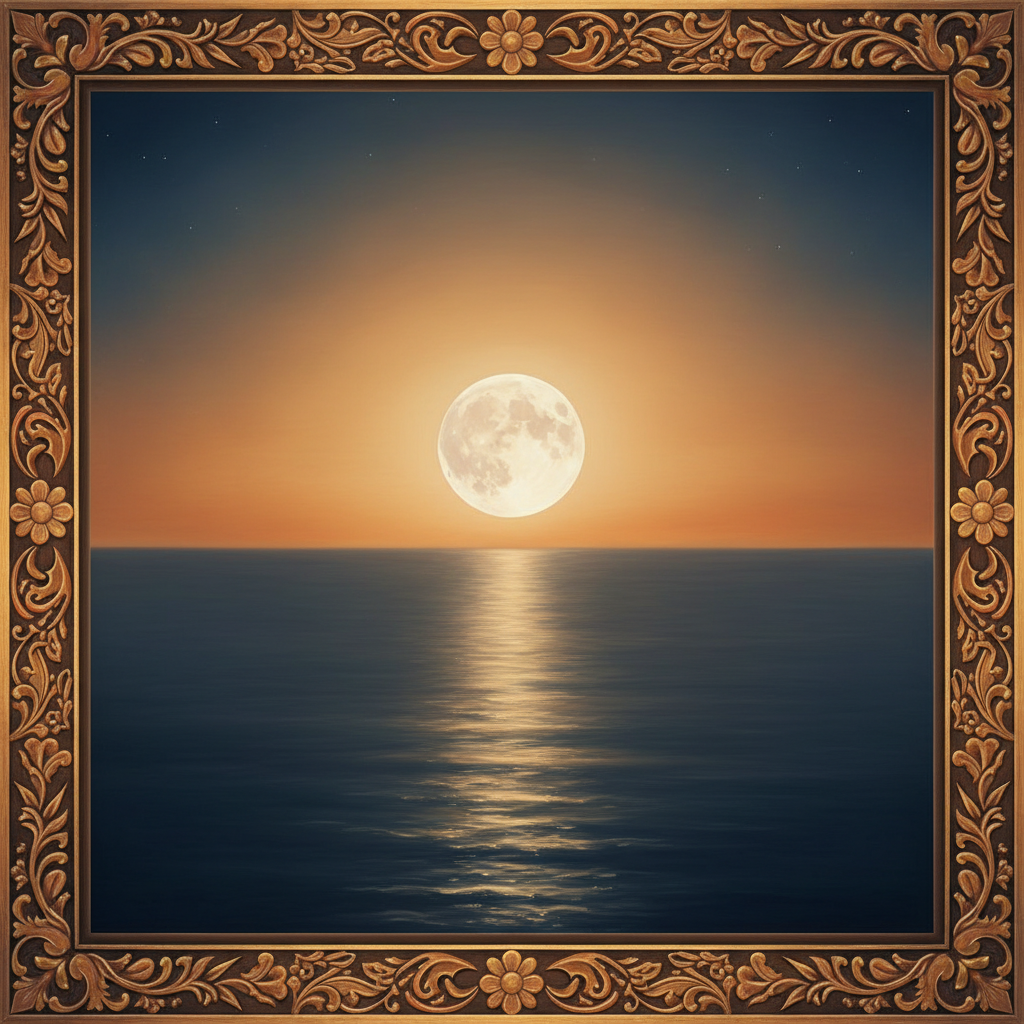
“Suddenly, Rama turns his face to the full moon in the eastern direction.” “The moon awakens in Him His attention towards Sītā.” The first idea is that it is like Sita’s face. Then he thinks again. “Moon can’t compare to Sita’s face.” It has a blemish, it waxes and wanes, “and it has no light of its own.” “This has a very broader implication.” Every sakamya karma, every action performed for worldly happiness and peace, aims at something like the moon. “Worldly attainment is like the moon.” “It seems so wonderful.” “But first, defect in it, it is never the same, it waxes and wanes.” “In the morning, something looks so good, by the evening, it doesn’t look so good.” The bigger defect is that it is not reality. “Happiness doesn’t come from the world.” “Happiness, the joy has its source in Brahman, the Absolute Self.”
Bhuma and alpam: the unconditioned and the little
So Sita’s face outshines the moon. If you have love for intuitive intellect, “All the temptations of the world can be put before you like a shining moon.” They will not compare. “The Upanishad calls it Bhuma, the unconditioned.” “Purified intellect is Sītā Devī.” Worldly attainments, by contrast, “They are termed as alpam, little.” They are illusory, like a mirage. The moon that attracts people’s minds is the desire for worldly pleasure.
The moon’s brother is poison
The next verse, janamu sindhu puni bandhu bishu, draws on the Puranic story of the moon’s birth. “The moon emerged out of salty ocean.” At the churning of the ocean many things emerged, and the same ocean brought out a terrible poison, taken away by Lord Shiva. “But what you are being pointed out is that the brother of the moon is poison.” The simple point: “The brother of all worldly pleasure is big pain.” The moon is also lusterless by day. “Worldly pleasure becomes lusterless in satsang atmosphere.” The shine on the face when you enjoy something uplifting outshines the shine that comes when you see a sweet laddu. “So how can Sita’s face be compared to that poor moon.”
Waxing, waning, and the full moon that pains
The moon waxes and wanes, and the mind relates to it. If you are sattvic and have done wonderful things, the full moon delights you. “The same full moon will give you more pain if you are separated from a loved one.” To compare the moon with Vaidehi Sita would be extremely improper. “Attaining Viveka Buddhi is Sita’s face.” “Attaining worldly enjoyment is the moon. You can’t compare them.” “Can’t put them on the same plane.” With his thinking settled, Rama returns with Lakshmana to Vishvamitra, and they rest for the night.
Dawn: the lilies close and the stars fade
As night passes and dawn appears, Rama says, uyau aruna avalokahu tata. “O Lakṣmaṇa, look.” The lotuses, the birds, the sun rising as a giver of joy to the whole world. Lakshmana, with folded hands, answers that with the rising of the sun the lilies close their petals and the twinkling stars have faded away. In the same way Rama comes into this assembly like the sun, and all the personalities there are like stars. “Your presence will make them all fade away.” “Lakṣmaṇa always highlights Rāma’s glory.” The kings who have come “are like stars in the night.” They have no strength to lift Shiva’s bow and break it, “Just like stars don’t have a strength to remove darkness.” “Stars shine, no matter how much they shine.” Night does not go away. “Similarly, all worldly pleasures are like stars.” All worldly goals cannot remove the darkness of ignorance. When Rama breaks the bow it will be as if the sun had risen. “Vain kings were like stars. They have moved away, they have faded away.” Hearing his brother, “Rāma smiled”, and both turn to their morning duties.
Shatananda’s summons and Vishvamitra’s watch
King Janaka sends his royal priest Shatananda to bring Vishvamitra, Rama and Lakshmana to the arena where Shiva’s bow is kept. Vishvamitra tells the brothers to come and behold Sita’s svayamvara. “And let us see whom God is going to give His special blessing.” “You know, Rāma will marry, but He keeps it secret.” “That’s how the stories remain interesting.” Lakshmana replies that whoever receives the sage’s grace, “that one will definitely break Śiva’s bow.”
Rangabhumi: the arena of colors
The brothers come to the rangabhumi, the arena. “That place which brings different colors.” People gather, become attuned to something, and a strange atmosphere is created; that is called ranga. “Hriday mein tarang, man mein rang.” A wave enters the heart and the mind takes on a special color. And when something goes wrong, “Something wrong takes place, you say raṅga meṃ bhaṅga.” Both are going to happen here. The people of Janakpur hear that Rama and Lakshmana have entered the arena, and they all come. “No matter whatever work they were doing, just left it.” Children, the young, the aged, men and women: King Janaka has them all seated according to their status.
Rama blue, Lakshmana fair: wisdom and meditation
Then Rama, Lakshmana and Vishvamitra appear, and everyone had come for that very darshan. “Nothing was more interesting than that. That was the source of their fascination.” Rama is of blue complexion and Lakshmana fair. “Understand also from a deeper point of view: Rāma is wisdom, jñāna movement.” “Jñāna movement leads you to expansion. Expansion is ākāśa.” “Ākāśa, sky is blue. So when you give color to it, it’s blue.” Rama and Krishna are both described as shyamala. “And Lakṣmaṇa is meditative movement.” Meditation focuses on purification, and purity is represented by snow, a fair complexion. Wisdom and meditation stand in the arena, waiting for viveka buddhi to join them, waiting for Rama to break Shiva’s bow. Seated among the royal assembly, “Rāma appeared like a shining moon in the midst of stars.” “Here the similes are on a different plane.” “The moon is not being looked down upon, highlighting Rāma’s glory.”
Everyone saw according to their bhavana
Jinha ke rahi bhavana jaisi, prabhu murati tinha dekhi taisi is another great utterance of the Ramayana. All those people looked at Rama, but no two saw him exactly the same way. “Everyone saw according to their bhavana.” Each saw according to the way the mind was structured, according to their vasanas. Those with heroic personalities “saw Rāma as the embodiment of heroism.” Kings who had come with crooked minds, to grab Sita and run away without deserving her, saw something else: “when they looked at Rāma, He appeared in a terrible form.” Demoniac spirits in human form “found Rama as the very embodiment of death.” The citizens of Janakpur “see Rāma and Lakṣmaṇa as the crowning glory of humanity,” a joy to the sight. And the women, looking through the heart with a flavor of art, “found Rāma and Lakṣmaṇa very enchanting.” “They were the very embodiment of sweetness.” The class closes with the chant of peace, Om purnamadah purnamidam.
Terms
- viveka buddhi — the discriminating intellect; Sita in the allegory
- dhanusha yajna — the ceremony of the bow at King Janaka’s palace
- bhava chapa — the bow of the world process; the pull of the world
- prarthana — prayer, the first stage of puja
- darshan — vision, the touch of something mystical in what is worshipped
- pratiti — experience; a feeling of inner expansion and fulfillment
- bhavana — feeling, the inner disposition through which each person sees
- satya asisa — a true blessing, one that cannot be shaken
- manokamana — a desire of the mind
- satsanga — the company of the wise; the word of Narada
- karuna nidhana — the boundless treasure of compassion
- sujana — all knowing, the same as sarvajna
- lonai — salt; the divine taste that makes a face glow
- mahavakya — a great utterance; here, verses of the Ramayana recited like mantras
- sakamya karma — action performed for worldly happiness and peace
- bhuma — the unconditioned, the infinite
- alpam — the little; worldly attainments
- rangabhumi — the arena; the place that brings different colors
- ranga mein bhanga — when something breaks in the middle of enjoyment
- akasha — space, the sky, blue in color
- vasana — a subtle impression that shapes how the mind sees
For reflection
- Where in your day does the mind’s where, why and when crowd out the question who am I, and what would it mean to wait, watch and wonder instead?
- Swamiji says God, being all knowing, does not give what would not help. How does that change the way you remember a prayer that seemed unanswered?
- Which of your own pleasures looks like a full moon at night and loses its luster in the company of the wise?
About this lecture
Tulsi Ramayana (Sri Ramcharitmanas of Goswami Tulsidas), Balakanda, dohas 236 to 241. Lecture 98 by Swami Jyotirmayananda. The complete archive of Swamiji’s lectures is free to all.
This study guide is drawn from the archived teachings of Sri Swami Jyotirmayananda.