
Six Pictures of the Mind, and the Way Out of Each
Vasistha does not describe the mind once in this section. He describes it six times, and each picture arrives with its own way out.
Section 50 of the Upasama Prakarana is where the Yoga Vasistha stops arguing and starts drawing. Sage Vasistha has been laying out the process that leads to enlightenment, and here he changes method entirely. Instead of one more definition of the mind, he gives Rama six allegorical portraits of it, one after another, and Swamiji is explicit about why: the mind is being described in different ways so that we can see it from different angles, because all the tangles in a life are made by it.
The six are a crow, an evil spirit, a snake, a vulture, a storm cloud, and a net. What makes the section useful rather than merely vivid is that Vasistha never leaves a picture standing on its own. Each ugly image is followed immediately by the practice that dissolves it, and the practices are not six unrelated techniques. They are one movement seen from six sides: enquiry, the great utterances, meditation on Brahman, non-covetousness, dispassion, and the fire of wisdom.
Swamiji’s own contribution in this lecture is largely translation, in the ordinary sense of the word. He takes an eleventh-century allegory about crows and cremation grounds and puts it where a listener actually lives. The mind that hoards worries becomes a bank account gathering interest. The ego running on the nervous system becomes an iPad, closing down at night while still keeping the record. The expectation you are sure will make you happy becomes a lightning flash, and he notes drily that people who chase lightning tend to crash.
One caution about how to read the section. Vasistha’s portraits are of the unenlightened mind only. Swamiji says so directly, more than once, and the distinction matters because the same faculty, enquired into, is what carries a person across. The crow does not get killed. It becomes Kakabhushundi, the one-eyed sage of the Ramayana, and the single eye is the point: no vision of duality. The lecture is not an argument for having no mind. It is an argument, stated plainly at the close, that “an impure mind is overcome by a pure mind.”
Passages in this lecture
- 00:00 The Lake and the Reflection
- 01:03 Invocation
- 02:00 Section 50: The Mind Seen from Every Angle
- 02:55 The Crow in the Nest of the Heart
- 11:10 Vichara: Who Am I Is the Dearest Question
- 13:52 The Pisacha and Trishna on the Tree of Ignorance
- 17:07 The Four Mahavakyas
- 24:23 The Snake: Good and Evil, Two Poison Fangs
- 30:05 The Vulture in the Cremation Ground of the Body
- 36:43 The Cloud of Citta, the Wind of Vasanas
- 44:46 The Net of Thoughts, and the Fire of Wisdom
- 50:28 Vairagya and Para-Vairagya
The Lake and the Reflection
The lecture opens on the image it will return to at its centre, and it is the simplest thing in the fifty-four minutes. Everything you think and feel requires consciousness. But consciousness is a lake, and every thought, feeling and experience is a reflection on its surface. “The lake remains aloof.”
The instruction that follows is a single sentence and the whole practice is inside it. “Switch your attention from your reflection to the lake.” While you are worrying, Swamiji says, the worry is a reflection. It is not that the worry is unreal or that you should pretend it away. It is that you have been attending to the wrong layer.
He runs the same structure through the cinema, which is his most frequent teaching image and which he uses twice here. What plays on the screen are projections, not realities. The screen alone is real. Prosperity, adversity, and the thousand small details of a day all move across something that is not moved by them, and that something is what you actually are.
The Crow in the Nest of the Heart
The first portrait is the strangest and the most carefully built. Consider the mind, Vasistha says, as a crow that abides in the nest of the heart.
Swamiji stops to correct the obvious misreading before it starts. The heart here is not the physical heart, and it is not the seat of feeling either. Take the mind away and what remains is cit, pure consciousness. That is the heart. However deep you go into yourself, unless you have reached Brahman, you have not reached your heart. So the image is not of a bird in a chest. It is of the mind roosting in the Absolute and living there as a scavenger.
The anatomy is worked out with some relish. The crow’s beak is two-part: bitter words above, wounding actions below, both of them piercing other people. Its cry is not the cuckoo’s. Its vision is selfishness, which Swamiji renders as a pair of glasses the bird has put on. Its feathers and wings are evil vasanas, and here he abandons the allegory for a moment to say that vasanas are the syrup poured on the pancake of the mind, which is what keeps it coming back.
The crow’s defining habit is that it never looks up. It has the whole sky available and no interest in it, no fascination to soar to Manasarovara, because there is faster food closer to the ground. Turned Godward, he says, “that mind is not looking for flesh; that mind is looking for something that is ever fresh.” That is the charge against the unenlightened mind: not that it is wicked, but that it is occupied, permanently, with what is nearest and least.
Then the turn. “O Rāma, drive this inauspicious crow of the mind from the nest of your heart.” The method is vichara, enquiry into the Self. Swamiji makes it concrete and slightly comic. First get the mind interested, he says, by offering it the dearest thing there is. Then follow the I. Every time something is gained, the report is I have it, I am happy, I am this. So look for what that I actually is. And since you are the dearest, stop running after every other deer.
Enquired into, the crow becomes Kakabhushundi. Same bird, one eye.
The Pisacha, and the Four Mahavakyas
The second portrait is a pisacha, an evil spirit, and Swamiji reaches for Dracula to place it. It sits on the tree of ignorance, married to trishna, craving, and the two of them wander a forest in which every tree is another embodiment. He pauses on the scale of that forest. For most of the world, he says, this is simply everything: all the news, all the talk, everything a person calls their life and their dreams.
The exorcism is the four mahavakyas, the great utterances, which he calls the teaching given at the climax level. He walks each one. Prajnanam Brahma, Brahman is pure consciousness, glossed with the lake. Tat Tvam Asi, thou art That, which he identifies as the initiation mantra and immediately hedges against misuse: not verbally chanting thou art That, but exploring who am I. Aham Brahmasmi, I am Brahman, the practice. And Ayamatma Brahma, this very Self is Brahman, which he marks as the fourth because it is not a statement at all but the experience the other three arrive at.
The ego gets its clearest treatment here. The ego is not you, but it is always supported by the real I Am. Swamiji’s image is technological: ego is an iPad running on the high technology of brain and nervous system. Go to sleep and the device closes down, still keeping the record. What is untouched by any of the day’s activity is the real I Am, and that one is the same in all personalities and all living beings.
The Snake, and the Two Poison Fangs
The third portrait is the most likely to be misheard, so it is worth slowing down. Mind is a snake, and its two fangs are good and evil karma, punya and papa. Both fangs are poison.
Swamiji is careful here, because the sentence can be read as a licence. Doing good karma is absolutely good and you have to do it in order to advance, he says, and no ashram is about to send its disciples home. But “Good karma in itself cannot give you liberation.” Good karma is meant to reduce the ego to a minimum. If instead it inflates the ego, it has bought an astral holiday rather than freedom, and the return ticket is included: the merit is spent, and birth follows.
The snake feeds on air, hissing as if enjoying it, and the air is vanity. Things of no importance that the mind decides are important, so that it can display how much it has. It is overcome by meditation on Brahman as satyam jnanam anantam, truth, wisdom, infinity.
The Vulture, and Other People’s Wealth
The fourth portrait puts the mind in a cremation ground. The vulture’s body is tattered, pecked by worries and anxieties, and Swamiji notes that today’s worries do not replace yesterday’s, they are deposited with them and gather interest. Its neck is long because expectations reach far.
Its address is the point. The vulture roosts where flesh is easy, and the citta roosts in the body. “If your identity is stuck only with the body, that means you are constantly in a marghaṭ, cremation ground.” Bodies are perishable by definition.
This is where he brings in the Isavasya Upanishad, and gives the verse a reading most people miss. Ma gridhah kasya svid dhanam, do not covet another’s wealth. Read literally it produces a modest morality: satisfy yourself, do not steal. The deeper meaning, he says, is that “All worldly wealth is others’ wealth.”, because every worldly attainment is an attainment of the not-Self, and the not-Self is precisely the other. To be rid of the vulture is not to be poor. It is to possess bhuma, the infinite.
The Cloud, the Net, and the Fire
The last two portraits come quickly and belong together.
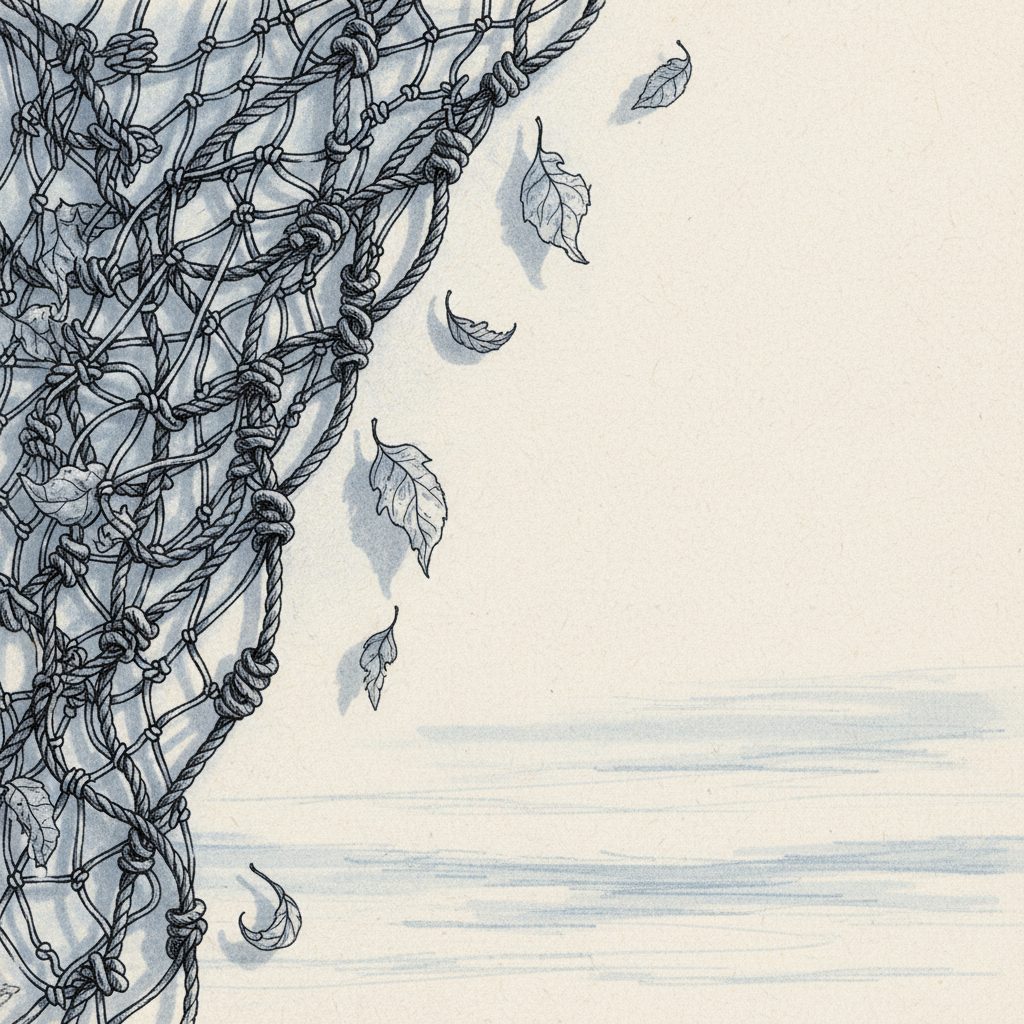
The cloud is citta gathering in the sky of the heart, and Swamiji clearly enjoys the meteorology. The wind that moves it, breaks it and re-forms it is vasanas. Out of it, expectations flash like lightning: sudden insights, sudden desires, sudden new estimates of your life. And what it finally rains is adversity, because both outcomes drown you. Frustrated expectation drowns a person, and so does the fulfilled one. Wait a few days after the lottery, he says, and look again.
The remedy for the cloud is vairagya, developed by repeated renunciation, and he is precise about the mechanism. Dispassion is not weather. It is light entering the cloud, so the moisture goes and there is no cloud left to disperse.
The net is the tightest of the six. Thoughts and desires are its ropes and strings; good and evil karmas are its knots; and what it ties is the soul to the idea I am the body. Every body is called sarira, that which wastes away, and deha, that which burns. The net is cut by jnanagni, the fire of wisdom, in which the very seeds of karma are roasted so that no further karma can be made.
Vairagya and Para-Vairagya
Vasistha closes the section with a rule rather than an image: “Just as the fury of one weapon is fought by another similar weapon in the same manner, an impure mind is overcome by a pure mind.” Not by suppression, and not by having no mind.
The road is vairagya, which Swamiji defines functionally. It grows together with mastery of mind and senses, and neither comes first. As long as there is strong raga, attachment, the senses cannot be governed; as the mind loses its trust in objects, control arrives on its own.
For what that looks like from outside, he gives the standard illustration and does not labour it. Rama is told he is to be crowned king of Ayodhya, and receives the news as though nothing has happened. The next day he is banished to the forest, and receives that the same way. The point is not stoicism or indifference. It is that a mind no longer trading on outcomes has nothing in either announcement to react to, which is why Swamiji frames the goal as a state where no incoming news disturbs you, whether it reports a great gain or a sudden loss.
He also gives that state its name here, and it is worth separating from a common misreading. Manonasha does not mean the mind has been destroyed or emptied. The mind is there, he says plainly. What has ended is its capacity to obstruct your awareness of what you are, which is why the phrase he reaches for is not a formula to repeat but something closer to a recognition: I am that am I.
And vairagya has a further reach, para-vairagya, which he leaves as an image rather than a definition, and which is the best sentence in the lecture. You are watching a film and the story is unpleasant, so you change the projection to a better one. That is vairagya. “Change coming in your dream is one type of vairāgya. Moving, waking up is para-vairāgya.”
Terms in this lecture
- Cit — pure consciousness. Here, what remains when the mind is taken away, and therefore what Vasistha means by the heart.
- Vichara — enquiry into the nature of the Self, the practice that drives the crow from the nest.
- Vasanas — latent subtle desires. The crow’s feathers, and the wind that moves the cloud.
- Trishna — craving, wed to the pisacha on the tree of ignorance.
- Mahavakyas — the four great utterances of the Vedas: Prajnanam Brahma, Tat Tvam Asi, Aham Brahmasmi, Ayamatma Brahma.
- Punya and papa — merit and demerit, good and evil karma; the snake’s two fangs.
- Citta — the mind-stuff taken as a whole; Swamiji notes it is used synonymously with mind throughout the section.
- Marghat — cremation ground, where the vulture roosts and where body-identity lives.
- Bhuma — the infinite, the only wealth that is not another’s.
- Jnanagni — the fire of wisdom that roasts the seeds of karma and cuts the net.
- Vairagya and para-vairagya — dispassion, and the dispassion beyond it. Changing the dream, and waking from it.
Questions for reflection
- Of the six portraits, setting aside which is most striking, which one actually describes how your mind spent this week?
- Swamiji says good karma that inflates the ego buys an astral holiday rather than freedom. Where in your practice is the merit being counted?
- The crow has the whole sky and no interest in it. What is the nearest and least thing your attention returns to when nothing is asking for it?
Yoga Vasistha, Upasama Prakarana, Section 50. Lecture 190 by Swami Jyotirmayananda, Yoga Research Foundation.
The complete archive of Swamiji’s lectures is free to all.
This study guide is drawn from the archived teachings of Sri Swami Jyotirmayananda.