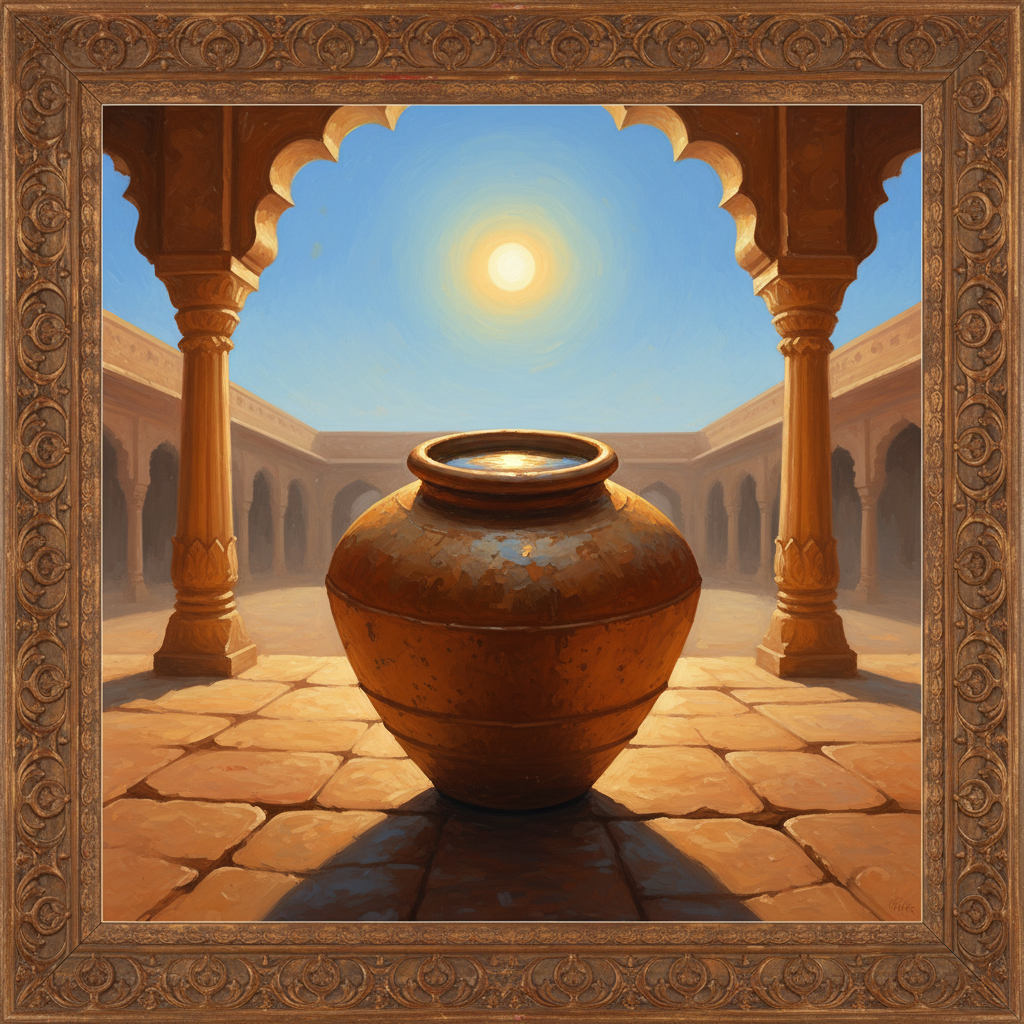
This class continues Section 53 of the Upasama Prakarana, where Sage Uddalaka practices spiritual affirmations as part of vichara, reflection on the question Who am I? Swami Jyotirmayananda opens with the image that governs the whole lecture: the ego is a sun reflected in a jar of water, asking the water to tell it who it is. Dirty water dims it, shaking water shakes it, a cracked pot leaves it lost, while the real sun is never touched. From there the lecture reads life as sangrama, a battle, and Swamiji finds the answer to the battle inside the word itself: come back into tune with Rama, Brahman within. The warrior image is taken as allegory, and it yields the line that opens the video: “Be a warrior, not a worrier.” Worry is fought with japa, meditation, satsanga and good deeds. The chitta, in turn, is a cloud that lets a ray of sunlight through and slowly allows itself to melt. The distinction the lecture turns on arrives with the text’s claim that body and mind are mutual enemies, with the soul caught between them like a person walking between two archers. Swamiji’s subtle point is that the idea “I am the body” does not live in the body at all. It lives in the mind. So the remedy is manonasha, the destruction of the mind, which he reads figuratively as a mind made healthy and turned toward liberation. Ending the body resolves nothing, because the mind goes on and creates another. The last part of the class turns the quarrel into cooperation. In Integral Yoga, body and mind work together as fire and water do in making tea, toward the twofold purpose of bhoga, enjoyment, and apavarga, liberation. Swamiji describes heaven, where the mind has no body to limit either pleasure or pain, and lands on the mature devotee who is invited to heaven by Indra and tells him goodbye, because Rama is waiting.
Where each passage begins
- 00:00 Be a Warrior, Not a Worrier
- 02:23 Section 53: Uddalaka Asks, Who Am I?
- 03:58 The Reflected Sun in a Jar
- 05:14 Sangrama: Life as a Battle to Rejoin Rama
- 16:22 The Cloud That Lets Itself Melt
- 19:06 Body and Mind, Mutual Enemies
- 22:33 The iPad and the Idea “I Am the Body”
- 29:25 Manonasha: A Mind Made Healthy
- 33:25 The Mind Outlives the Body
- 37:03 Integral Yoga: Fire, Water and Tea
- 39:30 Bhoga, Heaven and the Limits of the Body
- 46:56 Moksha: Goodbye to Indra
Uddalaka’s vichara and the reflected sun in a jar
Uddalaka’s affirmations are part of vichara, and Swamiji names the difficulty they meet: the mind spends all its energy serving an I it has never examined. “You don’t know who this I am is.” “But one way or the other, the mind is busy trying to help the idea.” “Egoism I am is reflected sun in a jar.” It asks the water who it is, and the water can only limit its shining. “dirty water and the sun loses its effulgence.” “shaky water and the reflected sun is shaking.” “cracked pot and the reflected sun doesn’t know where to go.” “So that’s the predicament of soul. Soul that is not enlightened.” It is defined by the mind and helped by the senses, and neither can tell it what it is. The senses, Swamiji adds, have their own agenda. “The senses are ever interested in the fulfillment of their appetites.” “They do not care for the good of this fictitious ego.” He compares them to horses in a chariot that have come to a disintegrated state. “Horses have developed their own whim.” “Don’t care who is the chariot driver.”
Jivanmukti: knowing the sun from the reflection
When the reflected sun knows it has nothing to do with the pot or the water, that revelation is the goal of life. “That’s a state of liberation, jīvanmukti.” The liberated person works with the body and faces every challenge while seeing it all as a dream. “The more you understand it’s like a dream, the more it becomes a sport.” No matter how wonderful a dream may be, it has no reality, and no matter what happens in it, the spiritual identity is not touched. “Sun is ever untouched.” Swamiji points to a proof everyone has. “And you experience this unwittingly in your deep sleep.” Whatever worries were faced during the day, “When you are in deep sleep, all is gone.” “And even if all this goes away, you are just the same.”
Sangrama: the battle and its answer
“Life is considered a constant battle.” The Sanskrit is sangrama, jivana sangrama, the battle of life. Swamiji reads the word in two parts: to be in tune with Rama, after having gone out of tune. “Sangram is a battle as well as the answer to the battle.” “Come back to the tune with Brahman, God within you.” “And that’s the whole project of your life.” “Rāma means Brahman, God, the Absolute.” Sangrama is the constant urge in the human personality to be united with God, and in that effort one is a warrior. He insists on the allegory. “Take the warrior in a literal way, it’s a miserable statement.” “You may be weak in your body but you may be strong in your battle.” The lesson drawn from the soldier is the spirit of sacrifice and the refusal to be defeated.
Be a warrior, not a worrier
From this example comes the passage the video opens with. “Be a warrior, not a worrier.” “Worry is normal, but being just a worrier means you stay satisfied with your worry.” The weapons are named plainly: “Fight your worry by your japa, your meditation, satsaṅga, by good deeds, by doing integral yoga.” “Then you are a warrior.” The worrier is the one who does not fight. “But you don’t fight at all. Just succumb to your mental worry and anxiety.” “Don’t be a defeatist.” “Sacrifice yourself as a hero.” That, Swamiji says, is good for the soul. The text then gives the image in its own words. “A warrior detaches himself from his dear relatives in order to allow himself to be sacrificed in the battle for the sake of winning higher worlds.” “Similarly, the citta detaches itself.” “The mind learns to detach, not to be hampered by seeing the face in a mirror.”
The cloud that lets itself melt
Having accepted its own destruction, the chitta in spiritual movement allows itself to melt away like a cloud. “The cloud has allowed a ray of the sun to pass through it.” That means Integral Yoga is succeeding to a degree, and an urge develops to shine more. “The cloud develops a strange type of ego.” “It begins to experience how wonderful am I.” “The fringe of the cloud is better than silk and dress. Shining, shimmering.” “Other cloud tells it, if you do that, you’re going to melt away.” The cloud does not even listen. That is the mind deeply involved in meditation: the more it subsides, the happier one is. “Now the mind carries profound objective, love of God, collecting spiritual virtues.” “Being good to all, not one or two.” All of this becomes possible as the mind turns toward the question. “Who am I? Ahaṃ brahmāsmi. I am Brahman.”
Body and mind as mutual enemies
The text now states its central difficulty. “Mind and body are mutual enemies.” While the two are in constant conflict, “Jīva, soul, finds no happiness in their presence.” The soul receives complaints from both sides. “Body complains against the mind.” “The soul doesn’t know what to do.” The text’s image is exact. “A person who comes between two soldiers who are discharging arrows at each other must suffer from the arrows of both parties.” “Again and again the soul tries to bring harmony between body and mind.” “The soul suffers from the miseries caused by both the body and mind.” Just as a child imagines a ghost, “the mind first imagines the existence of the body and then inflicts it with various miseries”.
The iPad and the idea “I am the body”
Here Swamiji gives the subtle point: the body is not separate from the mind. Under anesthesia before surgery, the brain is not operative and the whole body is put into an unconscious state. “Brain and nervous system is like the iPad.” “The iPad can bring many good things.” “But there is not a single touch that’s real.” “The idea I am the body is not in the body at all.” “It’s in your mind.” “All your study of your body is sustained by your mind.” How tall you are and every detail of the body is held by the mind only. He adds a caution: “All this teaching is from a very advanced level, so one has to be very careful.”
Near and dear ones and mirage water
For most people, “Body is the most focused highlight in your mind.” Its network entangles the soul, centered on the near and dear ones. “They are the source of biggest trouble.” “Mind that is meant to open itself to who am I to discover I am That.” “That mind is now brought into a mud puddle of who is my near and dear one.” “How can I secure my money? What can I do to prolong life and beat death?” “None of these can be realized because you are dealing with illusion.” “You cannot secure Mirage water in your refrigerator.”
The dull-witted son
The text’s next image is family. “Though the body is like a son to the mind, and mind is like the father.” “Your mind is constantly giving affection to the body.” When the body is tired, the mind lets it sleep. “Yet this dull-witted son is ever desirous of hurting me.” Swamiji recalls Aurangzeb as a historical example of a son who outwits his father and “Puts the father into prison for his sake, for his own advantage.” The relation runs both ways. “Mind gathers karmic seeds on the basis of the body.” And the body in turn generates karmic entanglements for the mind, so that they hurt each other. The mind-body relation creates samskaras, impressions backed up by illusion.
Manonasha: a mind made healthy
The text says that only through the destruction of the mind can the body become free from its troubles. “Destruction of the mind is called manonāśa.” Swamiji explains at once that “destruction is a figurative word.” It means: “Allow your mind to come to a healthy state.” A mind focused on the purpose of life. “Mind focused on who am I.” “It’s liberation.” When that enters the mind, the physical body and its troubles lighten. He points to the lives of sages and saints, who went through many physical challenges. “But physical challenges didn’t stop their progress.” “The state of the physical body was not a hindrance.” “You are with your body, body goes away, you are not going away.” “You are totally different from what the body is.” Everyone has seen what has happened to the body in this life. “Your body was just a small book edition in the beginning.” “Now it has grown up to a totally different size.” One is progressing through the body without depending on it. So the body is kept healthy, but “not to be recognized how wonderful body I am.” The aim is to recognize I am not the body. “And ultimately it is being pointed out, you are neither the body nor the mind.”
Why ending the body resolves nothing
Since the body stresses the mind, Swamiji names a third-class resolution: get rid of the body and the troubles are over. “But that’s the worst mistake.” “Mere destruction of the body does not cause the destruction of the mind.” “Your mind continues with the illusion.” He says that this mistaken idea lies behind taking one’s own life, and that it creates more trouble than it ends, because the mind takes another body and the same mental problems follow until a right track is found. “So simple point, removing the body is not the resolution to mental problems.” “This process continues until mind is enlightened.” When the mind becomes enlightened, “The body is no longer needed. The purpose of the body is over.” “You are pure consciousness.” In its extended form that is sat chit ananda. “Mortality is an illusion.” “The togetherness of the body and mind is meant to lead the soul to the state of enlightenment.”

Integral Yoga: fire, water and tea
The healthier way of handling body and mind is Integral Yoga. “The body is now led to practice āsana, prāṇāyāma.” Pratyahara and the other disciplines begin with the body. “And as these disciplines go on with your body, your mind goes on developing purity.” The mind has three problems to resolve. “Mala, gross impurity.” Vikshepa, subtle desires that are not pure. “And āvaraṇa, that’s ignorance, veil of illusion.” All three are overcome in and through the mind. The text’s image for the cooperation is fire and water, which “though opposed to each other, work together in cooking food.” “Body is like water, mind is like fire.” Enemies so far, they are used by one practicing sadhana. “You talk to them, integrate them, and you get tea.”
Bhoga and apavarga: heaven without limits
Body and mind work together for a twofold purpose, bhoga and apavarga, enjoyment and moksha. Bhoga begins with knowing that good karma brings prosperity. “So now you turn your mind to good karmas.” “But virtuous deeds not for liberation.” The formula is simple: more virtuous deeds, “more eating creams. I’m joking.” “more delightful pleasure.” The scriptures develop this into work for svarga, astral pleasure, where the body is gone and the mind enjoys. Here the body turns out to do a service. “When body is not there, mind’s enjoyment is unrestricted.” “As long as your body is there, mind limits your enjoyment and limits also your pain.” After death, “Mind has no way of limiting it.” “Mind suffers from pain in a profound way.” “But that fortunately doesn’t stay long.” After the astral plane, one comes back into embodiment. “To the masses, this is all they want.” “But deeper level, don’t be fooled by Swarga.” In heaven, “There is no limit. You can drink a whole ocean.” “In brief, Bhoga is not the goal.” Relatively, it is better to work for bhoga than for naraka, hell, where anger, greed and hate await a suffering with no limit once the body is gone.
Moksha: goodbye to Indra
The next level is moksha. Let prosperity blend with devotion. “The more prosperous, the more thankful you are to God.” The mind switches from worldly prosperity to real spiritual prosperity. “Your whole heart now becomes a garden of virtues.” “instead of your bank being lots full of money.” “When the citta is destroyed, the cycle of birth and death terminates.” “That’s called mokṣa.” Be good enough to deserve heaven, but once heaven is secured, “Go further step, don’t be tempted by it.” “Move forward to liberation.” In the old stories, Indra invites a devotee of many good deeds to heaven. “And if he is really mature, he says to Indra, goodbye to you.” “Rāma is waiting for me”. “But when citta is intensified through egoism, attachment and hatred, it gives rise to numerous embodiments.” Keep the chitta creating karmas and the cycle repeats, as it has through many lives. “If you like it, bravo.” The class closes with the chant of peace.
Terms
- vichara — reflection on who I am and what the reality is; the setting of Uddalaka’s affirmations
- chitta — the mind stuff, the whole total mind process
- sangrama — battle; read by Swamiji as coming back into tune with Rama
- jivana sangrama — the battle of life
- jivanmukti — liberation while living in the body, seeing the world as a dream and a sport
- jiva — the individual soul, caught between body and mind
- manonasha — destruction of the mind; figuratively, a mind brought to a healthy state
- samskaras — impressions in the mind, created by the mind-body relation
- sat chit ananda — existence, consciousness, bliss; pure consciousness in its extended form
- mala — gross impurity of the mind
- vikshepa — subtle desires that agitate the mind
- avarana — ignorance, the veil of illusion
- bhoga — enjoyment, the fruit of good karma
- apavarga — liberation; with bhoga, the twofold purpose of body and mind
- svarga — heaven, astral pleasure where the mind enjoys without a body
- naraka — hell
- moksha — liberation, when the chitta is destroyed and birth and death end
For reflection
- When Swamiji says the reflected sun asks the water who it is, what in the lecture plays the part of the dirty water, the shaking water and the cracked pot?
- Why does Swamiji insist that the idea “I am the body” is not in the body at all, and how does that change what he means by manonasha?
- In the closing story, why is the devotee who tells Indra goodbye called mature, after Swamiji has just said it is better to work for heaven than for hell?
About this lecture
Yoga Vasistha, Upasama Prakarana, Section 53. Lecture 198 by Swami Jyotirmayananda, Yoga Research Foundation, recorded December 11, 2019. The complete archive of Swamiji’s lectures is free to all.
This study guide is drawn from the archived teachings of Sri Swami Jyotirmayananda.