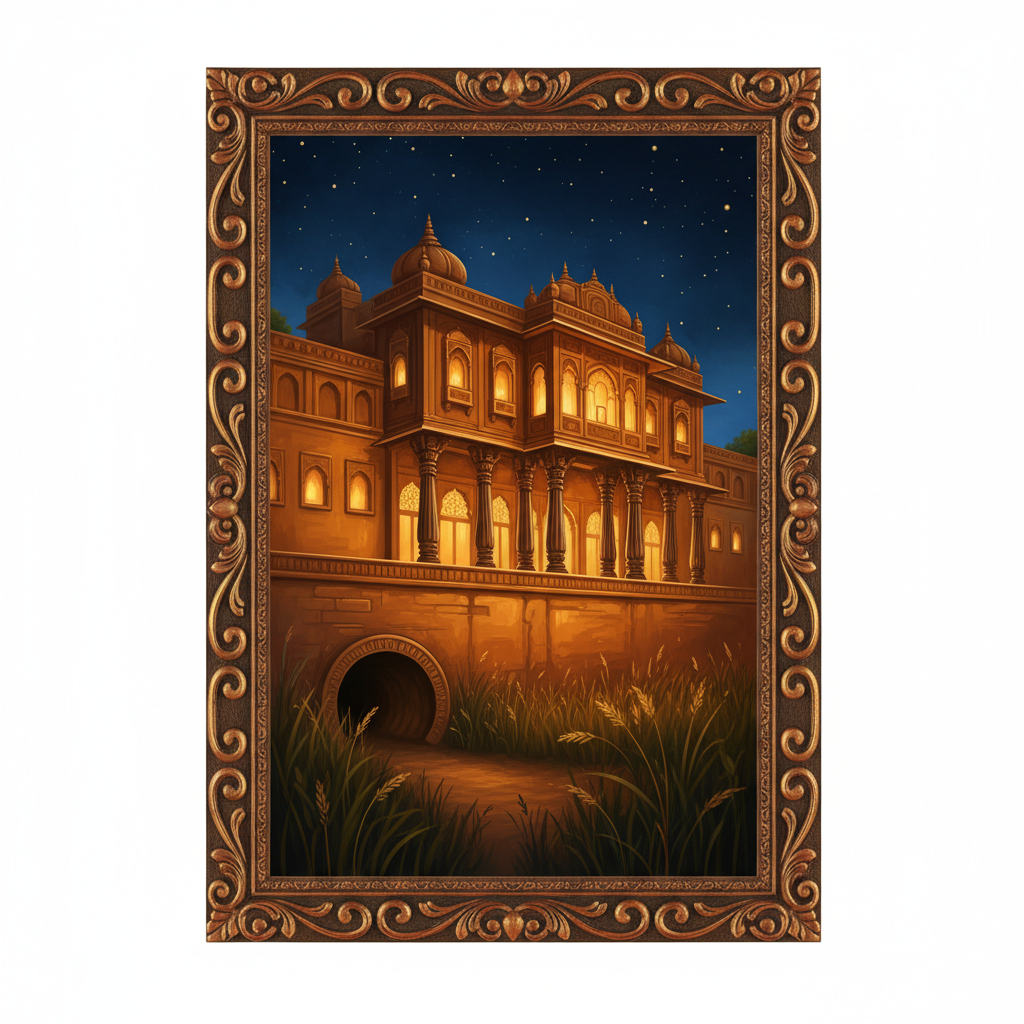
This class finishes Section 53 of the Upasama Prakarana, where Sage Uddalaka continues his reflection on the question Who am I?, and then opens Section 54, where he sits down to meditate on Om. Swami Jyotirmayananda begins from a single claim: the urge to know who I am is the instinct behind every other desire, distorted by the vasanas, the subtle desires of the unconscious, as sunlight is broken up by a cloud. The first half of the lecture follows that cloud. A dense cloud hides the sun; a softer one lets a ray through, briefly grows proud of its own shimmering, and then dissolves. That dissolving is manonasha, the destruction of the mind, and Swamiji is careful with the word. Nothing is smashed. The mind subsides the way a person lets the world go in deep sleep, and illusion yields to light rather than to force. Two stories carry the middle of the class. From the Mahabharata comes Lakshagriha, the house of shellac built to burn with the Pandavas inside, and the tunnel they dug without telling anyone: the body is the house, and the tunnel is daily inquiry and meditation. Then come the text’s own similes of the king and the lion. Two achievements are distinguished here, manonasha and vasana kshaya: the calming of the mind, and the final dissolving of subtle desires so that they never form again. The result is pictured as butter that will not blend back into milk, and as the swan, hamsa, that separates the essence from what has been mixed into it. Swamiji then corrects a common error. Growth does not mean shutting out joy. Turning away from all delight is the kindergarten stage of religion; seeing God in everything one loves is mature religion. Section 54 is practical. Swamiji explains the letters A, U and M with the silent fourth, Turiya, the individual and cosmic levels each letter stands for, and the Yoga Vasistha’s own pranayama of three and a half syllables.
Where each passage begins
- 00:00 The Ice Cream Dream and the Vulture
- 02:28 Section 53: Who Am I?
- 06:07 Vasanas, the Clouds Before the Sun
- 15:57 Manonasha: Light, Not Might
- 17:27 The House of Shellac and the Inner Tunnel
- 26:25 The King and the Lion: Where the Mind Cannot Go
- 31:04 Butter and Milk, Swan and Duck
- 34:49 Spiritual Life Does Not Shut Out Joy
- 40:58 A Family of Divine Virtues
- 44:17 Section 54: Uddalaka Meditates on Om
- 48:33 Vishva, Taijasa, Prajna and Turiya
- 55:12 The Pranayama of Three and a Half Syllables
Who am I: the best instrument and the most vital question
Uddalaka’s reflection is given, Swamiji says, as an example of how to let the mind work on the most substantial value of life. “Your mind is the best instrument you can get.” “Don’t use your mind for worst reasons.” It is meant above all for one inquiry, because nothing is more important to anyone than the one who asks. “Then who are you?” “You don’t respond back, who are you? No. Who am I?” When the desires for the objects of the world are destroyed, the first discovery is one of value. “You are of greater value than all the objects of the world.” “Who am I is most vital.” Among the countless illuminations of the sun, only the sun is important; the rest are its appearances. “This point is not easy to grab.”
Vasanas: the clouds before the sun
Every desire, in this reading, is that one urge in disguise. “The instinctive urge to find who am I has become distorted.” “It’s like this light of the sun gets refracted through a cloud.” “The instinctive urge of who am I has become distorted by your vāsanās, subtle desires of your subconscious, unconscious.” Their purpose is stated plainly: “subtle desires exist only to be dispersed in the vastness of the self.” A dense cloud blots out the sun completely. Spiritual life begins when the cloud softens enough to allow a single opening. “But come to softer, not all soft, but just allow a little hole in that black cloud.” The same desires that held a person to the world now turn him toward practice. “How you see the same mindset suddenly inspires you to practice meditation.” “Now allowing the glory of the sun to leak through the subtle desires.”
The cloud that grows proud of its light
Here the allegory turns playful and exact. “Cloud becomes egoistic. It discovers how wonderful it is. Looks around its body.” “The more it sees itself shimmering with the light.” Yet the light keeps passing through, and “the little group of swirly cloud is dissolving.” The other clouds warn it to stop, and it answers them from its new pride. “None of you is like me.” “Get out of my way.” What Swamiji points to underneath the joke is self-effacement experienced without any stress, “with a sense of diving into divine expansion.”
Deep sleep and the declaration without a tongue
None of this is unfamiliar. Every night, “You are suddenly leaping out of the world of turmoil.” “All things that you like, they are being wiped away from you.” What happens daily without awareness, the seeker now allows to happen with conscious awakening. “So just like you go to sleep, the entire world moves away.” “You go to deep nididhyāsana, profound vicāra.” And then the answer to the question. “Not the body, not the mind, not the intellect, not the ego.” “Not the past, not the present, not the future.” “Time, space, beyond all, I am.” “And that declaration is without a tongue.” Uddalaka’s own words follow: whether the body of blood, flesh, marrow and bones exists or not, “It is of no consequence to me.”
Manonasha: light, not might
“The mind melts away, mind subsides.” That is what is meant by destruction of the mind. As light passes through a cloud, one way of describing it is to say the cloud is destroyed. In the same way the mind, released from the clutches of the ego, is permeated by light until it has no substance of its own. “willingly, sahaja, spontaneously the mind has allowed itself.” It comes to the state “where mind becomes unmind.” So the word nasha must not suggest violence. “You’re not destroying anything.” “Illusions are not handled by might.” “They are handled by the light of truth.”
The house of shellac and the inner tunnel
The usual answer to who am I, “I am the body,” Swamiji calls a miserable predicament. “It’s just like a person living in a house.” “that’s inflammable at every step.” “Mahābhārata gives an allegorical story called Lakṣāgṛha, the house of shellac.” The Pandavas were lured to live in a house plotted by a demonic personality, and it looked wonderful and delightful. “But the Pāṇḍavas started scratching the house here and there, especially Bhīma.” “When he scratched, he discovered everything is inflammable.” They planned how to outfox the plot, and they did it quietly. “They started building up an inner tunnel.” Swamiji draws the lesson at once. A trip in the world is announced to everyone; an inner trip is not. “Don’t start calling everybody. I’m going to practice meditation. Come with me.” “So, that inner tunnel is the practice of your vicāra.” “Your inquiry, your meditation. Thereby you create a whole tunnel.” “And this house of shellac, your body.” Blood, flesh, marrow and bone: none of it is going to stay stable. “And who is keeping the eye on it? The spirit of death.” The tunnel changes that. Even while alive, Swamiji tells the student, “You are not confined or restricted by that house of shellac.”
The ridiculed reflection and the interrupted dream
Uddalaka now says the predicament of confinement to the body no longer touches him. “This predicament used to be my enemy.” “I’m not the body.” A reflected sun is ridiculed for always shaking, “But when it realizes I am the sun.” “All ridicules mean nothing.” The mind, by contrast, is never at rest. “It’s mind’s problem. It wants to get fulfilled through the body.” In a dream it eats all the ice cream it wants. “But suddenly a vulture flies by and you are interrupted. You wake up.” “What happened to all your ice cream? What happened to your mental fulfillment?” “That’s the story of the mind.” Wonders and miracles of fulfillment have been experienced, and “All that remains as a story.” Against that stands one line. “You are the unshakeable self.” “You attain enlightenment, but you don’t know who attained it.” Even the whole story of bondage and release “is being pulled by this foxy mind.” “Beyond this, you outfox it.” “All this story doesn’t apply. All this is a myth. Mithya.”
The king, the lion and the rabbit: where the mind cannot go
The text gives two similes. “Just as lowly persons are not admitted before the presence of a king.” “In the same manner, the mind and senses have no access into the domain of the self.” Swamiji adds a caution. “This is nothing to highlight about the politics. Just a simile.” Then the second. “Just like a rabbit dares not come before a lion.” The point runs both ways. “Self cannot come within the domain of mind and senses.” Behind the mind and senses lie the subtle impressions of the unconscious. “Even in that domain of impressions and subtle desires, truth cannot come within that domain.”
Manonasha and vasana kshaya
Therefore two things are needed: manonasha, the mind calmed, and vasana kshaya, the dissolving of the subtle desires. “Vasanas are like soft clouds.” “They gradually go on disappearing as you go on spiritually advancing.” Until one discovers completely who I am, the cloud dissolves and forms again. “Enlightened, it dissolves and is not going to reform.” When both are cleared, the veil of illusion cannot exist.
Clarified butter and the swan
“Just as clarified butter is no longer a part of milk.” “In the same way, I am no longer related to the body, mind, and senses.” Churn milk and the butter comes out. The watery remainder may call it back, but it will not blend again. “It will not mingle with your old style.” “Old style mind, your mind is ordinary milk.” “And lo and behold, you’ve turned yourself into a swan.” In the old image the swan separates the essence from the water mixed into it. “It’s not a biological study. It’s allegory.” The swan is called hamsa, which Swamiji reads as aham sah, I am That. “Similarly, if you have come to that state of separating truth from falsehood.” “You are no longer the same, you are Hamsa. I am that.” “And the mantra goes both ways, Hamsa Soham.” His message in one phrase: become a swan, and do not stay a duck.
Spiritual life does not shut out joy
Uddalaka adds a line that is easy to miss. “I’m no longer related to the body, mind, or senses.” “However, they will continue to delight me.” “It is not a one-step movement. It’s a progressive movement.” “As you start doing it, now your delight has not gone away.” Told that real happiness lies in God realization, many people develop a conflict. “So some start getting suddenly disconnected from all their comfortable way of living.” “moving towards something painful, full of austerity.” “That’s an error.” Instead, “You begin to recognize divine in all relations.” “Now you are seeing God in the picture.” “So, all lovable things you are not going to shut out.” “Rather, you allow them to open the window to the source of all love.” The more harmony and peace in life, the greater the possibility of coming closer to God. “That’s mature religion.” Keeping the mind always under stress is the kindergarten stage, and “kindergarten stage has to be controlled with patience, you have to get out.”
The doctor who treats only the healthy
Goodness needs a world to be tested in. If one does good only to good people, what kind of goodness is that? “You are a doctor. You will treat only healthy people.” Goodness shines when it holds in difficult circumstances and challenging situations. The joy continues in the presence of neighbors, of family, of the whole worldly setup. “But only a deeper movement has gone on that nobody sees.” “You have detached from earthly values and becoming attached to the divine value inherent in all things.”
A family of divine virtues and eternal festivity
“I’m now surrounded by celestial beings in the form of divine virtues.” “They are my near and dear relatives.” The text names them. “Purity, fulfillment, compassion, universal love, truthfulness, wisdom, bliss, immutability.” Non-covetousness, all-pervasiveness and fearlessness join them. “These are now your big family.” The class was given in the week before Christmas, and Swamiji takes up the season. “You have constant festivity. You don’t wait for one day before Christmas.” This is a progressive movement, and no matter how many challenges arise or how close one comes to despair, “That’s your goal.”

Section 54: Uddalaka meditates on Om
“Sage Uddālaka adopted the lotus pose and with eyes closed began to practice meditation on Oṃ.” Here the Yoga Vasistha introduces pranayama for a practical purpose: beginning the journey to liberation with something as ordinary as the breath. The subtle practice is Om upasana: Brahman, on the basis of the revelations of the sages, presented to the masses as the mantra Om. “Om has three stages. A, U, and M.” “Your personality has three stages: physical, subtle, causal.” But Om is also transcendental. “It’s represented by a little dot in the Sanskrit literature, Anusvāra.” That dot implies transcending all. “Transcendent called Turīya, the fourth.”
Vishva and Virat, Taijasa and Hiranyagarbha
The A of Om is the first state of experience: I am the body. Swamiji asks that it be taken scientifically. “There is nothing that happens that does not relate to the entire universe.” “If you say I am the body, then you are universal matter.” “The whole universe and your body cannot be separated.” Identity with the individual body is Vishva; the physical universe is Virat. “So I am body, I am Virāṭ.” The U goes deeper. Where does the idea I am the body come from? “When body is paralyzed or anesthetized, you have no awareness of body.” “So body actually is mind.” A wave of mind belongs to the ocean of mind. “The moment you feel miserable, many begin to share your misery without you knowing it.” “The moment you are joyous, many begin to share your joy.” Identified with the individual mind, one is Taijasa, from tejas, light, because the mind is what lights up the body. Its cosmic counterpart is Hiranyagarbha. “Hiranya is gold, the mystic gold.” Swamiji’s counsel is practical. “So don’t confine your mind into your kitchen.”
Prajna and Ishvara, and the fourth
The M reaches beyond the mind to the unconscious level, which keeps a subtle individuality and becomes as if one with God. “Not completely, but just as if.” This is Prajna, “A state where you have a special knowledge that you didn’t have in other states.” Its cosmic aspect is Ishvara. Through the three letters of Om one relates oneself to three planes: Virat, the cosmic body; Hiranyagarbha, the cosmic mind; and Ishvara, the cosmic causal body. “But that’s not the end.” Then comes the plunge into the transcendental, Turiya. “Mind is completely wiped out.” “There’s nothing but absolute reality.” “The only way you can express it through silence.”
The pranayama of three and a half syllables
“But all this begin with a simple pranayama.” “He proposed that there are three and a half syllables in Om.” “Think of Om as A plus O plus M.” Sit relaxed. On A, breathe out. “And first state, exhale. Feel free of stress.” “And while doing that, feel unity with the whole universe.” On O, breathe in, mentally focused on the sound and expanding, until “The expansion is that you are all mind.” On M, hold the breath. “Don’t breathe, don’t breathe in, nor breathe out, simply retention.” “Turn to your mind, sahasrāra cakra has opened, nectar is showering.” “When you are experiencing the showering, that’s the fourth step.” Then begin again, simply watching the breath, without bringing a hand to the nose. “This prāṇāyāma comes from Yogavāsiṣṭha.” The class closes with the chant of peace.
Terms
- vichara — reflection, inquiry into who I am; the inner tunnel of the Lakshagriha story
- nididhyasana — profound meditation, in which the world moves away as in deep sleep
- vasanas — subtle desires of the subconscious and unconscious; the clouds before the sun
- manonasha — destruction of the mind; the mind subsiding into unmind, by light and not by force
- vasana kshaya — the final dissolving of subtle desires, so that the cloud does not form again
- sahaja — spontaneous, natural; the way the mind willingly allows itself to subside
- Lakshagriha — the house of shellac in the Mahabharata, built to burn; an image of the body
- mithya — false, illusory; the whole story of bondage and release seen from beyond the mind
- hamsa — the swan that separates essence from water; read as aham sah, I am That
- soham — sah aham, That am I; with hamsa, the mantra that goes both ways
- Om upasana — meditation on Om, Brahman presented to the masses as a mantra
- anusvara — the dot over the letter in Sanskrit; in Om, the silent fourth beyond A, U and M
- Turiya — the fourth, the transcendental state where the mind is wiped out
- Vishva — the individual identified with the physical body
- Virat — the physical universe, the cosmic body
- Taijasa — the individual identified with the mind, from tejas, light
- Hiranyagarbha — the cosmic mind, the mystic golden light that lights the universe
- Prajna — the individual at the unconscious, causal level, as if one with God
- Ishvara — the cosmic causal level, God as Lord of all
- sahasrara chakra — the crown center, felt opening and showering nectar in the fourth step of the pranayama
For reflection
- Why does Swamiji insist that the Pandavas’ tunnel, and your own meditation, be dug without telling anyone, and what would announcing it cost?
- What separates manonasha from vasana kshaya, and why does a cloud that dissolves and forms again describe the stage before enlightenment?
- If lovable things are windows to the source of all love rather than walls to be shut out, what changes in the way you understand renunciation?
About this lecture
Yoga Vasistha, Upasama Prakarana, Sections 53 and 54. Lecture 199 by Swami Jyotirmayananda, Yoga Research Foundation, recorded December 17, 2019. The complete archive of Swamiji’s lectures is free to all.
This study guide is drawn from the archived teachings of Sri Swami Jyotirmayananda.