
The Merchant Who Bought a Dead Horse
A man travels to Arabia to buy the finest horse in the world. The seller, a famous dealer, tells him he has the best horse anyone could imagine, and then spends a full hour proving it: the nose, the ears, the mane, the legs. Nothing in the description is false. At the end of the hour the buyer asks the only question he has not asked yet. Is there any defect? There is only one.
That story sits at the centre of the second lesson of the Yoga Vasistha, and Swamiji uses it to describe something most listeners will recognise before they can name it. The first half of the lecture is not about the horse at all. It opens on the third of the three verses that begin the scripture, the verse on bliss, and makes an argument for it out of an ordinary night’s sleep. The second half is the text’s own story beginning to move: a young brahmana who stops performing his duties because two scriptural commands will not fit together in one life, his father’s refusal to answer him directly, and a king in the forest who is offered heaven and asks, first, what is wrong with it.
Between those halves is the horse, and the horse is the hinge. It is a joke, and Swamiji lets it be a joke, and then he turns it into the distinction the whole scripture is built on: between the path that goes out into the world and the path that turns back. Neither is described as a mistake here. One of them simply cannot deliver what people assume they are buying from it.
This is the second of thirteen early lessons that were recorded and then never published, and it is worth saying that it does not behave like a beginning. Lesson one opened the text. This one is already inside it.
The Passage Index
- 00:00 One Defect
- 00:51 Invocation
- 01:59 The Verse on Bliss, and the Innermost I Am
- 06:22 Every Delight Is a Drop of Ananda
- 10:06 Karunya Comes Home and Stops
- 13:10 Pravritti and Nivritti
- 16:36 The Merchant, the Horse, and the One Defect
- 19:19 Why Ochre Cloth Is Not Sannyasa
- 22:02 No Bhagna, Jagna
- 25:30 Agastya Answers With a Story Instead
- 31:35 Aristanemi and the Disadvantages of Heaven
- 42:26 Who Is Rama? Ascending Nature, Descending God
Bliss Is Not a Reward. It Is the Floor.
The lecture opens with the verse that invokes Brahman as bliss, the third after the verses on existence and consciousness, and Swamiji does not argue for it philosophically. He points at sleep.
Every night something takes your senses away from you. It takes your mind, your intellect, your ego, your imaginations and your sentiments, and it takes them completely. You lose the whole apparatus you normally call yourself. And you do not experience this as a loss. You wake up refreshed, you say you slept wonderfully, and if anyone asks what you got out of it you say you do not know, nothing.
That nothing is the point. At the root level of the personality there is nothing to worry about. Whatever is there when everything else has been removed is not a blank; it is the thing you return from rested. The scripture calls it ananda, and the argument is not that bliss is waiting for you at the end of a long practice. It is that bliss is what you are standing on, and you visit it involuntarily every night.
From there Swamiji extends it outward. Every delight anyone has ever had, he says, proceeds from that source: the delight of understanding something clearly, the delight of a feeling that gets answered, the delight of possessions and family and reputation. The scripture has a name for the last cluster, the three great urges, and Swamiji names them: the urge toward children, the urge toward wealth, the urge toward recognition. He does not disparage any of them. His image is meteorological. The ocean of ananda is up there, and what reaches the individual is a fine mist off it, a few drops, and that mist is what allows a person to endure a life that is not simple and to go on loving it anyway.
This matters for what comes later. When the lecture starts dismantling the outgoing path, it is not dismantling joy. The joy was never the problem.
Karunya Comes Home and Stops
The storyline begins. Sage Agastya is speaking, and he tells of a young brahmana called Karunya, son of Agnivesha, learned in the Vedas and the Vedangas, who finished his studies and came home. And then did nothing. He stayed in his father’s house immersed in confusion and abstained from the duties of life entirely.
His father, watching this, asks him plainly what the cause is. How can you attain anything if you remain inactive? Tell me why you have withdrawn.
Karunya’s answer is not laziness and it is not rebellion. It is a genuine contradiction between two things he has read and believes. The Upanishads and the Smritis enjoin that a person must perform the fire sacrifice and the daily rites for as long as he lives. The same body of scripture declares that liberation cannot be attained by wealth, cannot be attained by ritual actions, and cannot be attained through what one’s children accomplish; it is by renunciation alone that seekers reach supreme freedom.
So which is it? Should he stop every action and go and sit in a cave, or should he keep working? He puts the question to his father as a request for an ordinance: of these two, which is mine to follow? And in the meantime, unable to choose, he has become indifferent to all of it.
Swamiji pauses the story to note that this is not an exotic problem. It is Arjuna’s question in the Gita, asked in almost the same shape, as though action and renunciation were two different things standing opposite each other.
The Horse
Here the lecture gives its answer sideways, through the dealer in Arabia.
The description takes an hour and every word of it is accurate. Then the buyer asks about defects. “Sadly, the horse is dead.”
Swamiji applies it immediately, and the application is what makes the joke land twice. Pravritti, the outgoing path, will make you pass your examination. It will make you rich beyond imagination. It will make you powerful, and popular, and well loved. One defect: you will die.
And then he closes the obvious escape. Say it does not matter, because the good karmas are banked. Fine, go up a level. You will be born in a good family, you will have all of it again, and there is one defect. You can go on, horse after horse, and each one has such a defect. The pattern does not break by climbing higher inside it.
What the story is built to produce is viveka, the discriminating understanding that finally asks a different question: what would actually stop this recurring entry into birth and death, rather than furnishing it more comfortably?
Ochre Cloth Does Not Put You in Order
The answer given at that point is nivritti, the path of turning back, sannyasa. And Swamiji immediately removes the version of it most people picture.
“Simply becoming a sannyāsī, putting on ochre clothes and getting into an order, doesn’t put you in order.”
Ritual renunciation is a change of costume and address, and the scripture is not asking for one. The real thing is inward, and it is portable. You may be a king, a householder, a doctor, anyone at all. What matters is whether the spiritual movement has entered your life deeply enough that the fascination has gone out of what Swamiji calls, with some enjoyment, the world of where, why and when: time, space and causation.
He is candid that this is not easy to grasp, and that the mind, on first understanding it, usually produces a twisted version: that action must be pushed away and inaction pursued. That version is wrong in the same way the horse was wrong. It looks like the answer and it is the same trade.
Running and Waking
The distinction he uses to fix it comes from a Hindi saying, and it is the most portable thing in the lecture.
You are in a dream and something dangerous is happening. Your mind says run. A sage standing beside you says something else: “No bhāgnā, jāgnā.” Not running. Waking.
Pravritti, he says, is running. It is the constant movement from the present situation to some other one, on the conviction that arriving there will resolve the problem. Every karma performed for its fruit is a move from a difficult position to a slightly more comfortable one, and the running never terminates, because the next position also has a defect.
Waking does not depend on the fruit of any action at all. Which does not mean the action stops. Perform your duties, he says; that is perfectly fine. What changes is what the action is for. Done rightly, karma purifies the feelings; purified feelings make the will strong in a particular direction, not an ordinary will but one aimed at what is real; and the intellect stops being satisfied with verbal understanding and goes into intuition.
At that moment karma has become karma yoga. The feelings following the same movement become bhakti yoga, the will becomes dhyana yoga, and the intellect becomes jnana yoga. Behind all four there is one word, and yoga has four arms. They are interrelated, Swamiji says, like the notes of a vina. You cannot announce that you will do only one and push the others away; that is a narrow practice and it will not succeed.
The Story Inside the Story
The lecture then returns to the frame, and the frame turns out to be the teaching too.
When Sutikshna asks Agastya what path he should follow, Agastya does not answer. He says he will relate a beautiful story, and that his son should consider its significance and then do as he likes. Swamiji reads this as a deliberate art. A direct instruction from a father would be obeyed, and the obedience itself would be unbearable and would teach nothing. A story is a different matter.
And the story is designed to catch a young man’s attention: a heavenly damsel, Suruci, the best of the apsarases, seated on a Himalayan peak full of peacocks, with the Ganga flowing past. She sees a messenger of Indra crossing the sky and stops him to ask where he is going. Now the son is listening properly, and the suspense belongs to the character rather than to the father.
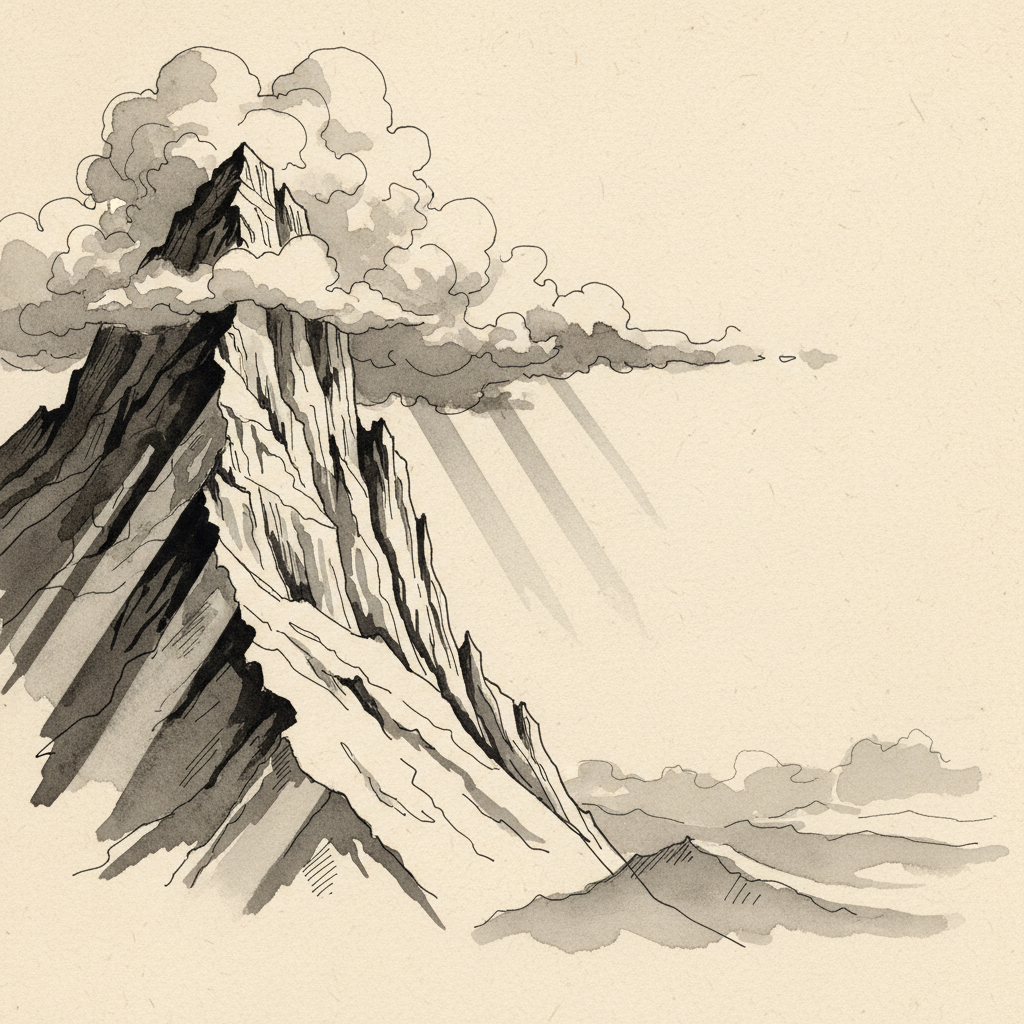
Inside that story is another. The Yoga Vasistha is famous for this, Swamiji notes, world within world and story within story, and the structure is itself an image of maya, whose illusions come in layers like a banana tree: you strip one, then another, and continue until nothing is left.
What Are the Disadvantages of Heaven?
The messenger’s errand concerns a royal sage, Aristanemi, who gave his kingdom to his son and went to the forest, and who is performing intense austerity on the fragrant mountain. Swamiji takes the mountain’s perfume as an image and applies it inward: the vasanas are the source of a person’s smell, and a subtle sweetness attends the good ones.
Indra’s instruction is to take the king a celestial chariot loaded with dancers, musicians and gandharvas. It is, as Swamiji points out, a lottery win of unimaginable size, and the ordinary response is to take it.
Aristanemi asks a question first. What are the advantages and disadvantages of the heavenly world? Tell me, and then I will decide.
The answer is the most quietly devastating passage in the lesson. Heavenly enjoyment is graded strictly by merit: the highest merit gets the highest delights, the middling gets middling, the lowest gets least. And nobody there is at rest, because everyone can see the ones above them. Those with great merit live near Indra’s palace and catch the fragrance of whatever is being prepared there; those with less wait for a chariot to be allowed a distant view of it. There is no contentment anywhere in the arrangement, only comparison, competition, jealousy and elation. And when the merit is exhausted, the souls witness their own fall and must take embodiment again.
The king declines. He would rather give up the body through austerity, as a snake sheds its skin and moves on, than ascend to that.
What happens next is easy to miss. Indra, surprised, sends the king to Sage Valmiki to be instructed toward liberation. The same power that offers the enjoyments promotes the soul upward once it has proved it deserves to go, and Swamiji puts it in one line: Indra leads the soul to Upendra.
Nature Ascending, God Descending
Valmiki tells the king he will relate the Ramayana that expounds the nature of indivisible Brahman, a dialogue between Rama and Sage Vasistha, and that listening to it will bring liberation in life. Swamiji clarifies the term: the simple Ramayana is the story of Rama and Ravana, while the Maharamayana is the body of teaching Rama received from Vasistha. That is the text we are in.
The king’s next question, who is Rama, opens the final movement. The answer arrives as allegory, and Swamiji reads the allegory rather than the surface. The Absolute cannot be approached directly, so it is approached through form; the same reality, through sattva-predominant prakriti, appears as creator, sustainer and destroyer.
And the reason for an avatara at all resolves into two movements that have to meet. Nature ascends, purifying itself; God descends, like a mountain growing upward while the light of the sun comes down to it. Swamiji is explicit that this is not only cosmic history. It has to occur in every individual. You allow your own nature to be purified and to rise, and along with it the descent happens, and what is left is a mind that no longer needs to be a mind.
The lesson ends on the curse between Sanatkumara and Vishnu, which Swamiji reads as the same thing in another costume: the chitta that is not humble and does not recognise the glory of what it belongs to, sent through a long evolution of impurity, distraction and veiling, with God going through the work of remedying all of it. He notes, drily, that to the masses this stays a story about somebody who did not stand up.
Terms in This Lecture
- pravritti — the outgoing path; action directed toward acquisition, achievement and enjoyment in the world.
- nivritti — the path of turning back; renunciation understood inwardly rather than as a change of dress or station.
- ananda — bliss; in this lecture not a reward but the substratum every delight is a trace of.
- viveka — discriminating understanding; the faculty that asks what a thing can actually deliver before pursuing it.
- sannyasa — renunciation; Swamiji distinguishes the ritual form from the inward reality it is meant to signify.
- bhagna — running away; movement from a difficult situation to an easier one, which never terminates.
- jagna — waking; the awakening that does not depend on the fruit of any action.
- sat sankalpa — a will whose strength is directed toward what is real, as distinct from ordinary willpower.
- vasana — the subtle latent tendency; the source, in Swamiji’s image, of a person’s characteristic fragrance.
- Maharamayana — the Yoga Vasistha itself: not the story of Rama’s deeds but the teaching he received from Sage Vasistha.
- avatarana — the descending movement of the divine, which meets the ascending purification of nature.
- chitta — the mind-stuff; represented allegorically by Sanatkumara in the closing story.
Questions to Sit With
- Which horse have you been describing to yourself, and how long has it been since you asked about its defect?
- Where in your week are you running from a difficult situation toward an easier one and calling it progress?
- If renunciation is inward and portable, what would it actually change about the work you did today?
Lecture 2 by Swami Jyotirmayananda. Yoga Vasistha, Vairagya Prakarana, Section One. Yoga Research Foundation.
The complete archive of Swamiji’s lectures is free to all.
This study guide is drawn from the archived teachings of Sri Swami Jyotirmayananda.