This class continues the Upasama Prakarana where the last one ended. Sage Uddalaka, his intellect settled by reflection on the question Who am I?, sits in the lotus pose, closes his eyes and begins to meditate on Om. Swami Jyotirmayananda turns the passage into a practice a student can follow, and then follows the sage to its end: samadhi, and liberation while still living in the body. The practice has two stages, one focused on prana, the vital force behind the breath, and one focused on the mind, and each supports the other. Breathing out is joined to the letter A, and the small world of limited identity is swept away. Breathing in is joined to U, a filling up. The M is rest and surrender, and the silence after the three letters is Turiya, the fourth, which is no longer a practice at all. Along the way Swamiji lays out the levels of identity the letters stand for: the body widening into the physical universe, the mind into the cosmic mind, the deep unconscious into God. An old allegory frames it. Sage Agastya drank the whole ocean in three sips, and the three sips are the three bodies, physical, subtle and causal, each seen as not the self. The second half gives two images worth carrying out of the room. One is a cinema show: the vampire’s mouth is full of blood, and one can scream, or smile, knowing it is ketchup and that the screen was never touched. The other is a mirror, and the three knots of the heart that keep a person from seeing his own face in it. The class ends with Uddalaka setting aside psychic powers as toys of children, and becoming jivanmukta.
Where each passage begins
- 00:00 Agastya Drinks the Ocean in Three Sips
- 02:30 Uddalaka Sits to Meditate on Om
- 04:42 Two Stages: Prana and Mind
- 06:09 Breathing Out: The World Swept Away
- 09:27 A Wave Cannot Wave Goodbye to the Ocean
- 13:47 Breathing In: Being Filled
- 15:03 Vishva, Taijasa and Prajna
- 20:35 Turiya, the Fourth
- 24:42 Still as an Ocean Without Waves
- 28:56 The Screen Behind the Show
- 35:09 Mala, Vikshepa, Avarana: Holding the Mirror
- 48:18 Siddhis Are Toys of Children
The ocean in three sips
The text reaches for an allegory, told so that people can read it and digest it easily. “Sage Agastya in ancient times had emptied the whole ocean by drinking it.” “How can you drink up the whole ocean? He drank it up in three sips.” The sips are three understandings. “When you allow your mind to understand, you are not the physical body.” That is one sip. Understanding that you are not the subtle body is the second, and that you are not the causal body, the third.
Uddalaka sits down to meditate on Om
Having settled his mind and invigorated his intellect, Uddalaka adopts the lotus pose and closes his eyes. “His chant of Om sounded like a bell, reverberating upwards.” “As you practice more, your whole spine resonates.” It promotes the purity of sushumna, the central channel. He chants until the pranas reach the crown of his head and he finds himself face to face with the Absolute. Swamiji lightens the phrase. It is like sitting down to face the sun: the sun is far away, and you simply settle yourself, without making a problem in your mind of how anyone could face Brahman. It is a matter of being mentally settled, nothing more dramatic than that.
Two stages: prana and mind
“The practical practice has two stages.” One is focused on prana, the other on antahkarana, the mind process. “If you control the mind, prana automatically becomes calm.” Prana is not the breath. “Breath is a result of prana within.” Controlling the breath helps harmonize the pranas, but how long one can hold it must not become the focus. “It is balancing the breathing process that allows prana to be controlled.” Ordinary pranayama has inhalation, puraka; retention, kumbhaka; and exhalation, recaka.
Breathing out: the world swept away
During recaka, breathing out, the mind turns toward an identity of the soul with the entire physical world, not just the body. The shift is not hard work. “It’s just like open your eyes and looking through the window, it’s a big area.” The letter for the outbreath is A, with a little silent H in it. “Feel you are shaking away all your world based on limited identity.” “And like a river entering into the ocean. It’s becoming the whole ocean.” In that widening one becomes Virat, the whole cosmic body.
A wave cannot wave goodbye to the ocean
Then attention moves to the O, and the mind relaxes. “Your mind is no longer confined to your room. It is expanding into universe.” How could anyone’s mind be separated from the universal mind? “You are always a part of the universe.” “If universal mind is ocean, your mind is a wave in it.” Swamiji catches his own phrase and plays with it: a wave “cannot wave goodbye to the ocean.” The student only touches this insight. “Detail operates automatically.” The last letter, M, is complete rest. “It’s very sweet.” “You are in the arms of God.” This is the level of Ishvara, the causal level of the universe.
The reality behind the body is mind
Swamiji gives the technical terms. The soul identified with the physical body is Vishva; its universal identity on the physical plane is Virat. The next level asks for some intelligence. There would be no body for you unless your mind told you so. “So, the reality behind your body is mind.” That mind is related to the cosmic mind behind every flower, every blade of grass and every star. How far one can relate to it depends on relaxing the mind from the clutches of the ego. It is a whole project. “If you don’t accomplish it in a few days, it doesn’t matter.”
Breathing in: being filled
“When you are breathing out, your heart becomes free of burden.” With the inbreath, attention goes to the ajna chakra, between the eyebrows. All incompleteness, negativity and emptiness is taken away. “Pūraka means filling up.” When the breath has come in, there is silence. “Surrender to God, Absolute Surrender.” Then breathe out again, through the same three stages, for perhaps half an hour or less.
Meditation: navel, heart, and the three identities
After the breathing comes meditation. Focus on the navel center and imagine its lotus resonating with Om, no longer divided into letters. “Total Om radiating from your navel.” Enjoy the feeling I am the entire universe. “If the entire universe is difficult, just choose any one other thing.” Be the air, or the clouds you once liked to watch. Next, turn to the heart. Identified with the mind, one is called Taijasa. “Taijasa means effulgent.” It is the inner light, tejas, that gives the body its brightness and joy. “If Tejas is there, your body is bright.” That light is universal, and the cosmic mind is Hiranyagarbha. “Hiraṇya means gold.” “Garbha is a womb.” The gold points to absolute truth. One develops the understanding of growing in the image of God. “I’m all intelligence spreading everywhere.”
Prajna, and the fourth
Identified with the causal body, one is Prajna. “Prājña has two implications.” In one sense it is being specially ignorant: the world does not exist for you. “Another meaning, all-knowing: Prājña.” It is the sense of being one with God, the source of creation, sustenance and dissolution. Yet “Your personal life has not ended yet.” Then comes the fourth aspect of Om. “Turīya, transcendental.” “The transcendental state is no longer your practice of prāṇāyāma, no longer your practice of meditation.” “It is samādhi.” One enters deep silence. How deep, he says, will depend.
What the scripture says: still as an ocean without waves
Swamiji returns to the text. “There are three and a half syllables in Oṃ.” Uddalaka meditated on the A with exhalation and saw his body become empty of the pranas. “Empty of the prāṇa simply means harmonization of the prāṇa.” The two stages work together. “Prāṇa helps your mind, mind helps your prāṇa.” When someone has shocking news to give, what do they say? “Sit down. Breathe.” As the prana relaxes, the mind takes over and the pranas “simply become humble, they become like pets.” In retention the aim is not duration but a mind so relaxed that holding the breath becomes natural. “So therefore rhythmic breathing becomes more important than abrupt breathing.” “He became still like the ocean.” He became cool and calm like a mountain covered with snow. “You didn’t send yourself to Himalayas, you became Himalayas. I’m joking.”
The elephant tied to a post
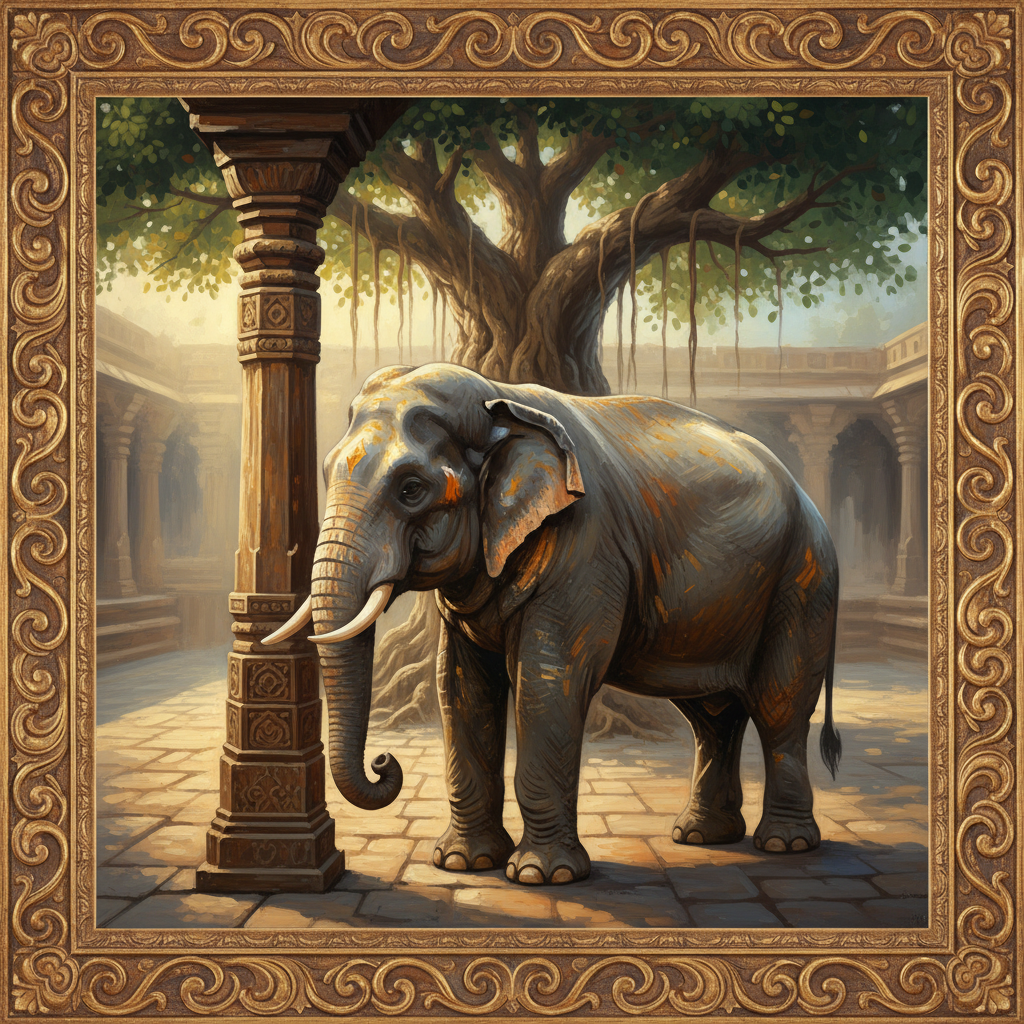
Then the sage turned to the half syllable, the transcendent aspect of Om. Pranayama stops, and upasana comes to its climax. He withdrew his senses and remained steady. “Even like a mighty elephant tied to a post.” “Don’t take it literally, just a picture.” Not a wild elephant, but completely steady: sthitaprajna. He purified his mind to attain nirvikalpa samadhi. As in deep sleep the world vanishes, but here you are not missing it. “Your sleep is perfect awakening.” With the purification of the citta, Uddalaka became established in the Supreme Self, the substratum of the world.
The screen behind the show
To make that substratum plain, Swamiji goes to the cinema. There are two ways to watch a show. One is for entertainment, enjoying the events, positive or negative, and allowing time for the show to come to an end. The other is to go to a deeper level and understand what is causing the show. “A vampire’s mouth is filled with blood.” Instead of being shaken by it, “you smile.” It is only ketchup. Even while experiencing the world, “You are not shaken by the world.” The world is not intending to hurt anybody, Swamiji says, even though that is not easy to understand. Every life is a challenge, and every soul goes through terrible situations, but in the end it is like waking from a dream in which you saw catastrophe, even your own neck broken. “Wake up, nothing has happened.” That waking state has to be understood, and moving away from bondage to the world is a progressive movement. The show depends on projections, and projections are caused by the mind. “The mind is creating this show.” This is why yoga is defined as the cessation of the thought waves of the mind. A vritti is not one small movement. “One little touch, the vṛtti opens up the whole Google.” “When mind itself dissolves. What is left then? Just the screen.” “All the time you were enjoying it, the screen had not gone away.” “The screen was the reality behind everything you experienced.” “And yet you were screaming at the pictures.” “But behind all that, there is nothing but Brahman.” Vedanta says the same with the snake seen on a rope: the projection is the snake, and the rope is Brahman.
Mala: the first knot of the heart
The movement from projection to the absolute has three steps: mala, vikshepa and avarana. “These are called granthis, knots of the heart.” Mala is gross impurity: anger, hate, greed, obsessive involvement in bodily existence, a philosophy of eat, drink, be merry and become powerful. No soul can stay without work. “Activity is designed for both, either to get more mala or clean up your mala.” Without purpose the soul grows dependent on the world and on its own past. “You are dependent upon your negative memories.” Regret and depression are the more powerful malas. “So karma yoga is the answer behind removing mala.” Activity must become interesting, purposeful and purifying. “And the mantra behind it, be good, do good.” Swamiji sets this against a life that only wants to exist by hook or by crook: gather enough money and spend the last days watching the setting sun. Karma yoga relieves a person of that predicament, because the same work that once added impurity now clears it away.

Vikshepa: the higher sweetness
There is also the level of feeling. “Feeling must turn to bhakti devotion. Bring sweetness in your heart.” Love is divine, and it is highlighted day by day through japa, satsanga and adoring God. Devotion removes vikshepa, the distraction of the mind. “So, devotion and meditation blend together, called upāsanā.” Once a person tastes the sweetness of fulfillment in the heart, a waffle is seen differently. “You go for the higher sweetness.” “Undistracted by the world, your mind goes on enjoying closeness with God.” Swamiji gives a frank picture of vikshepa in a seeker. Hearing of psychic powers, an immature mind runs in every direction: I want to be this, I want to be that. There are so many ashrams, each promising something new. “You are going everywhere purposeful, but you are not enjoying anything, not gaining any success.”
Avarana and the mirror
The third knot is avarana, the veil, like darkness. “Sun shines and darkness is not there.” When mala and vikshepa are sublimated the veil is no longer there, and “all that you have to do is lift up your head.” The mirror makes the sequence clear. “If you want to see your face in a mirror.” First, hold the mirror steady. “If your hand is shaking, your face will also shake in your mirror.” “So that karma yoga allows your hand to be steady.” Second, hold the vision steady, so the reflection does not flicker and you can recognize who you are; that is the work of upasana. “So the last stage is just a matter of lifting up your head now.” Swamiji notes why even that last step can be hard. After a long addiction to body identity and dependence on the realities of the world, the mind cannot quite believe what it sees. In a calm state it glimpses that one is universal and free of all, and then, unable to hold that understanding, it runs off in many directions again. The mirror has to be steadied more than once.
Steady as a lamp flame
The text now describes Uddalaka’s state, one with the Divinity, homogeneous, pure and eternal, an ocean of bliss. “He became steady like a flame of a lamp, unaffected by wind, or like a painted picture.” The images go on: still as an ocean without waves, or like a cloud free of moisture, melting away. “When it becomes secure, you are enlightened.” “As long as you are not secure and progressing, you are evolving.”
Toys of children
In long samadhi Uddalaka saw the Siddhas, beings of great psychic power, and the gods of the heavenly regions. The description shows how far this attainment exceeds the imagination of aspirants, who in early stages are drawn to such powers, even ready to give up their practice for a small attainment, like a pranayama said to let the body levitate. “One side is liberation, another side temptations of siddhis.” Between the sun and its illuminations, “the sun becomes your highlight.” The Siddhas offered powers capable of bestowing the glory of Indra, but the sage regarded them as toys in the hands of children. “They are toys of children.” “Alpam, little.” After six months absorbed in blissful samadhi, “he became jīvanmukta, liberated in life.”
Terms
- Om upasana — meditation on Om, in which devotion and meditation are blended
- prana — the vital force within; the breath is its result, not the thing itself
- antahkarana — the inner instrument, the mind process, the second stage of the practice
- recaka — exhalation, joined to the letter A, in which the small world is swept away
- puraka — inhalation, a filling up of all incompleteness
- kumbhaka — retention, in which the pranas are neither external nor internal
- Vishva — the soul identified with the physical body
- Virat — the whole physical universe, the cosmic body
- Taijasa — the individual identified with the mind; effulgent, from tejas, light
- Hiranyagarbha — the cosmic mind; literally the golden womb
- Prajna — the individual at the causal level, both specially ignorant and all-knowing
- Ishvara — the causal level of the universe, God as the source of all
- Turiya — the fourth, the transcendental state beyond A, U and M; samadhi itself
- sthitaprajna — one established in wisdom, steady as an elephant tied to a post
- nirvikalpa samadhi — the absorption the sage purified his mind to attain
- vritti — a thought wave of the mind, each one opening a whole world
- granthis — the knots of the heart: mala, vikshepa and avarana
- mala — gross impurity, removed by karma yoga
- vikshepa — distraction of the mind, removed by devotion blended with meditation
- avarana — the veil, which is no longer there once the first two are sublimated
- siddhis — psychic powers; toys of children beside liberation
- jivanmukta — one liberated while living in the body
For reflection
- Swamiji says prana and mind help each other: in your own experience, which usually settles first, and what does the other then do?
- Where in your life are you still screaming at the pictures, and what would it mean to watch that scene from the side of the screen?
- In the image of the mirror, which of the three problems is the one you most need to work on now: the steady hand, the steady vision, or simply lifting your head?
About this lecture
Yoga Vasistha, Upasama Prakarana, the meditation of Sage Uddalaka on Om. Lecture 200 by Swami Jyotirmayananda, Yoga Research Foundation, recorded December 18, 2019. The complete archive of Swamiji’s lectures is free to all.
This study guide is drawn from the archived teachings of Sri Swami Jyotirmayananda.