
This class continues the Upasama Prakarana, moving toward Section 54. Sage Uddalaka has completed his practice and attained jivanmukti, liberation while living. The psychic powers came before him and he was not tempted. Swami Jyotirmayananda, teaching on Christmas Eve, reads what follows beside the call to take up the cross. The class opens with a cinema show and the screen behind it, then lays out three ways of seeing God: with form and attributes, with attributes but beyond form, and beyond both, where every concept falls away and only Brahman remains. That is why, in the story, the gods come to bow before the sage. The sage then rises beyond joy and sorrow into a state the text calls Anananda, the joyless state. It is not sorrow. It is the end of every little joy measured against the infinite, and Swamiji gives the two words that measure it: alpam, the little, and bhuma, the infinite. Once a person has seen a garden of blossoms that never wither, a garden of thorns holds no interest, unless one happens to be a camel. The second half is practical. Swamiji offers an affirmation for meditation, a garden of golden-leaved trees full of swans. He distinguishes a passing mood, avastha, from the ground one stands on, sthiti, with the image of a tree that sways in the wind and does not break, and he uses the dream to show how the sage becomes everything that exists. The class ends with the seven steps to liberation given in the Yoga Vasistha, from aspiration and inquiry to asamsakti, living in the world untouched by it, like a hand rubbed with oil before cutting jackfruit. Its closing counsel is plain: do it now.
Where each passage begins
- 00:00 The Garden of Thorns
- 02:51 Christmas Eve: Taking Up the Cross
- 03:43 The Cinema and the Screen
- 06:42 Three Ways of Seeing God
- 13:16 Beyond Joy and Sorrow
- 15:27 Anananda, the Joyless State
- 18:05 Alpam and Bhuma: The Little and the Infinite
- 29:05 The Garden of Golden Leaves
- 31:18 Avastha and Sthiti: Sway, but Do Not Break
- 35:52 You Are Everything in the Dream
- 44:28 The Seven Steps to Liberation
- 50:09 Oil on the Hands: Untouched by the World
Taking up the cross
The class falls on Christmas Eve, and Swamiji offers the passage in that light, as the highlight of the teaching of Jesus. “Take up the cross” he says, and then draws out what it asks. “And be sure that you don’t exist after you take the cross.” “Self-effacement.” The one who has done this is jivanmukta, and he keeps the cross with him and continues to work. “Horizontal vision intercepted by the vertical.”
The cinema and the screen
Swamiji names the horizontal vision bhava pratyaya and goes to the cinema. Watching a show, one is involved with the pictures and the story, which can bring the absence of things or the presence of things. Yet the whole film is the presence of projection. “Presence of projection must move away to reveal what is the reality behind the projection. That’s the screen.” All experience, the whole story of evolution from bondage to release, belongs to the mind’s projections. When the mind has been withdrawn completely, there is nothing but the reality, which was supporting every experience all along. “Screen was the reality. If it was not there, nothing would shine forth.” “That screen is the light of lights.” “This is the central core of all religions of the world.”
Three ways of seeing God
The scripture describes gods, Siddhas and Lord Shiva presenting themselves before Uddalaka with their benedictions. To explain why, Swamiji turns to the ways the mind approaches Brahman. “When we think of Brahman, there are three stages.” The first is saguna sakara, God with form and divine attributes. That is how a seeker begins, and Swamiji is frank about it. “God made you and you are making the God. You are fashioning God in your image.” The sages allow it, because without an image that matches one’s practical reality, “You cannot even start anything.” Shiva, Rama, Krishna, Buddha, Jesus, all the forms of all the religions of the world, belong here. Going further, one may keep the form, but the deeper understanding becomes saguna nirakara, beyond form. “Form is only just like we were swimming, you need a support.” “So when you start swimming, support moves away.” Then the subtle point: “Actually we are always supported, you are not really swimming.” The third is nirguna nirakara. “Nirgun Nirakar. You are entering into a state where mind becomes completely calm.” One is moving from the show to the screen, and the mental concepts are no longer needed. “Automatically they drop away” “And there is revelation. Brahman alone is.”
Words that point a finger
A devotee may still use words for God, but the heart knows better. “You may be using words for God, but in your heart you realize all that you are saying is pointing a finger.” “God cannot come in your descriptions.” One person calls God absolute bliss, another insists on absolute, absolute bliss. “Third one may say, tell 100 absolute then say bliss.” “No matter what you say, the best you can say, but you have not really touched God.” That is the meaning behind the gods coming to the sage. “All Sagun Sakar aspects bow down to Nirgun Nirakar experience.” And a devotee of the formless has pleased Rama, Krishna and Shiva alike, speaking allegorically, because that movement “allows you to have the blessings of all gods and goddesses.”
Beyond joy and sorrow
“The mind of the sage rose beyond joy and sorrow.” Deep sleep gives a hint of this. One does not really go beyond the world in sleep, but “The world is veiled out of your vision.” The experience shows that the real self is not exhausted in the world of relativity, nor confined to waking, dream or deep sleep. Every night gives that lesson, and still the intellect looks elsewhere. “But human intellect is wild to go after politics and many other things of this world.” It does not ask Who am I? Through satsanga one turns to that inquiry, the most profound of all, because for the sake of the self everything else becomes dear.
Anananda, the joyless state
“He attained a state known as Anānanda.” Literally it means joyless, and the word is easy to misread. “What you think of your joy is so little.” The mind thinks of happiness as something having happened: one was deficient, gained something, and the deficiency was filled. “That type of joy is led by your karma.” So the usual hope needs correcting. “Spirituality will not make you happy nor miserable.” “Spirituality goes beyond your concept of joy and sorrow.” “So it is Anānanda, the joyless state, since it is the negation of all concepts of happiness.”
Alpam and bhuma: the little and the infinite
Gather all the happiness, progress and attainment the mind seeks in time and space. “It’s called Alpam, little.” Swamiji gives a simpler picture: the sun and all its illuminations. The illuminations seem more interesting than the sun, and all of them together, of all times, are very vast. “Can it equal this one?” “One side is little, another side is infinite.” One who has tasted the bliss of the Self is not tempted by the pleasures of the earth. Bodily existence will never be perfect, one cannot hold on to the things of the world, and they are not immortal either. “So the mortal one pursuing perishable things. That’s the strange predicament.” “The attainment is progressive.” What tempted one before stops meaning anything. “You got a child with so many toys, you see a better toy in another child’s hand.” “You’re tempted by it. You grow up.”
A cloud the sun passes through
For the liberated, the length of the body’s life means nothing. The sage is like “a cloud that has allowed the sun to pass through.” Only the sun passing through makes the cloud important; the cloud itself has no stability. “It’s an illusion.” Whether the cloud is there or not, the sun is not affected. “When in enlightenment, stay with your body as long as your karma maintains the body.” Swamiji adds a caution: this is the highest climax, and “Your movement is progressive with great patience.”
The garden of thorns
The text gives its own picture. One who has enjoyed heavenly gardens cannot revel in a forest of thorny bushes. Beside the bhuma, the world where happiness is little and everything ends in mortality looks like a garden of thorns. Offered a garden of blossoms that never wither or a garden of thorns, who would choose the thorns? “That garden will be interesting if we are a camel.” An emperor does not revert to poverty and humiliation. “All these are illustrations, don’t take it literally.” “Having attained enlightenment, no way can you slip back.”
Gods at the door
The gods then asked the sage to ride in their celestial chariots and grace them with his presence. Swamiji reads it as allegory. A life led by karma aspires to immense pleasure. “Not joy, not the bliss, pleasure.” That is Svarga, the plane of heavenly enjoyment, and the invitation from Indra amounts to this: “implying come and have a party with us.” “That has no attraction for a sage.” He graciously bowed out and roamed the picturesque valleys of the mountains.
The garden of golden leaves
Every concept of enjoyment has a limit. “Every flower withers” So imagine a garden of heavenly flowers that never wither. “This is called affirmation.” Even before samadhi, “Allow your mind to have a little picture of what Samādhi would look like.” Bring to mind the most beautiful garden you have known, “where all the trees have golden leaves.” The blossoms are the best the mind can imagine. “And all the birds are swans.” Light cascades through the big trees. The affirmation helps one succeed in samadhi, and the movement goes on of itself. The text says the sage stayed in samadhi for a day, a month, a year or more. That is not to be taken literally. “It is an internal state.”
Avastha and sthiti: sway, but do not break
“Sthiti means where you are established.” Avastha is “like a mood, it comes and goes.” Good karma may lift one to a level like profound samadhi. “But it is not yours, it is just a mood.” The reverse holds too: one established high may come down for a while, and that is also only a mood. Without this, one wants progress to be mathematical. “You have finished Yama, now you are doing Niyama, now finished. Not like that.” “What you think you have finished, you will get back again.” “But when you get back, you are not really getting back. You are just staying.” “A tree must sway” “Swaying is avasthā. Moods must change that allows you to live in the practical world.” “Swing and sway, but don’t break.” With sthiti, “sthiti is a root. You are strong at your root.” “So those up and down levels you have to understand, they are not yours.” “You are simply swaying.” So the sage is enlightened “whether in samādhi or out of samādhi.” “His external actions became his divine sport.” His was sahaja samadhi, the revelation I am Brahman, “and it is spontaneous. It doesn’t require any effort.”
You are everything in the dream
With likes and dislikes destroyed, the sage became one with Brahman. “Just as the sun distributes the light in a homogeneous manner.” So he experienced the homogeneous light of the Self, and passed into sattva samanya. “He became the very essence of all that exists.” “It’s a hard thing to imagine.” “But simple way to understand, you are dreaming.” In a dream one has become the dream subject, the dream world and the dream experiences. “You are your beautiful palace.” “You are little insects.” “You are the ugly crow.” “If you have that waking awareness, in your dream you will shout, I am everything.” Everything in the world has five aspects: existence, consciousness, bliss, name and form. “Names and forms are projections of the mind.” They hide one’s reality, which is Sat Chit Ananda. “Deep down you will never imagine that we’ll become non-existent.” When names and forms move away, the three are one. “Absolute existence, absolute consciousness, absolute bliss.” The heart, too, must recognize that all this world is Brahman, and feel joy in it. “Oh, this is Brahman, therefore you are everything in this world.” “Don’t be jealous of anything. You are already there.” The world only seems split. “And if you go further, no two persons live in the same world.” “Therefore the world is māyā, illusion.”
The seven steps to liberation
The Yoga Vasistha gives seven steps, the saptabhumikas. “First step is aspiration”, subheccha: the qualities that make one deserve progress, discrimination, dispassion, serenity, control of mind and senses, detachment from the fruits of action, and faith. “World will be always a shaky world.” The mind should understand “that anything that causes disturbance to you is not going to last forever.” “Even this will pass away.” “So therefore do not be shaken.” The second is vicarana, inquiry, “Understanding what is real, who am I?” It becomes a spiritual addiction. “Now we are addicted, how can I discover myself?” “How joyous it is to jump into the heart of everyone.” The third is tanumanasi. “Now your mind that has been so fat, obese, so many illusions,” “that mind begins to thin out, attenuate.” Anger, hate and greed no longer inflate it. The fourth is sattvapatti. “Now you become established, you have perfect revelation.” “Your revelation remains constant.” “You become a jīvanmukta in the fourth step, sattvāpatti.”
Oil on the hands
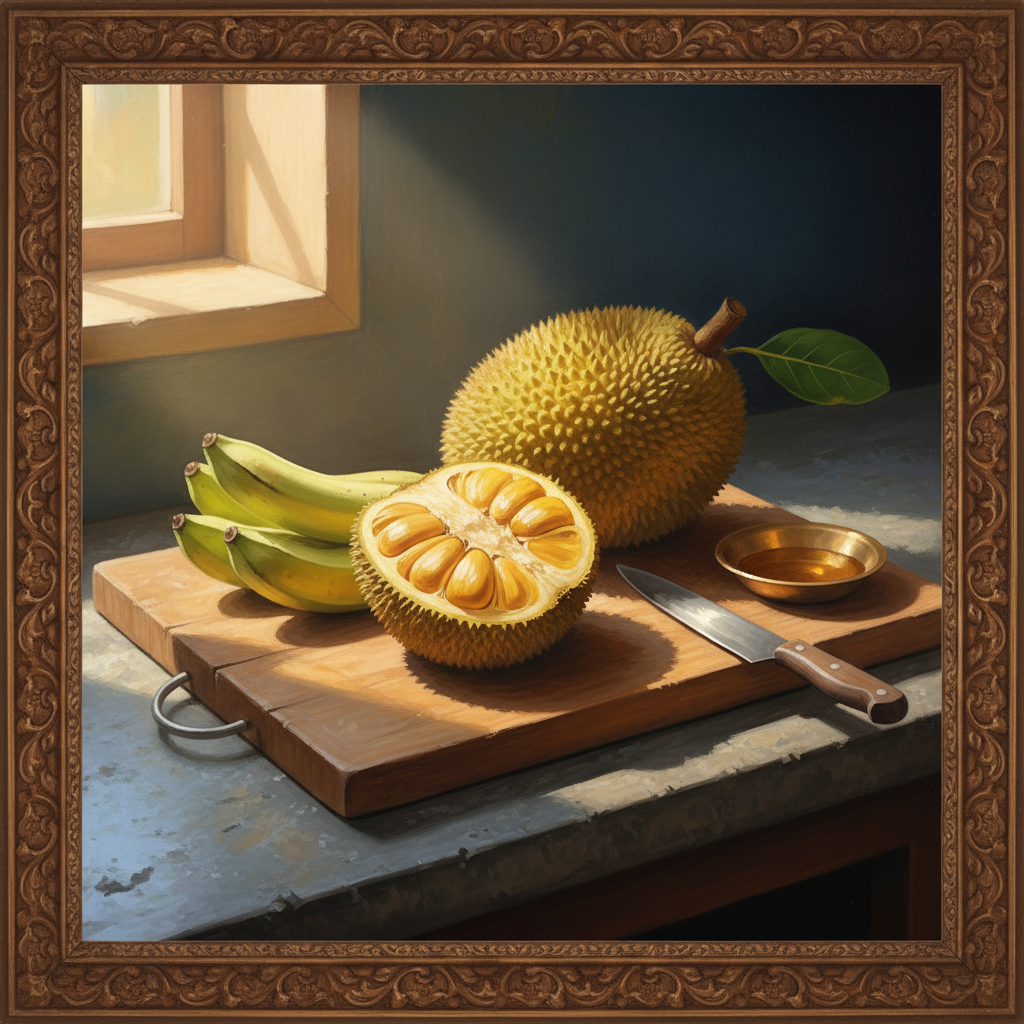
The fifth is asamsakti, the ability “Not to be tainted by things that you handle.” Swamiji gives a kitchen illustration. Cutting jackfruit or plantains, “If you put oil in your hand,” the gluey things seem to come onto the “fingers, but they are not there in your fingers.” “Similarly, you live in the world, but the world does not catch you.” Even a student facing an examination does a version of this, handling every family situation “because the mind is on the project.” “It’s not the ideal state, but that gives you an idea.” With spiritual progress it is the “Same thousand times greater”. “But you handle them in such a way that they’re not touching you.” Hence the practical mantra. “Whatever you have to do, do it now. Don’t leave it for tomorrow.” “Kaal kare so aaj kar.” “Great catastrophe can happen. The whole world can dissolve.” “Yoga is skill in action.” “So be alert, live your life with great vigor and vitality.”
Nothing is there
The sixth step is padarthabhavana. “Padārthābhāvanā as if nothing is there.” Before, the fruit did not stick to the fingers. “But now your only fingers are there. Nothing is there.” It is the peace of deep sleep, not to be taken literally, and it makes one more effective. “Great sages can be like Shankaracharya, very busy, very active.” The seventh is turiya, where even that description moves away. “No description can be given because Brahman is not a state.” “Brahman is the absolute reality.” “Soul grows, evolves through these states and we will continue next time.”
Terms
- jivanmukta — one liberated while living in the body; jivanmukti is that liberation
- bhava pratyaya — the horizontal vision, experience in the realm of projection, like watching the pictures of a film
- saguna sakara — God with attributes and with form, where every seeker begins
- saguna nirakara — God with attributes but beyond form, the support held loosely
- nirguna nirakara — beyond attributes and beyond form; all concepts drop away and Brahman alone is
- Anananda — literally joyless; the negation of every concept of happiness based on relativity
- alpam — the little; all the happiness of time and space gathered together
- bhuma — the infinite, the reality behind all the little
- Svarga — the heavenly plane of pleasure, which holds no attraction for a sage
- avastha — a mood, which comes and goes, like the swaying of a tree
- sthiti — where one is established; the root that holds
- sahaja samadhi — spontaneous samadhi, the effortless revelation I am Brahman
- sattva samanya — the state in which the sage became the very essence of all that exists
- Sat Chit Ananda — existence, consciousness, bliss: one reality described three ways
- saptabhumikas — the seven steps to liberation in the Yoga Vasistha
- subheccha — aspiration, the first step
- vicarana — inquiry into what is real and who am I, the second step
- tanumanasi — the thinning of the mind, the third step
- sattvapatti — established revelation, the fourth step, where one becomes jivanmukta
- asamsakti — non-attachment, handling the world without being tainted, the fifth step
- padarthabhavana — as if nothing is there, the sixth step
- turiya — the seventh, beyond every description
For reflection
- Swamiji says moods sway and the root holds: what is one recent high or low you took as your real level, and how does it look if it was only a mood?
- Which thorny bush in your own garden do you keep returning to, and what would make it lose its interest?
- Where in your day could the oil on the hands apply, a duty you handle fully but could let go of when the day is done?
About this lecture
Yoga Vasistha, Upasama Prakarana, the liberation of Sage Uddalaka. Lecture 201 by Swami Jyotirmayananda, Yoga Research Foundation, recorded December 24, 2019. The complete archive of Swamiji’s lectures is free to all.
This study guide is drawn from the archived teachings of Sri Swami Jyotirmayananda.