The Four Paths · Lesson 21 of 29
Kundalini: the Chakras of the Astral Body
Going Deeper: Tantra and Kundalini.
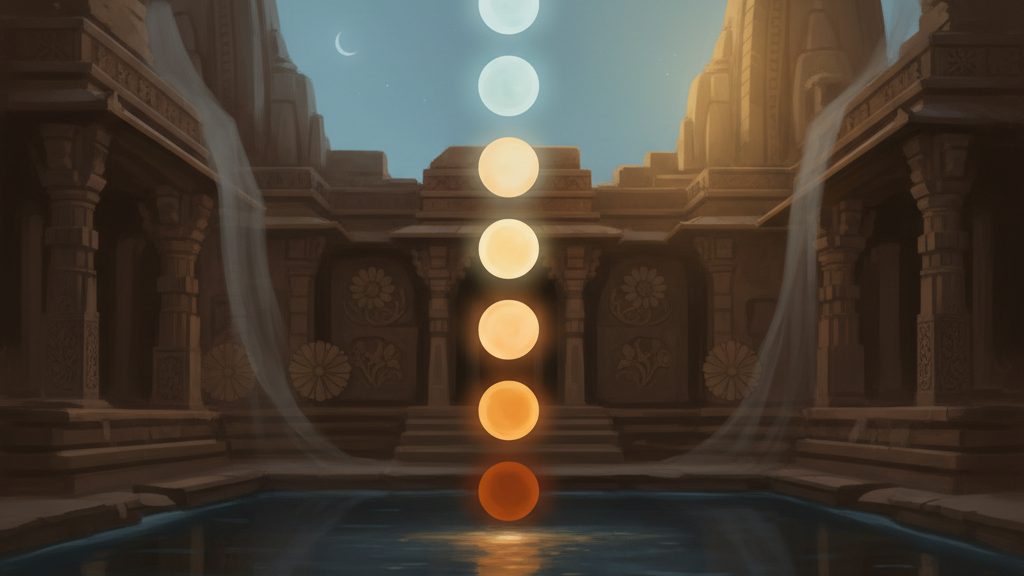
KUNDALINI YOGA
Kundalini Yoga literally means “Yoga of coiled-up (or dormant) energy.” In mystic symbolism, a serpent with three and a half coils represents the Kundalini Shakti “sleeping” at the base of the spine. The purpose of Kundalini Yoga is to “awaken” that sleeping “serpent.”
The mystic implication of this is very profound.
The three coils represent the three Gunas or the Modes of Nature present in an individual as well as in the universe. They are Sattwa—the principle of harmony, Rajas—the principle of activity, and Tamas—the principle of inertia. The half coil represents the entire universe.
The Kundalini Shakti in the form of the serpent is symbolic of Cosmic Energy lying dormant in every human being. It is possible for anyone to tap into that Cosmic Energy and to utilize it to promote his spiritual evolution. Though described in a highly figurative language, Kundalini Shakti is the energy behind everything a person does.
Kundalini Yoga is a specialized study of the Pranic or vital energy in this universe. Cosmic Mind expresses itself in two ways: through the Chitta (mental-process) and Prana (vital energy). Thought and energy go together; every time you think, there is an expression of Pranic energy, and that energy is the subject of Kundalini Yoga.
The Chakras—Anatomy of the Astral Body
A practitioner of Kundalini Yoga gains an insight into the subtle astral channels, called Nadis, through which Prana or vital energy flows. These Nadis form junctions, called Chakras, located in seven basic
centers along the Sushumna, the major Nadi.
The Pranas, along with the Nadis and Chakras, are not located in the physical body as such, but to some extent correspond to the spinal column and the major plexuses of nerves within the body. The solar plexus, for example, roughly corresponds to the Manipur Chakra at the navel center and the cardiac plexus at the heart corresponds to the Anahata Chakra, while the medulla plexus corresponds to the Ajna Chakra between the eyebrows. Deep studies have been made on the physiological correspondence with these Chakras. As the Chakras are “awakened,” these centers in the nervous system are also influenced, profoundly affecting the psycho-physical body.
Mystically speaking, every Chakra in a human being is symbolized by a “downward-drooping” lotus. As you begin to practice Kundalini Yoga, increasing amounts of Prana begin to operate at the centers, and the corresponding “lotuses” begin to turn upward and “unfold.” As each Chakra is “awakened,” you become aware of and experience the respective latent powers (corresponding to the Chakra you are concentrating on) within yourself that lay dormant within the Chakra.
Every Chakra has a central vibration or frequency. Secondary to the basic vibration of each Chakra, the petals of their symbolic lotuses also have sounds associated with them. These sounds have been studied and recorded by Yogis in ancient times, and have been identified with certain letters of the Sanskrit alphabet.* On this basis, Mantras (powerful prayers with Sanskrit syllables) have been evolved which effect a spiritual transformation in a person if repeated with devotion and persistence.
At the base of the spine lies the Muladhara Chakra, and its frequency corresponds to the sound “LUM.” A little above the Muladhara is the Swadhishthan Chakra which resonates with the sound of “VUM.” At the navel center is the Manipur Chakra, which resonates with the sound of “RUM.” Corresponding to the heart center is the Anahata Chakra with the sound frequency of “YUM.” Therefore, many Mantras terminate with the sound “YA,” for example, in the Mantras “Om Namah Shivaya” or “Om Namo Bhagavate Vasudevaya.” At the throat center resides the Vishudhi Chakra, and its sound is “HUM”—the sound of joy. The “OM” sound resonates at the Ajna Chakra, the center between the eyebrows. The Sahasrar Chakra, symbolized by the thousand-petalled lotus at the crown of the head, is represented by all the letters of the Sanskrit alphabet. When the Kundalini Shakti reaches this Chakra, the Yogi attains the highest level of Realization.
* The root-letters of the Chakras have been briefly mentioned, each Chakra also has its own color, element, presiding deity, world, form of Yantra, and resultant fruit when awakened through Kundalini meditation. For more details, refer to Concentration and Meditation by the Author.
Kundalini Shakti— A Barometer of Spiritual Movement
Kundalini Shakti is like a barometer, which indicates the spiritual progress and levels of consciousness in a human being. The higher the Kundalini Shakti ascends up the Sushumna, the more integrated the personality. However, there is a difference between the Kundalini Shakti going up and down the Sushumna, as it does in everybody’s case to some extent, and the mastery of the Kundalini Shakti by a Yogi, who regulates and controls the Kundalini Shakti by his will. The Yogi allows it to move steadily up to the crown of the head whereby he attains Enlightenment.
From the book Integral Yoga: The Secret to Enlightenment by Swami Jyotirmayananda, published by the Yoga Research Foundation. © Swami Jyotirmayananda. All rights reserved.
Swamiji teaches live every morning at 8:25 Eastern. Free, and nothing to sign up for. Sit in on the morning satsang
Know someone who would like this? Send them jyotirmayananda.org/start
- Previous · Lesson 20Tantra: the Worship of God as Mother
Next: Lesson 22, How to Awaken the Kundalini Shakti
It arrives by email two days after this one.
The Four Paths: the full outline