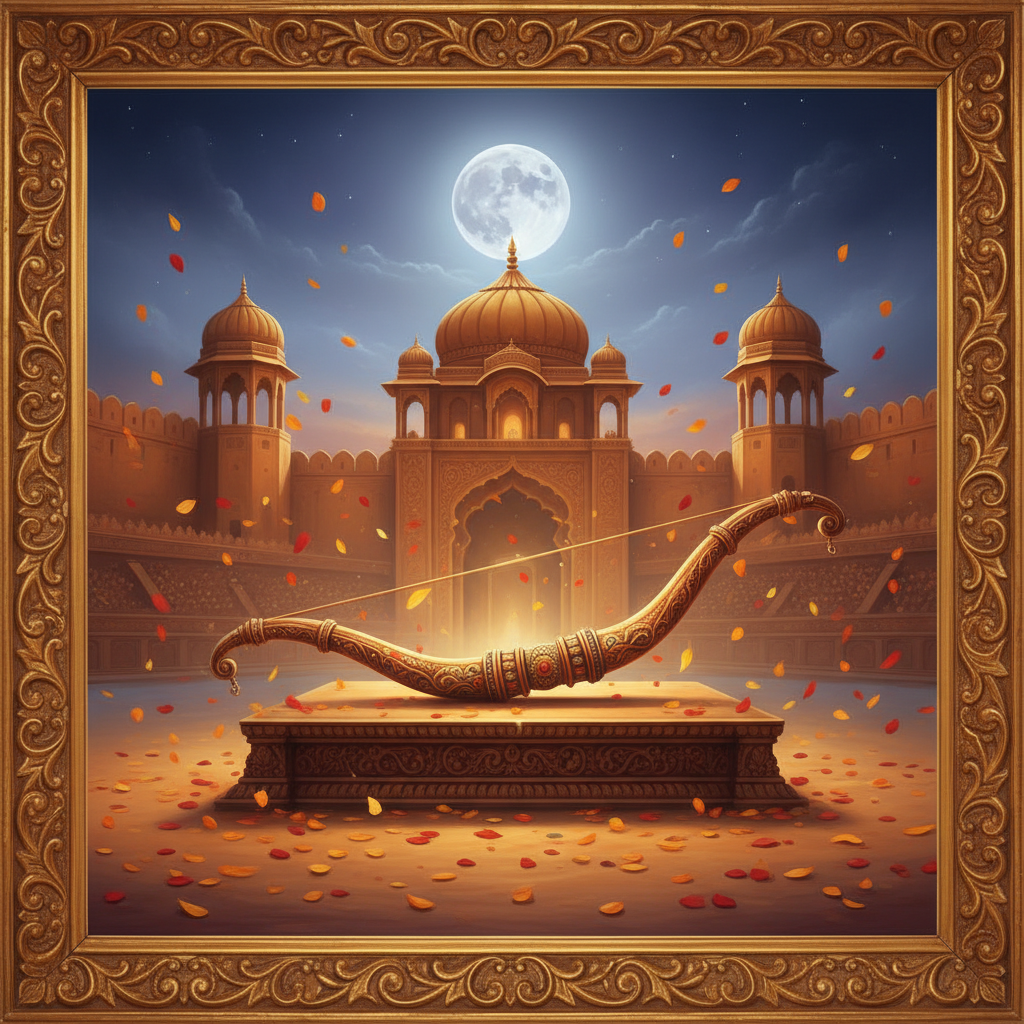
This class continues the Balakanda of the Ramcharitmanas, beginning at verse 244. Sage Vishvamitra sits with Rama and Lakshmana on a high seat in King Janaka’s arena, and a great audience has gathered for Sita’s svayamvara. Sita is to choose her own husband, but her choice carries a condition: whoever breaks Lord Shiva’s bow will marry her. Swami Jyotirmayananda reads every turn of the scene as a map of the seeker’s mind, where Sita is viveka buddhi, the intuitive intellect, and Rama is the Supreme Self. The class opens with the kings. Seeing Rama, they lose heart the way the stars lose their twinkle when the moon rises. Some console themselves that Janaka will give Sita to Rama anyway, and Swamiji hears in that the excuse of the aspirant who expects enlightenment without further effort. Others laugh and brag about their muscles, and the wise simply smile. From this he draws the four stages of the mind, and the image of satisfying hunger with sweets imagined in the mind. Then Sita enters with her friends. Tulsidas declares her beauty beyond description and refuses to compare her even with Sarasvati, Parvati, the wife of Cupid or Lakshmi. Swamiji uses the passage to teach that all words and concepts, however sublime, belong to the mind, and that the goal lies where the mind subsides. The class closes on the jayamala, the garland of victory in Sita’s hands, and on the word svayamvara itself. Read closely, it asks whom you would choose above everything in the world. The answer is svayam, the Self. And when Sita’s eyes stop blinking as she looks at Rama, Swamiji points to what shines between the thoughts.
Where each passage begins
- 00:00 Rama Like the Rising Moon
- 01:48 Sita’s Svayamvara Begins
- 04:40 No Shortcut to Viveka Buddhi
- 09:13 What Your Personality Radiates
- 13:50 Four Stages of the Mind
- 15:04 Beating the Drum of Your Cheeks
- 21:55 Flowers From the Gods
- 24:08 Beyond Every Description
- 28:55 Why Sita Cannot Be Compared
- 37:43 The Goal Is When the Mind Subsides
- 43:25 The Victory Garland
- 46:19 Between the Blinks
Sita’s svayamvara: kings who lose heart before the rising moon
This is Sita’s svayamvara, and “Sita has to choose according to her choice, but her choice is again as a condition.” “Whoever breaks Śiva’s bow, he will marry Sītā.” Prabhuhi dekhi saba nripa hiyam hare, janu rakesa udaya bhaem tare. The kings had come hoping that one of them would break the bow. “But seeing Rāma and His elegance and His effulgence, internally they became defeated, a sense of I can’t do it, this person is going to win.” Then comes the poetic simile. “All the stars create a lot of shimmer and twinkle.” But when the moon emerges and shines, all their twinkle crinkles into nothing. “So Rāma coming in, He is like a shining moon. All others become like little stars.”
No shortcut to viveka buddhi
To console themselves, the kings develop another view: even if Rama does not break the bow, Janaka will set aside his vow and give Sita to him anyway. “There is a subtler meaning behind this type of thinking.” To attain liberation you need qualifications. But some aspirants study Vedanta a little and become so excited with all that Vedanta says that they think “They don’t need to do any further effort.” “They will attain enlightenment without aparokṣānubhūti.” The moral is simple: “no one can develop viveka-buddhi, intuitive intellect, just by force of their virtuous karmas.” “Karma doesn’t give you that.” You can attain it only through profound “vicāra, inquiry into Who am I.” If you have practiced only shravana and manana, listening and reflection, “You may feel that you have gained a lot of knowledge.” “Just like Rāvaṇa had that. I knew all the Vedas and Vedānta.” But “that does not imply you are going to have viveka-buddhi, intuitive knowledge.” So minds that are not highly advanced start advising the other kings to go home. Let us move away from this arena, they say, since Sita will marry Rama whether he breaks the bow or not. Swamiji calls it a defeatist feeling.
Glory, strength and radiance: what your personality radiates
That feeling thwarts and restricts the four things the verse names: jasu, glory; pratapa, effulgent power; bala, strength; and tejas, radiance. When you begin to develop aspiration for God realization, “your personality radiates special vibrations, call it, special radiations.” What you radiate follows the state of your mind. If your mind dwells on miserable, grief-stricken thoughts, you may hide it outwardly and smile a lot. “But what you are radiating is negative.” But if you have a sincere movement and are at a high level, you may stay very passive. “Yet you are radiating something powerful.” Sensitive people feel it.
The laughing dullwits and the wise who smile
Bihase apara bhupa suni bani, je abibeka andha abhimani. There was another type of people, “who were dullwits.” “They were conceited”, and they lacked the readiness to be wedded to the discriminative intellect. “They simply laughed.” Rama is a young man, a kid, they said, and he cannot break this bow. Nor would Janaka give Sita away without it. “They looked at their muscles.” Even if death itself were to come, they bragged, “We are going to conquer him. We are going to win Sītā.” Meanwhile the virtuous, the hari bhaktas or devotees of God, and those who were wise listened to the words of the dullwits and smiled.
Four stages of the mind: mudha, ghora, ekagrata, niruddha
Here, Swamiji says, you are being pointed to the stages of the mind. “The four types, four stages within your mind.” “First stage is mūḍha.” That is the dullwit. “Ghora is the agitated state.” “Next stage is called ekāgratā, one pointed stage and the last stage is called niruddha, controlled stage.” And people “come in different categories depending upon the different states of their mind.”
Beating the drum of your cheeks
Byartha marahu jani gala bajai, mana modakanhi ki bhukha butai. The good people try to calm down the braggarts. Do not die, they say, “by allowing your cheek to create drum-like sound.” “The Hindi statement is gāla bajānā.” You say so many words, “and they come out with perfect expression, clarity, grammatical and literary. Just like music comes out of a drum.” “But there is no real purpose behind.” “So human face has become like a drum.”
Sweets in the mind: Sita cannot be gained by imagination
Can one satisfy one’s hunger by imagining lots of good things? “Mentally you have created a whole imagery of a whole plate filled with modak, laddus, wonderful things.” “In other words, Sītā cannot be gained.” “Sītā is viveka-buddhi, intuitive knowledge.” She cannot be gained by keeping the mind in a state of imagination. “Your mind has to actually go through a change and transformation.” Only then does it become an intuitional mind.
Shiva and Rama: bhakti and jnana
Listen to us, the good people continue. “Sita Ji is the mother of the whole universe.” So give up the idea of having Sita. “And Rama is the father of the entire universe.” “Behold, have darshan.” “Don’t try competing”. These two brothers are the givers of joy, and “They abide in the heart of Lord Śiva Himself.” Swamiji recalls a point he has explained before about Shiva and Rama. “They are like bhakti and jñāna.” Devotion and wisdom. “Wisdom loves devotion, devotion loves wisdom.” “Rāma loves Śiva. Ask Rāma who is the greatest: Śiva. Ask Śiva who is the greatest that You love: Rāma.” “That’s a mystical part of the story.” This Rama before us is “like the ocean of nectar.” Why not enjoy his darshan, the good kings ask, instead of imagining that you will win Sita? Then they step back. “However, we have been fulfilled. Do what you want.”
Flowers from the gods: joy in satsanga
The good ones “continue to remain relaxed, enjoying the darshan of Rama.” Above, the gods in their celestial vehicles shower wonderful flowers on the assembly. “This point is highly allegorical.” When, in satsanga, something very inspiring enters your heart, your mind becomes joyous. The mind is man, and the joyous mind is suman, the best of flowers. “Suman, flowers are also called Suman.” “So, the little tickles of spiritual joy that enter your mind. They are coming from gods. They are showering flowers.”
Sita enters with her friends, the divine sentiments
Finding the opportune time, King Janaka had Sita brought into the assembly with her many friends. “The friends are very wise and very good looking.” Mystically, Sita implies viveka buddhi, intuitive knowledge. If it were to come into your personality, “All divine sentiments will begin to shine. It will come along with divine sentiment.” “So they are the friends of Sita Devi”.
Beyond every description: words are words
Siya sobha nahi jai bakhani, jagadambika rupa guna khani. The beauty and virtues of Sita Devi cannot be described. The best of words and similes become little compared to her, because all verbal descriptions relate to your mental concepts. “They’re not from beyond your mind.” You can use them for a purpose, “but don’t consider those concepts as realities.” “Take for example, take God is supreme joy.” You say you know God is ananda. How much? Supreme. “You pass the examination. Correct answer.” “But it doesn’t mean that you have understood it or realized it.” “It’s a verbal understanding.” “All descriptions are given to help your mind.” They help the mind to ascend, to fly, but they do not relate to the reality of the divine being. “Brahman is far beyond words like sat-cit-ānanda.” “Words are words.” So any poet who says he can bring Sita into verbal description “does so because he’s not a real poet.” People hurry to get into the story, Swamiji knows. “I’m leading you into the deeper waters.”
Rama the Paramatma, Sita the Parashakti
“Rāma is Paramātmā, the Supreme Self.” “Sītā Devī is Parāśakti”, Supreme Energy. “Both, both are one and the same.” There is one reality, Brahman: Rama, the absolute truth, and all that expresses through his power, his shakti. “The power and one who possesses the power, both are one and the same.” Therefore “Sita is not to be compared with any concept of Devi and Devata.”
Why Sita cannot be compared: Sarasvati, Parvati, Rati, Lakshmi
Sita cannot be described as being like Sarasvati Devi, “Because Saraswati Devi is a big talker.” “Sītā is beyond.” When we talk of God, the mind is first led to God with form and attributes, sagun sakar, because there is no other choice. “Your mind cannot understand any other language. So God is presented that way.” “So the actual divinity cannot be described in terms of Sagun Sakar.” “Sītā and Rāma are being pointed out as the Absolute.” So Sita cannot be compared even with Sarasvati, Lakshmi or Parvati. Sarasvati talks too much, with eloquence, loud. “Parvati Devi, she can’t stay herself alone. She’s always with Shiva half and half.” Nor can Sita be compared to the wife of Kamadeva, the Cupid God, who is always miserable “because her husband has no body.” And Lakshmi Devi? “Lakshmi Devi has miserable brothers.” She came from the ocean. “So, poison, drinks, they all are brothers of Lakṣmī Devī.”
Two angles on Lakshmi: sakamya worship and the ishta devata
“Same Tulsīdās says, Sītā is the incarnation of Lakṣmī.” “readers get confused. Even teachers get confused.” That is because of the different angles. In sakamya worship, worship of God for fulfillment of desire, “Then every deity becomes important.” “Lakṣmī Devī gives you wealth, Sarasvatī gives you knowledge and so forth.” But you are turning to Sita not for fulfillment of desires. If you have made that Devi your ishta devata, she goes beyond the limited concept of the Devi. “She’s not only giver of wealth, She’s a giver of the absolute wealth, liberation.” “Then that type, that Lakṣmī, Mahālakṣmī, is Sītā.” The Lakshmi of desires is befriended with poison, worries, anxieties and intoxication, and Sita cannot be compared with her.
Lakshmi from the ocean of beauty
Lakshmi Devi emerged when the ocean was churned. “That’s a whole allegorical story.” But she emerged out of a salty ocean, and poison came out of the same ocean. “See, all those who come through the mother, they are brothers and sisters.” Now Tulsidas gives a poetic angle. Suppose the ocean were an ocean of beauty, and a supremely handsome spirit the turtle. Suppose shringara rasa, the climax of sweet sentiment, became the mountain and the churning rod, and Cupid himself did the churning. If all that were possible, what emerged “out of that beauteous ocean, not salty ocean” might be likened to Lakshmi, “not completely.” Even then the poet compares her with Sita “in a shy manner.”
The goal is when the mind subsides
“So big exercise is given to your mind.” “The exercise is, the ultimate goal is not within your mental concepts, no matter how wonderful your concepts.” “The goal is when the mind subsides.” Even in daily life, “The real rest you get when mind is not there.” Your happiness, glory and power may depend upon mind, on what Raja Yoga calls bhava pratyaya, mental projections. “You must realize your mental experience is limited by your nervous system.” However much it may be, it is perishable. “It’s not the ultimate goal.” It is like watching a cinema show: all that you see is projection. The reality is when you transcend the show, or when the show completely closes up. “That’s the reality.”
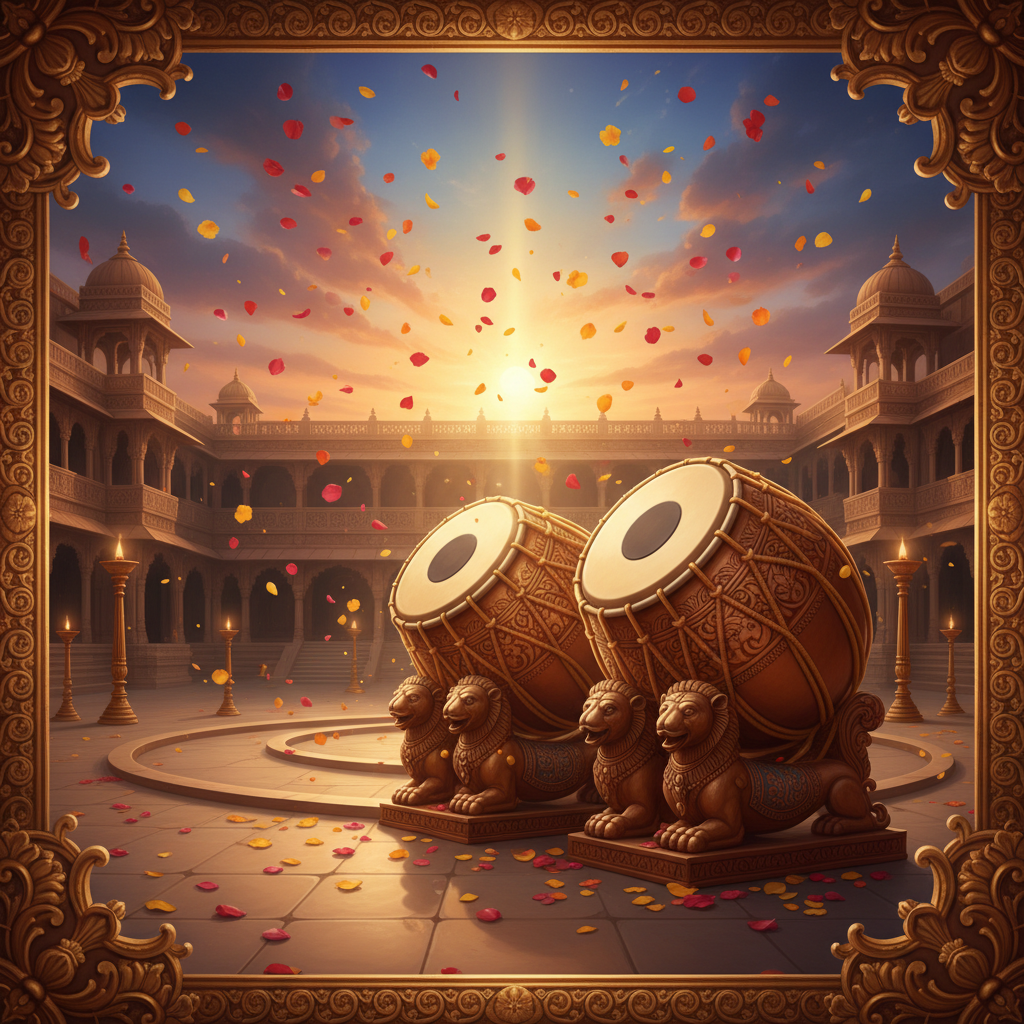
Sita in the arena, and the drums of the gods
“Now coming back to the storyline.” Sita Devi and her friends were singing songs that thrill the heart, and her friends had adorned her whole personality, from the toes to the head. The beauty of this Mother of the Universe is incomparable. Rangabhumi jaba siya pagu dhari, dekhi rupa mohe nara nari. “The moment Sītā placed Her feet in that arena,” everyone was enchanted, surprised in such a way “that the eyes became stuck not winking”. A subtle psychic atmosphere builds up. “Gods began to beat their drums,” not only showering flowers now, but with a drum beating behind. “All other sound moves away.”
The jayamala: the victory garland
“And Sītā Devī in Her lotus hands, She’s holding a Jayamālā.” “The garland of flowers.” It is known as jai because it gives her victory.
Svayamvara: whom will you choose?
“This whole process is called Svayaṃvara.” In the old method, “She chooses her husband by her own choice. It’s called Svayaṃvara.” Beneath the literal meaning lies a profound one. Whom will you choose? “Vara is Varaṇa Karaṇa. Who will be your best choice in the whole world?” The answer is svayam, the Self. Atmanastu kamaya sarvam priyam bhavati. “For the sake of Self, all become dear.” “So on whom would you want to put your garland?” “On yourself.” “I’m not referring to your body. I’m referring to the self.” Choose anything other than the Self, “and you are in trouble.” “Svayaṃvara, that’s the subtle meaning behind it.”
Seven steps of wisdom: marriage as a rehearsal for liberation
The ritual aspect of marriage, Swamiji says, is actually “a kind of rehearsal for attaining liberation.” The bride and the bridegroom go around the fire seven times. “There are seven times or seven steps of wisdom.” “Soul joining with intuitive knowledge.” Ascend the seven steps, “And Svayaṃvara becomes perfect. You have found yourself.”
Between the blinks: what shines between the vrittis
Siya chakita chita ramahi chaha, bhae mohabasa saba naranaha. Sita Devi looks at Rama with a fervent heart, a heart that is spiritually dynamic, and all the kings of the assembly “become as if paralyzed.” “A state of big suspense.” When Sita looked at the two brothers, it was “As if she found her treasure and her eyes stopped winking.” The subtle meaning is that your vrittis, your thought waves, stop. “And what is in between the vṛttis, shine forth.” “Your vṛttis are like frames that are projected on a screen to create a cinema show.” If, while the show goes on, you can look in between the thought waves, “then that’s absolute reality.” “Vṛtti is compared to your winking.” “All things you see, your eyes go on winking. But in between the wink,” you get something where “Your ego does sink.”
Rama kept within the heart
Seeing the elders and the great assembly, Sita felt shy. “She turned Her gaze away from Rāma.” She started looking at her friends, but “She brought Rāma’s form right in Her own heart.” Keeping Rama within her heart, she went on behaving like a normal person. The class closes with the chant of peace, Om purnamadah purnamidam.
Terms
- svayamvara — the bride’s own choice of husband; svayam, the Self, as the only true choice
- jayamala — the garland of victory in Sita’s hands
- viveka buddhi — the intuitive, discriminating intellect; Sita in the allegory
- vichara — inquiry into Who am I
- aparokshanubhuti — direct experience, without which knowledge stays verbal
- shravana — listening to the teaching
- manana — reflection on what has been heard
- jasu — glory
- pratapa — effulgent power
- tejas — radiance
- mudha — the dull stage of mind
- ghora — the agitated stage of mind
- ekagrata — the one-pointed stage of mind
- niruddha — the controlled stage of mind
- gala bajana — beating the drum of the cheeks; words without real purpose
- bhakti — devotion
- jnana — wisdom
- suman — flowers; the joyous mind in satsanga
- Paramatma — the Supreme Self; Rama
- Parashakti — the Supreme Energy; Sita
- shakti and shaktiman — the power and the one who possesses it, one and the same
- sagun sakar — God with form and attributes
- sakamya — worship of God for fulfillment of desire
- ishta devata — the chosen deity
- shringara rasa — the climax of sweet sentiment
- bhava pratyaya — mental projections, in Raja Yoga terms
- vritti — a thought wave, compared to the blink of the eye
For reflection
- When someone else seems sure to win, where do you tell yourself the prize will come without effort?
- Which of the four stages of the mind did you bring to today, and what would move it one step further?
- If the garland were in your hands this morning, on whom or what would you place it?
About this lecture
Tulsi Ramayana (Sri Ramcharitmanas of Goswami Tulsidas), Balakanda, from verse 244. Lecture 100 by Swami Jyotirmayananda. The complete archive of Swamiji’s lectures is free to all.
This study guide is drawn from the archived teachings of Sri Swami Jyotirmayananda.