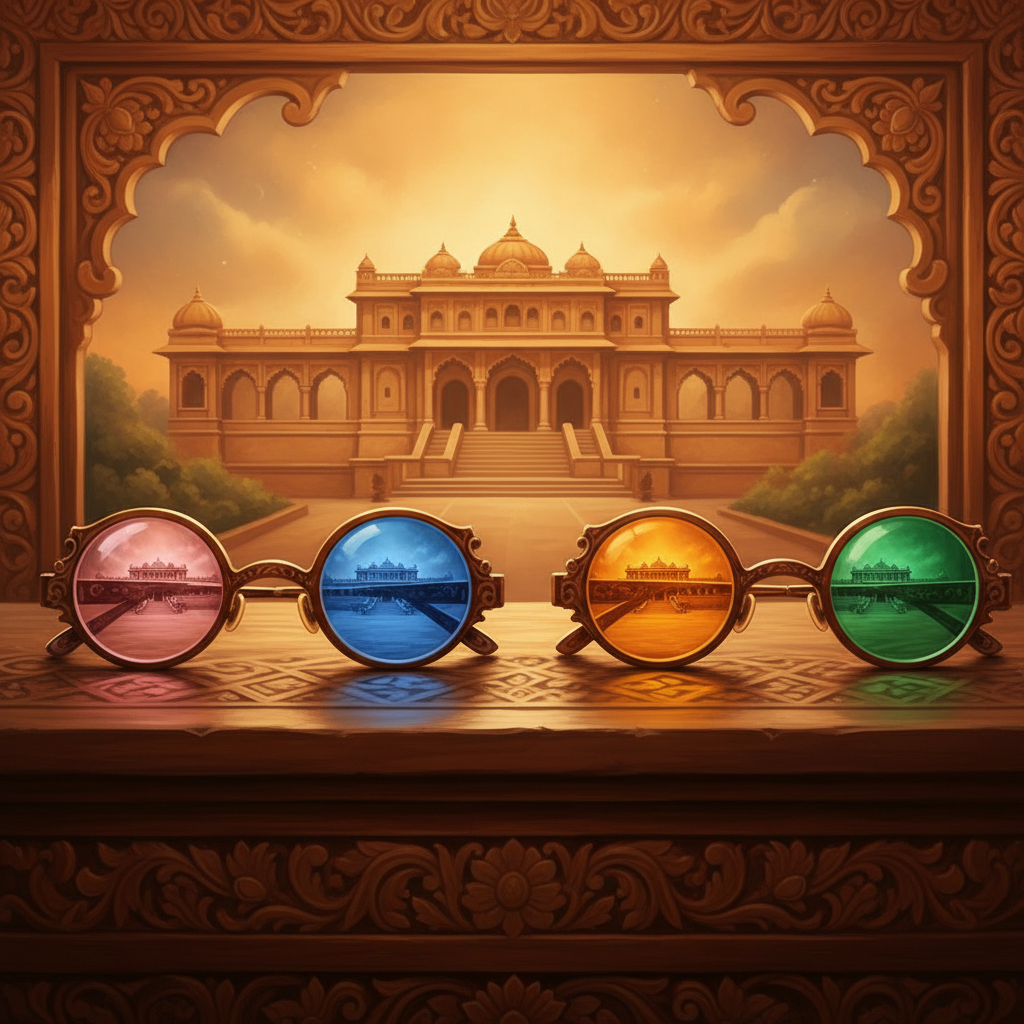
This class continues the Balakanda of the Ramcharitmanas, covering verses 240 to 242. The sage Vishvamitra has brought Rama and Lakshmana into the assembly of King Janaka, where the dhanusha yajna is under way: whoever breaks or bends Lord Shiva’s bow will marry Sita. Swami Jyotirmayananda reads the contest as a present reality. The bow is the world process, the one who breaks it is Rama, the soul, and the one he marries is Sita, viveka buddhi, the intuitive intellect. The heart of the class is a single line of Tulsidas: jinha ke rahi bhavana jaisi, prabhu murati tinha dekhi taisi. Everyone in the hall looked at the same Rama, and each saw him according to their bhavana, their feeling, which rests on their vasanas. Swamiji compares it to colored glasses that we forget we are wearing. Then the hall is described one group at a time. The crooked kings see terror, the demons in disguise see death, the people of Janakapura see their nearest and dearest, the learned see the cosmic form, the yogis see absolute peace, and the devotees see their ishta devata. The love with which Sita looks at Rama cannot be described at all. The second half turns to the form of the two brothers, a beauty that makes millions of Cupids look petty. Swamiji reads each ornament: the four-cornered cap, the three lines of the throat, the tulasi garland, the gajamukta, the yellow cloth, the bow and quiver. Every detail is there to melt the mind, as water melts salt. The class ends with Janaka seating Vishvamitra and the brothers on the highest seat in the arena.
Where each passage begins
- 00:00 One Mantra, Every Aspect of God
- 01:33 The Bow of the World
- 06:54 Each Sees by Their Own Feeling
- 08:41 The Colored Glasses
- 12:23 Ten Marks of Dharma
- 15:14 Crooked Kings, Disguised Demons
- 16:21 Janakapura, Sages and Yogis
- 23:20 Devotees See Their Ishta Devata
- 25:51 How Sita Looks at Rama
- 28:45 Beyond Millions of Cupids
- 35:45 The Mind Melts Like Salt
- 39:12 Ornaments of the Divine Form
The bow of the world process
The storyline is simple. Sage Vishvamitra has brought Rama and Lakshmana into Janaka’s assembly, where a great project has been presented, the dhanusha yajna. Whoever breaks or bends Lord Shiva’s bow will marry Sita. “It’s the storyline.” But Swamiji points to the real line beneath it, which “is at every moment the same reality.” “Whoever will break the bow of the world process, bhava-cāpa.” “The moment you broke it, who broke it? Rāma.” “And who is going to marry Rāma? Viveka-buddhi”, the intuitive intellect. So there is nobody else in the story but Rama and Sita. “So allow Rāma and Sītā to emerge from your personality.” As they emerge, you are immersed, and your little self vanishes forever. Meanwhile the hall is full of suitors, all looking at their muscles, sure that so little a bow will give them no trouble, and all planning a wonderful future.
Two full moons among the stars
Before reading the central verse, Swamiji gives another: raja samaja birajata rure, udagana mahum janu juga bidhu pure. The two brothers began to shine in that assembly like two full moons, while everyone else who had gathered there became little stars.
Each sees by their own feeling
Then comes the line that governs the whole passage, jinha ke rahi bhavana jaisi, prabhu murati tinha dekhi taisi. Everyone looked at Rama. But how did they feel about him, what was their perception of him? “That was dependent upon their bhāvanā, their feeling.” “And feelings dependent upon their vāsanās.” “And that’s the reality which applies philosophically always.” “First point, don’t take it for granted whatever you are perceiving.” “Your senses are limited.” Behind the senses the mind is operating, and behind the mind is the intellect. Whatever you come to feel is my reality is not the reality. “Your reality is defined by your vāsanās.”
The colored glasses
Swamiji gives a simpler illustration. Put on glasses with different colored lenses and sit anywhere. “Everyone sees according to the glasses you are wearing.” The trouble begins when you forget the glasses are there. “You say this is the way the world is.” It does not even require spirituality to see this. “You are seated on the solid earths, but it’s not so solid.” It holds liquid, gas and fire inside. “It is not so steady. It is spacecraft moving in vastness of space.” The sky is not empty either, yet to everyone’s perception it is a wonderful blue sky.
Rama alone exists
And yet the truth is never lost behind the glasses. “The truth, because the truth never runs away.” Whatever you are experiencing, whether it appears joyous, hellish or turbulent, “But you are seeing Rāma, nothing else.” Swamiji turns it around once more. “And also, put another way, it is Rāma alone who is seeing if at all.” “Rāma alone exists.”
A peacock that steals every eye
Back in the hall, everyone suddenly began to look around, “as if Rāma snatched their eyes.” Swamiji points out that this happens even with small things. “A beautiful peacock comes here.” “Immediately it will steal all your eyes.” The verse dekhahi rupa maha ranadhira, manahum bira rasu dharem sarira says that the heroic saw in Rama the heroic sentiment, vira rasa, as if it had taken a body. His form was the personification of glory.
Ten marks of dharma
To go deeper, Swamiji takes the word dhira in that verse. Dhira and vira are synonyms, and dhi points to intellect. “There are 10 characteristics of dharma. Rāma is the embodiment of dharma.” Rama is the Absolute Self, the source of all divine virtues, and the movement also runs the other way: “Divine virtues lead you to the Absolute Self.” He recites the verse naming the ten: dhriti, firmness; kshama, forgiveness; dama, control of the senses; asteya, non-stealing, which implies not being greedy; shaucha, purity of body and mind; indriya nigraha, control of the senses; dhi, intellect; vidya, divine knowledge; satyam, truth; and akrodha, absence of anger. When the intellect has become pure, “Truth begins to shine through your intellect.” That term is the highlight of dharma, and all the other virtues are implied in it. “That type of hero, whoever has these virtues, he is the real hero.” Only such a hero can match the strength of the demoniac forces.
Crooked kings and disguised demons
Dare kutila nripa prabhuhi nihari, manahum bhayanaka murati bhari. The kings who were kutila, crooked, “Crooked means crooked mind”, with perverted intellect, found nothing good in Rama and Lakshmana at all. To them the brothers were “Terror personified.” “And there were demons disguised as kings.” They “looked at Rāma, and Rāma appeared to them as death personified.”
Janakapura and the tender-hearted
The people of the city of Janakapura saw Rama and Lakshmana “as a source of immense joy.” “These people refer to those who are sāttvika.” Janaka himself was an enlightened sage, beyond body consciousness, and so called Videha. His people looked at Rama as their “near and dear, but not near and dear, nearest and dearest.” The women of Janakapura looked at the brothers according to their own taste. Some found Rama an embodiment of love. “Some find Him a beautiful child.” “Some find Him a wonderful friend.” Swamiji adds a clarification: “whenever we talk of women, it’s not a sex differentiation.” “Tender-hearted people are looking at Rāma with immense tenderness”, and their love rises to its climax, shringara rasa.
The learned see the cosmic form
Bidushanha prabhu biratamaya disa, bahu mukha kara paga lochana sisa. The vidwans, those expert in Vedic knowledge, saw the cosmic form condensed in Rama. “They see Rama having countless faces, countless hands, countless feet.” Countless eyes and heads: the virat form. Swamiji adds a light remark. “It took time for Kṛṣṇa to become Virāṭ.” Here Rama and Lakshmana appear in it at once, to those with that kind of Vedic culture.
The king’s family and the yogis
Janaka’s relatives found Rama “exceedingly dear a part of their family”. King Janaka and the royal queens looked at the brothers “as if they were their children, young ones.” Joginha parama tattvamaya bhasa. The yogis, advanced in meditation and samadhi, beheld the Supreme Reality expressing itself through Rama and Lakshmana. “Shant, Absolute Peace.” “Shuddha, absolute purity. Sama, absolute equanimity.” “and self-effulgence.” All these attributes were shining in the two brothers.
The story is happening in front of you
Here Swamiji pauses to give advice for reading any great scripture. “When you study, allow develop a bhavana feeling.” It did not happen in some distant age whose years you have to count. “It’s happening right in front of you.” “And Hanuman is seated somewhere in this.” He is thrilled and dancing in the satsanga, and the gods are watching from their aerial cars. When the story touches people’s minds and those minds simmer with joy, the shimmering comes from the flowers the gods are dropping, suman vrishti.
Devotees see their ishta devata
Haribhagatanha dekhe dou bhrata, ishtadeva iva saba sukha data. The devotees “they find in Rama their Ishta Devata.” The ishta devata is the deity of the mantra into which you are initiated, and it implies turning the mind toward the Absolute Self. “Brahman is presented in the form of Iṣṭa-devatā.”
One mantra, every aspect of God
“So whether your mantra is Shiva, Rama, Krishna, Saraswati, whomsoever.” Your mantra becomes highlighted, but all aspects of God are with that mantra. If Rama is the star, Rama is highlighted, and all the others join along with him. If Sarasvati is the star, then Vishnu, Shiva and the rest bow down to her. That understanding must be there, or people go on creating problems in their minds about which God will help them better. “One year you loved Shiva. No, no, Rama. No, no, Krishna. No, no, Buddha.” As devotion to the ishta devata becomes profound, “Then you view the entire world as expressions of Ishta Devata.” Swamiji recalls the line siya ram main sab jag jaani. “The entire world is nothing but Sita and Rama.”
How Sita looks at Rama
Ramahi chitava bhayam jehi siya, so sanehu sukhu nahi kathaniya. “That love, that joy with which Sita looks at Rama.” It “cannot be described.” It can be understood profoundly through mystical insight. “Sita is not an ordinary personality. Sita is Viveka Buddhi.” “An inherent urge within you to realize God.” That urge reaches its height in the form of Sita. “No creature exists without Rama and Sita. Rama is the soul.” Sita is the understanding that allows Rama to attain his highest glory. God, the Absolute Self, “has taken double role as a Rama and as a Sita.” So the poet cannot say who experienced this love. It “is a heart based experience.” “people who have purified their heart, they can understand.” Otherwise it cannot be described. All the people in the hall looked at Rama according to their different bhavanas, their different mental states.
Beyond millions of Cupids
Verse 242 begins: rajata raja samaja mahum kosalaraja kisora, sundara syamala gaura tana bisva bilochana chora. The two princes of Kosala shine in the assembly of kings, Rama with blue complexion, Lakshmana fair as jasmine, and their presence steals the eyes of all. Nothing in the world compares to the glimpse of them. Sahaja manohara murati dou, koti kama upama laghu sou. If you try to describe their beauty in worldly terms, you might say they are like “Millions of Cupid gods put together.” But Tulsidas says even that comparison is petty. It is like describing the sun as a thousand bulbs, a million electric lights, a trillion. “No matter what you say, compared to the sun, all this becomes little.”
Pravritti and nivritti
The reason is that karma based beauty belongs to the relative world of time, space and causation. “A world that is constantly changing is not real.” As long as the projections of the mind exist, you talk about beauty and glory in that world. It cannot compare with where the absolute reality shines, because there all the projections of the mind subside. “Two points are given to you before you, pravritti and nivritti.” Pravritti seeks the goal in the world of time and space, which has every kind of beauty and glory. Put them all together. “So glory of attaining God realization goes far beyond.” Rama and Lakshmana symbolize the state of nivritti.
A look that blows the mind away
Chitavani charu mara manu harani. The moment Rama looks anywhere, the mind is completely blown away. “Not only mind of ordinary people, even the mind of Cupid God himself.” It is a simple experience: whatever is extremely dear to you, you cannot describe. Tulsidas goes on describing Rama: beautiful cheeks, earrings that dance with the earlobe, tender lips. “All this is created for devotees, for any devotional practice.” Look at your deity, your ishta devata, with all its fascinating qualities, and allow the mind to become deeply immersed.
The mind melts like salt
“Just like you put water over salt and salt melts, the mind itself melts.” “And the melting process is your success in meditation.” The verses continue. The brothers’ soft laughter excels the luster of the moon. Their eyebrows and nose are wondrous, the high forehead is decked with tilak and kumkum, and their hair has a strange curl. “Swarms of black bees” feel defeated before its beauty. Swamiji knows some listeners are waiting for stories. “I have stopped the stories.” The stories will come. But the details people usually pass over fast hold wisdom and subtle points, meant “to give you a special type of rasa, taste.” “And that very listening and delighting in itself has done an act of Sadhana on your part that you cannot imagine.” “Certain things go impress in your mind and you can’t let it go.”
The four-cornered cap and the three lines of the throat
Pita chautanim siranhi suhaim, kusuma kalim bicha bicha banaim. On their heads they wear caps with four points, an old style cap with four angles, beautified with buds of flowers. Those four angles are “Dharma, artha, kāma, mokṣa”, the four purposes of life. Their throats carry three beautiful lines. “These beautiful three lines refer to three lokas.” Physical, subtle and causal. The throat represents the vishuddhi chakra: if kundalini goes beyond the throat, all this world is transcended. “So God keeps the whole world up to His throat level.” The brothers are the summation of all the beauty of the three worlds and beyond.
Tulasi mala, gajamukta and the shoulders of a bull
On the chest, close to the heart, they wear the tulasi mala, a garland of holy basil. Near the throat is the gajamukta. The ordinary meaning is an ornament made from elephant tusks. “Extraordinary meaning: gaja, elephant, represents Gaṇeśa.” Ganesha’s presence removes all obstacles. “And Tulasī Devī abides as His mālā.” Their shoulders are like mighty bulls, vrishabha. “Vṛṣabha term relates to Dharma”, the entire dharmic process; it is the bull that Shiva rides. They stand like lions, and their long arms hold tremendous strength. This is describing God in human terms, arms and feet and standing. But every description is leading the mind to something beyond. “Every description is blowing your mind away.”
Yellow cloth, quiver and bow
Kati tunira pita pata bamdhem, kara sara dhanusha bama bara kamdhem. Rama wears yellow cloth, pitambar. “Yellow term relates to intuitive knowledge.” That golden color is symbolic of “Hiraṇyagarbha, cosmic mind.” At the waist is the quiver, the device that holds all the arrows. “Hand holds the arrow. Shoulder holds the bow.” Across the body runs the yellow sacred thread, the yajnopavita. From the toenails to the top of the head, the whole form of Rama and Lakshmana is amazing beauty.
Every eye follows them
Dekhi loga saba bhae sukhare, ekataka lochana chalata na tare. All the gentle-minded people, those who were not crooked, went on looking at the brothers without blinking, eka taka. King Janaka was thrilled. He came to Vishvamitra, touched his lotus feet, introduced himself and showed him the whole setting created for the bow sacrifice. As they walked, jaham jaham jahi kuamra bara dou, taham taham chakita chitava sabu kou. “Wherever they move, all their eyes move towards Him.” To everyone Rama was an immense source of joy, each seeing him in their own way. “But no one could actually comprehend the reality,” “the real mystery of Rama and Lakshman.”
The highest seat
Vishvamitra praised the way Janaka had arranged the assembly hall, and the king was very pleased. Saba manchanha tem manchu eka sundara bisada bisala. Out of so many seats in different layers, there was one that was highest and most beautiful. Janaka asked Vishvamitra to sit there, with the two brothers by his side. What happens next waits for the following class. “And we can keep in suspense what happens.” The class closes with the chant of peace, Om purnamadah purnamidam.
Terms
- bhavana — feeling; the inner disposition through which each person sees
- vasana — a subtle impression of the past that shapes how the mind sees
- dhanusha yajna — the ceremony of the bow in King Janaka’s assembly
- bhava chapa — the bow of the world process
- viveka buddhi — the intuitive, discriminating intellect; Sita in the allegory
- vira rasa — the heroic sentiment
- dhira — firm and wise; dhi points to the intellect
- dharma lakshana — the ten marks of dharma
- sattvika — of pure, harmonious nature
- shringara rasa — love risen to its climax
- virat — the cosmic form, with countless faces, hands and feet
- ishta devata — the chosen deity of one’s mantra
- suman vrishti — the shower of flowers from the gods
- pravritti — seeking the goal in the world of time and space
- nivritti — turning away from the world toward God realization
- chakoni topi — the four-cornered cap; the four purposes of life
- vishuddhi chakra — the throat center
- tulasi mala — a garland of holy basil
- gajamukta — an ornament from elephant tusks; Ganesha, remover of obstacles
- vrishabha — the bull; dharma
- pitambar — yellow cloth; intuitive knowledge
- Hiranyagarbha — the cosmic mind
- yajnopavita — the sacred thread
For reflection
- What colors the glasses you are wearing today, and when did you last remember that you have them on?
- Swamiji says that whether experience appears joyous or hellish, you are seeing Rama and nothing else. Where in your life is that hardest to accept?
- Which detail of the divine form, or of your own chosen deity, could you hold in the mind until it melts like salt in water?
About this lecture
Tulsi Ramayana (Sri Ramcharitmanas of Goswami Tulsidas), Balakanda, verses 240 to 242. Lecture 99 by Swami Jyotirmayananda. The complete archive of Swamiji’s lectures is free to all.
This study guide is drawn from the archived teachings of Sri Swami Jyotirmayananda.