
The Fire of Aspiration: Satsanga, Surrender and the Paduka of Bharata
In the morning satsanga of September 24, 2026, Swami Jyotirmayananda taught that devotion, surrender and the Guru's grace turn every duty into worship, and read the four brothers of the Ramayana as the yogas of one seeker.
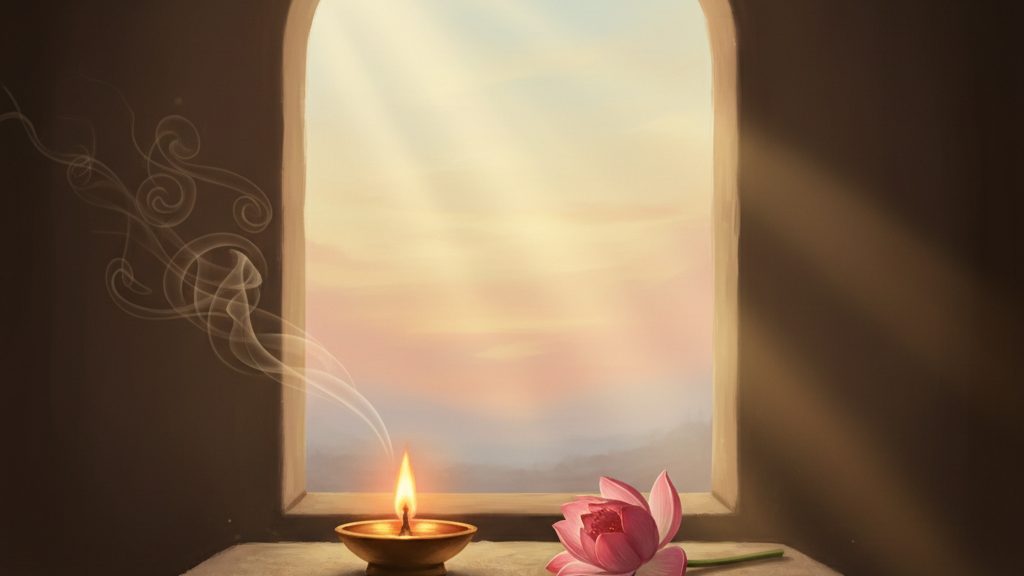
After an invocation to Lord Rama and the Hare Rama mantra, Swamiji read a short poem, "The Fire of Aspiration," that sets out the whole morning. On the altar of the heart, collect the fuel of good karma. Strike the match of satsanga and kindle the flame of divine love. Pour in the sacred oblations of meditation, service and supplication. Into that flame go cravings for illusory gain, the cycle of birth and death, and the knots of the heart. What remains is a fire that beckons the soul to the eternal goal: the realization "I am Brahman."
After prayers to Goddess Lakshmi and Sri Tulsi, Swamiji named the theme: the role of bhakti, devotion, in every aspect of sadhana.
The Love That Keeps One From Satsanga
Every individual, Swamiji taught, carries the potentiality to discover "I am Brahman." But when a person is not drawn to satsanga because of family moha, because the family wants him to go nowhere and stay serving them, that type of love is a curse. The potentiality to discover the Self moves away, and the attention settles instead on "I am body," the son of a great father, the bearer of a lineage. That identity, he said, is not the real identity. It is a deluded one, and it has a remedy: "The delusional identity is removed by satsanga."
The Greatest Dharma Is Surrender
Swamiji then turned to the verse of the Bhagavad Gita that begins sarva dharman parityajya. Do not be confused about which dharma to practice, he explained; come under the refuge of God. Once that surrender is made, one is automatically led to do everything with perfect skill. When one is led by the ego instead, skill moves away, and every action carries a distortion.
A mother's love, he said, should let her child grow, not be limited by motherly moha. When the expectations and love of many people press on one person, the result is confusion: father wants it one way, mother another, and everyone offers different guidance. The dharma that is backed up by moha is not the dharma that leads to victory. The greatest dharma is saranagati, surrender to God, and one who begins there performs all the other dharmas without stress.
It is like health: a healthy person does every job gracefully. So practice your dharma, but for this purpose only: success in duty should help you develop devotion and surrender to God. Otherwise all that you perform keeps you bound to the cycle of birth and death.
Bhakti Integrates Every Yoga
Scriptural knowledge alone, Swamiji cautioned, does not make one a real jnani; it can simply produce abhimana, the pride of "how much I know." But when there is love of God and the miracle of surrender, all the yogas are done spontaneously, because love is in the mind. "Your karma movement will be karma yoga. You don't have to worry about it." The emotional movement becomes bhakti yoga, and rational inquiry becomes jnana yoga.
With that love, everything done in the world is seen as the worship of God. "Whatever you do is divine worship." The devotee follows the footsteps of God, grows in the image of God, and develops the qualities of God, and God comes down as if He has become a friend. Pray, he said, as if God listens to your prayer and has vowed to help you, a vow He cannot alter.
The Guru and the Paduka
The Guru, Swamiji explained, guides the seeker to that kind of devotion. When it has developed, Guru and God both come into the cave of the heart, and there is no difficulty in choosing whom to worship first, because it is the Guru's grace that brought God down. That is the purpose of worshipping the paduka, the sandals the Guru wears. With great love the devotee places the paduka on his head and feels that the Guru's grace is now guiding him.
The Four Brothers as One Sadhana
In the Ramayana, Bharata receives the charana paduka of Rama. He still rules, but no longer from a capital city: he rules within his own heart, and the real ruler is God Himself, present as the feet of God. Swamiji called this a subtle description of sannyasa. Bhakti is marked by complete renunciation, which means not turning to the world or to any sakamya, desire-driven, movement. "All attainments in the world are perishable." What is gained in the heart is imperishable, and in it the three knots of the heart are removed.
As they are removed, the four brothers follow. Shatrughna represents karma yoga: the more one listens to the glory of God, the more qualified one's actions become, and the greater the success in karma yoga. Mandavi, Bharata's wife, is a canopy. Once bhakti has developed, the whole world may present eruptions and volcanic movements, and all of it becomes a shower of grace. Lakshmana follows whatever Rama says like a shadow; he is the movement of raja yoga, which becomes real raja yoga only when the grace of Rama is behind it. Otherwise meditation brings psychic powers and leads to trouble.
All four brothers constantly help one another. For the sadhaka who practices, Swamiji concluded, the end result is that ignorance is destroyed and the negative forces are brought to an end. The satsanga closed with a prayer for the grace of God to shower over all.
Terms in This Satsanga
- satsanga — the company of truth; in the opening poem, the match that lights the fire of aspiration.
- moha — deluded attachment; the family love that keeps one from satsanga.
- saranagati — surrender to God, which Swamiji called the greatest dharma.
- abhimana — pride; what scriptural knowledge becomes without love of God.
- charana paduka — the sandals of the Lord or the Guru, worshipped as the carrier of grace.
- sakamya — motivated by desire; the movement toward perishable attainments.
Join the live morning satsanga, or follow the WhatsApp channel at jyotirmayananda.org/whatsapp.