
The Deer Maricha and the Three Worlds: Mati, Maya and the Immortal Self
In the morning satsanga of October 3, 2026, Swami Jyotirmayananda taught that the seeker is the immortal Self, not the body-mind complex, and read Rama's pursuit of the deer Maricha as the predicament of every soul that seeks lasting happiness in a transient world.
The satsanga opened with prayers to Lord Ganesha, the Divine Mother and the Guru, and with the meditation verse on Lord Rama of the Raghu dynasty: complexion like a blue lotus, tender and delightful in appearance, Sita Devi seated at his left side, a powerful bow and arrow in his hands. The Hare Rama mantra followed.
The Great Utterances
Swamiji began with the four great utterances of the Vedas, which he called a summary of all wisdom. The first, Prajnanam Brahma, defines Brahman as pure consciousness. In another, the Guru initiates the disciple with "Thou art that": you are not the body, you are Brahman. The disciple in turn recites Aham Brahmasmi, "I am Brahman." All sadhana, Swamiji explained, is coming to that stage of discovery, and it ends in one realization: "Brahman alone is real."
Then he spoke directly to the listener. "You are not this transient personality." And again: "You are the immortal self." Within you are heights before which the mighty Himalayas shrink into rolling hills, and depths before which the deepest ocean turns into shallow waters. "You have the effulgence within you," before which millions of suns pale into insignificance, and a love that may heal the miseries of all and turn the sorrows of the world into the sunshine of unending bliss. You are not this body-mind complex; you are existence, knowledge, bliss absolute.
Rama and the Deer Maricha
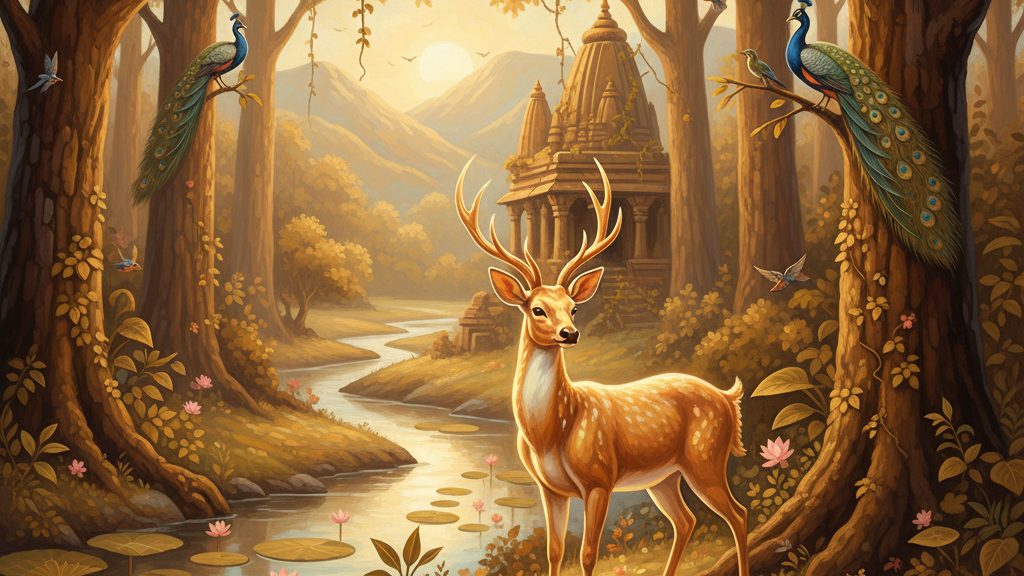
Turning to the mystical Ramayana, Swamiji described Rama going after the deer Maricha as the predicament of all souls. Running after Maricha is the sakamya state of mind: a mind striving to attain its goals, and so caught in the karmic process. We run after Maricha to find happiness, but all the happiness of this world is transient, not permanent. "One day you become very happy by some good karma." The next day some negative karma starts a problem. The law of karma is not under your control, he said, for "you have created your karma" without knowing it.
Recalling a Sanskrit verse, Swamiji taught that you are your own enemy when you keep yourself bound, through the sakamya state of mind, to the law of karma. You become your own friend when that state is abandoned and you attain the state called sannyasa: a state of mind, he stressed, not an ordinary initiation. In it you are no longer looking for any attainment in the world before you.
The Three Worlds
That world has three parts: the practical, the sentimental and the intellectual. From a practical point of view you may have built a very beautiful house. But inside it, your sentimental world is constantly thinking of different relatives and what is going on with them. "It's not keeping you as relaxed as the house looks." The intellectual world is not steady either. We think a particular person is very great and will promote our happiness, and how wonderful it would be if he stayed close; but hardly one or two days pass before the mind suddenly changes.
"They keep you constantly in turmoil," Swamiji said of all three. "So renounce them."
The Rope and the Snake
The sannyasa mantras, he said, are very inspiring, and they all point to this: in the state of sannyasa one develops not the ordinary intellect but the intuitional intellect, which is not deluded by the snake on the rope. The ordinary intellect sees a rope lying like a snake and is suddenly terrorized. All that experience of terror rests on a snake that was never there. All this, Swamiji said, is illusion, maya, and Rama has now started that process.
Mati and the Grip of Ignorance
After a short pause, Swamiji continued the allegory. Mati, the intellect, is Sita. But now Sita is playing another role: the intellect becomes deluded and falls under the grip of Ravana, ignorance. Then all one's divine qualities begin to act like demoniac ones, and the very intellect that should guide you to realization drives you to stay under Ravana's control.
"Everyone goes into that turmoil," he said. We use an impure intellect to keep ourselves in bondage. The mind goes after the world of eat, drink and be merry, and at that stage it cannot listen to the truth that all of it is illusory. In a dream you have a wonderful feast, and hardly have you begun to enjoy it when you wake up. So Sita, playing this role, drives Rama and Lakshmana into a world of turmoil and comes under the grip of Ravana. "The more you cut down your ignorance," the more mati becomes sumati.
Lakshmana and the Lure of Psychic Powers
Lakshmana, Swamiji explained, represents raja yoga: the practice of concentration, meditation and samadhi. Instead of keeping the highest samadhi and revelation as the goal, practitioners are drawn to psychic powers, and then they come under the influence of ignorance and the law of karma.
He likened this to the pull of modern devices. With one tap of a finger you connect with people far away, in Alaska or in New Zealand, as if they were right here. The greed for ever greater power, for better and better iPads, is the same type of movement of mind.
Jatayu and the Moon's Strength
"All these are highly allegorical," Swamiji reminded the gathering. He spoke of ritualistic support: a puja room, the right place for the candle, divine pictures in the right setting. Rama too was supported, and he regarded Jatayu as a father. Jatayu is killed by Ravana with the Chandrahasa, the weapon Ravana holds, whose name means laughter of the moon. The moon's strength comes from the sun. If you are after only the moon's strength, he said, it is lunatic: "Luna in the attic."
Spiritual movement, he concluded, is not bound by the puja room or by how perfect its pictures are; it extends beyond them. "So all these are subtle points." The satsanga closed with a prayer that the grace of God shower over all, and with prayers for the peace of all beings.
Terms in This Satsanga
- sakamya — motivated by desire; the state of mind that runs after Maricha.
- sannyasa — renunciation; here a state of mind, not an outer initiation.
- maya — illusion; the snake seen on the rope.
- mati / sumati — the intellect, represented by Sita, and that intellect made good.
- raja yoga — concentration, meditation and samadhi, represented by Lakshmana.
Follow the WhatsApp channel at jyotirmayananda.org/whatsapp for each day's satsanga notes.